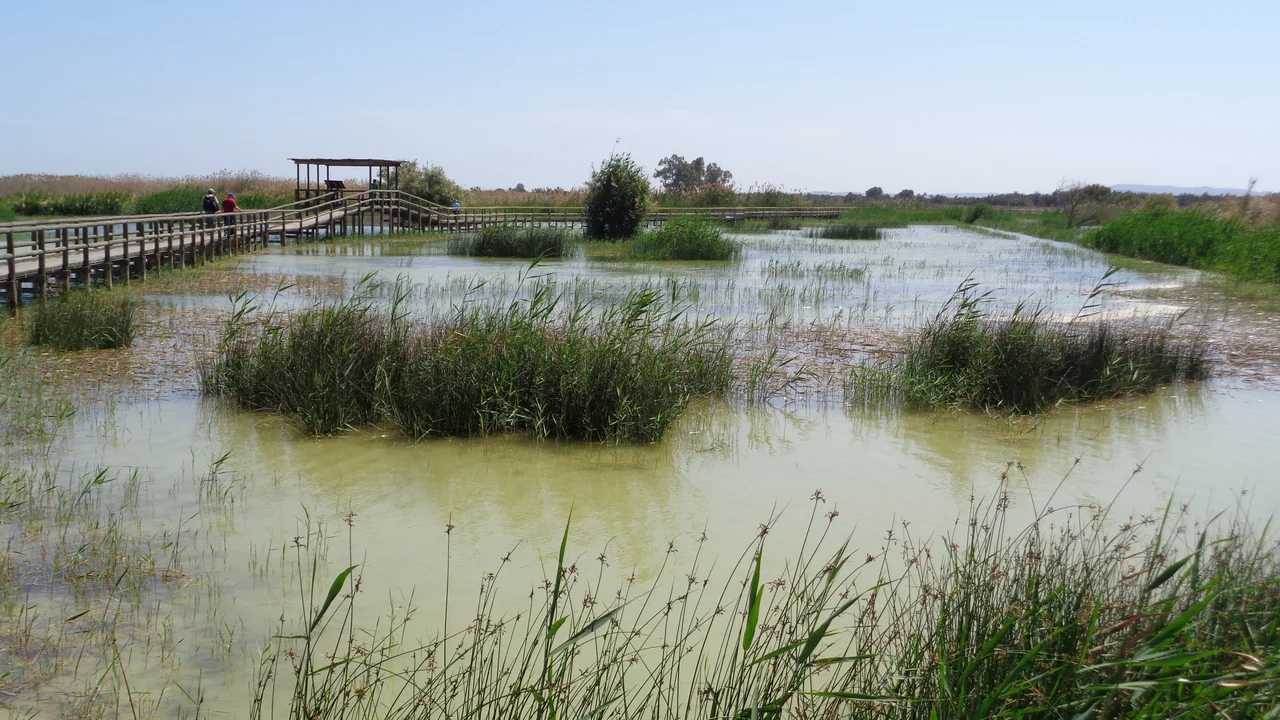

El Fondo Natural Park
Every winter since the 2008-2009 season, a greater spotted eagle hatched in Estonia has crossed most of a continent to settle into the same patch of southeastern Spanish marsh. Researchers know its movements precisely, because the bird carries a satellite transmitter, and year after year the signal comes to rest over El Fondo. Only around a thousand breeding pairs of these eagles are thought to remain in all of Europe, which makes one bird's stubborn loyalty to a single wetland near Elche feel like something close to a small miracle. It is also a clue to why this unassuming stretch of reed and standing water matters far beyond its modest size.
Where Two Rivers Give Up
El Fondo sits in the Baix Vinalopo district, straddling the boundaries of Elche and Crevillent in the south of the Valencian Community. Two rivers, the Vinalopo and the Segura, both surrender their water into the lagoons that make up the park. This was once the edge of a far larger coastal lagoon, a shallow inland sea the Romans knew as Sinus Illicitanus and later generations called the Albufera of Elche. During the 17th century, natural sedimentation and deliberately placed silt filled most of it in, turning marsh into farmland. What escaped the plow settled into the reed beds and open water that survive today, a remnant of a landscape that used to stretch all the way to the coastal salt pans of Santa Pola.
Lagoons Made to Order
The park's two biggest bodies of water are not accidents of geography. Levante, covering 450 hectares, and Poniente, at 650 hectares, were dammed by human hands to hoard water from the Segura for irrigating the thirsty fields around them. In other words, El Fondo began life as agricultural plumbing and only later became a refuge. That double identity shapes everything. The reservoirs hold fresher, heavily enriched water where rushes and reeds crowd the deeper channels, while the shallower peripheral pools run saltier and clearer. There, salt-marsh specialists take hold, plants like sea lavender, glasswort, and shrubby sea-blite that thrive precisely where most vegetation cannot.
The Ducks the World Almost Lost
The birds are the reason people come. El Fondo shelters two of the largest populations anywhere on the planet of the marbled duck and the white-headed duck, both among Europe's most endangered waterfowl. In breeding season the reed margins fill with herons, the purple, the night, and the shy squacco among them, alongside avocets, black-winged stilts, collared pratincoles, the crested coot, the tiny European penduline tit, and the moustached warbler. Ospreys and marsh harriers work the open water; in winter the greater spotted eagle joins them. Below the surface swim eels, grey mullet, and the Spanish toothcarp, a small fish found nowhere in the world but the Spanish Mediterranean.
Protected on Paper and in Practice
For all its manufactured origins, El Fondo now carries some of the strongest conservation credentials a wetland can hold. The Valencian government declared it a natural park on 12 December 1988, protecting 2,495 hectares. It appears on the Ramsar Convention's roster of internationally important wetlands and is designated a Special Protection Area under the European Union's directive safeguarding wild birds. The semi-arid Mediterranean climate keeps the light hard and the horizons wide, and the whole basin is easy to reach: the Alicante-Murcia motorway runs past its edge, with an exit at Crevillent Station pointing visitors toward the small village of San Felipe Neri.
From the Air
El Fondo lies at 38.18 degrees N, 0.75 degrees W, on the low coastal plain between Elche and Crevillent. From the air the park reads as two large, geometric sheets of open water, the rectangular reservoirs of Levante and Poniente, threaded by reed channels and set against a dry agricultural patchwork. To the east, the white glare of the Santa Pola salt pans and the Mediterranean edge help orient you; the Segura River curls in from the southwest. A low pass of 1,500 to 3,000 feet gives the best view of the lagoons and wintering waterfowl. The nearest field is Alicante-Elche (LEAL), roughly 15 km northeast; Region de Murcia International (LEMI) lies to the southwest. The semi-arid climate delivers clear, high-visibility days for most of the year.
Nearby Stories
- Posición Yuste 7.2 km away
- Villajoyosa 10 km away
- Cresta del Gallo 17 km away
- 2011 Lorca Earthquake 33 km away
- Benidorm Island 36 km away
- Castle of Lorca 67 km away
- German submarine U-602 130 km away
- Castle of Alarcon 131 km away