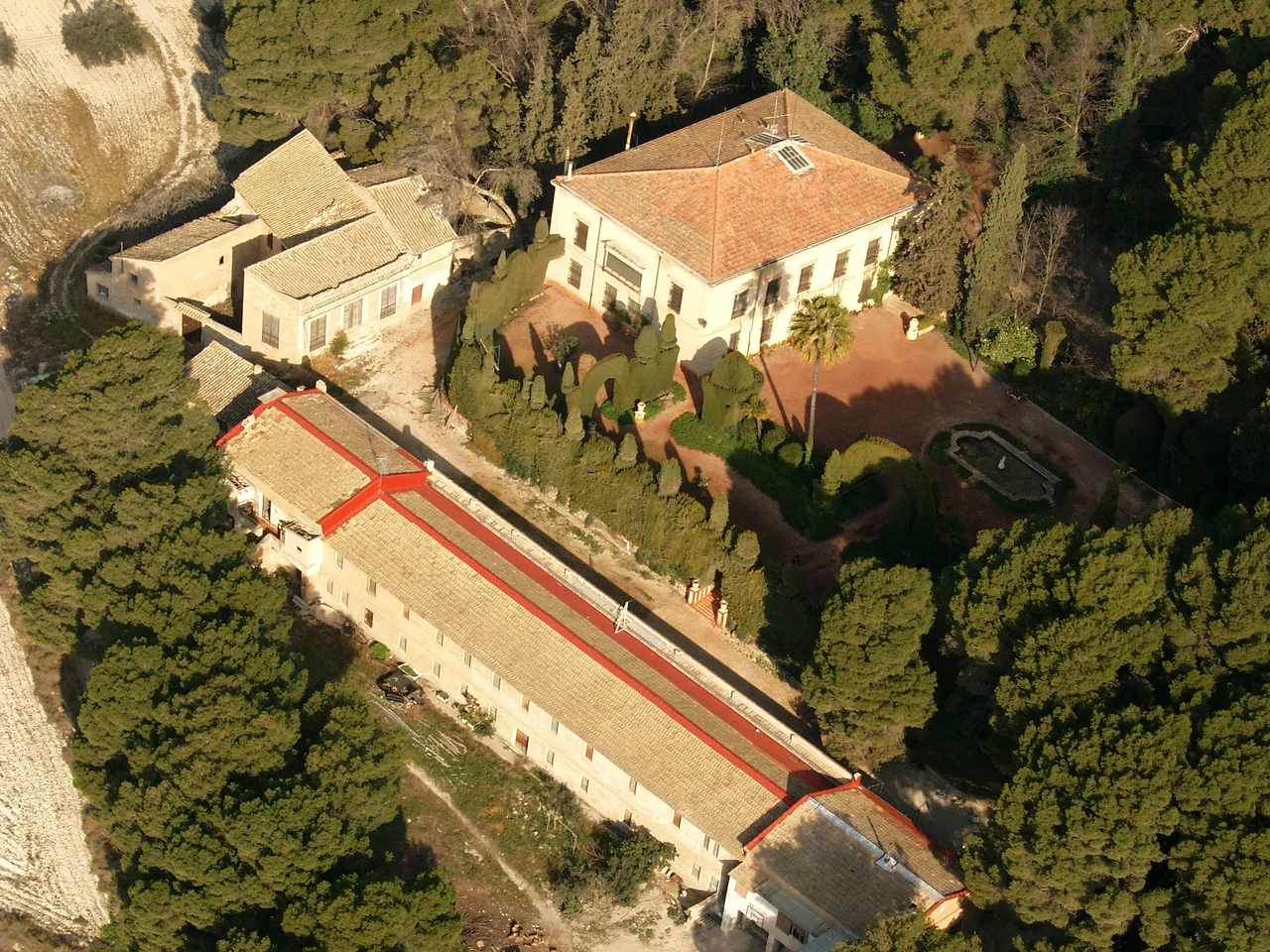

Posición Yuste
The codename itself reads like a premonition. When the Government of the Spanish Republic slipped into a country house near Petrer in the last winter of the Spanish Civil War, it called the place Posicion Yuste, after the monastery in Extremadura where the emperor Charles V, who ruled Spain as Charles I, had withdrawn four centuries earlier to lay down his crown and spend his final years. Whether or not anyone intended the echo, it was painfully apt. For ten days in early 1939, this hidden estate among the pine trees was the beating heart of a republic that was running out of time, and everyone who gathered there knew it.
A House That Hid From the Road
On 24 February 1939, President Juan Negrin held a Council of Ministers and then left Madrid behind. He installed the seat of the presidency in a country house set deep in a dense pine forest, screened so thoroughly by the trees that it could not be seen from the nearby road, on the El Poblet estate in the municipal district of the Alicante town of Petrer. There the government remained from 25 February to 6 March 1939. It was barely fifteen kilometers from the airfield at Monovar. Negrin's chief ally moved with him: the leadership of the Communist Party of Spain set up its own headquarters not far away, near Elda, in a palm grove they codenamed Posicion Dakar. The Republic's command had, in effect, relocated to a quiet valley in the Levante interior.
Why So Far From Madrid?
The decision has puzzled historians ever since. Writing in 1976, Hugh Thomas pointed to the contradiction of placing the government's seat so far from the capital if Negrin genuinely meant to win the war, and he gave voice to the harshest reading, favored by Negrin's critics, that the remote location suggested an escape had already been foreseen. In 1999 Angel Bahamonde and Javier Cervera likewise called the move nearly inexplicable, noting that pulling away from Madrid only deepened Negrin's isolation and eroded support for the policy of continued resistance, a policy some of his own ministers were beginning to doubt. To leave the capital, in this view, was to signal that the fight was already lost.
A Plan to Save Lives
A later reading is more sympathetic, and more human. In 2010, Angel Vinas and Fernando Hernandez Sanchez argued that the withdrawal to Posicion Yuste fit a change in Negrin's thinking. Once he understood the true military situation in the Center-South zone, his aim was no longer resistance at any cost in the hope that a wider war would break out in Europe. It was a staggered retreat, a fighting withdrawal toward the ports of the Levante that would let Republican forces fall back and evacuate, saving as many people as possible under the protection of the navy anchored at Cartagena. Negrin understood something with cold clarity: that Francisco Franco, once victorious, would show no mercy to the defeated. From that grim calculation, the hidden estate near Petrer, close to the coast and the sea lanes, made undeniable strategic sense.
The Last Days
Whatever Negrin intended, events overtook him. The government's stay at Posicion Yuste ended on 6 March 1939, and within weeks the war itself was over, the Republic swept away and the long reckoning Negrin had feared for the vanquished set in motion. What survives is the El Poblet estate on the outskirts of Petrer, its country house still standing among the pines, now recognized as a protected heritage site. It is an unassuming place for so heavy a memory: a quiet house in the woods where a dying republic spent its final days not dreaming of victory, but trying to spare its people the worst of the defeat that was already certain.
From the Air
Posicion Yuste lies at 38.50 degrees N, 0.80 degrees W, on the El Poblet estate just outside Petrer in the Vinalopo valley of Alicante province, immediately beside the twin industrial towns of Petrer and Elda. From the air the site is deliberately inconspicuous, a country house tucked into pine woods rather than a monument, so navigate by the dense Petrer-Elda urban cluster in the valley and the surrounding sierras; the former Monovar airfield lies about fifteen kilometers away. A viewing altitude of 2,000 to 4,000 feet above the terrain frames the wooded estate against the valley and its towns. The nearest major airport is Alicante-Elche (LEAL) to the southeast; Valencia (LEVC) lies to the north. The dry inland climate keeps skies clear for most of the year.
Nearby Stories
- Aitana (mountain) 11 km away
- Monastery of Sant Jeroni de Cotalba 14 km away
- Palmeral of Elche 17 km away
- Castle of Almansa 19 km away
- 2011 Lorca Earthquake 71 km away
- Castle of Alarcon 97 km away
- Castle of Lorca 104 km away
- German submarine U-602 168 km away