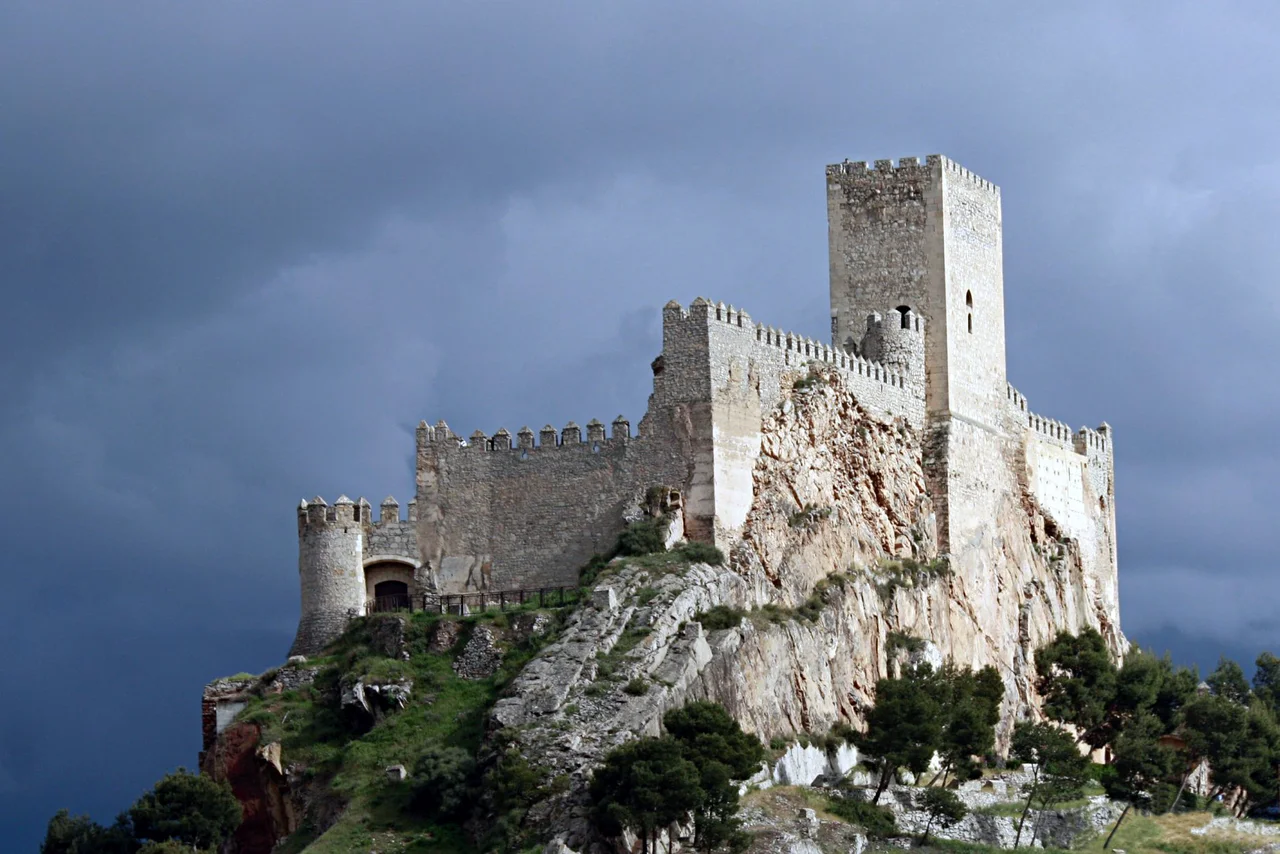

Castle of Almansa
From the flat, irrigated farmland of eastern Castile, a single pale crag jumps up without warning, and a castle grips its summit like a hand closed around a fist of rock. This is Almansa. The name may sound unfamiliar, but it is stamped across the maps of European history, because on the plain below this castle a single afternoon in 1707 decided the fate of a Spanish throne.
The Crag Above the Plain
The hill is called the Cerro del Aguila, the Eagle's Crag, a knuckle of white limestone rising abruptly from a fertile, well-watered plain. For anyone controlling the frontier between Castile and the old Kingdom of Valencia, it was an obvious place to build. You reach the monument from the Plaza de Santa Maria, climbing a wide flight of steps to the gate, where the town has tucked its tourist office into the fortress it once feared. From the battlements the land opens in every direction, which was precisely the point: nothing could cross this plain unseen.
Whose Walls Are These?
For generations the oldest walls were read as the work of the Almohads, the North African dynasty that favored rammed earth, layers of packed soil rising into surprisingly durable ramparts. Then restoration in 2008 complicated the story. Analysis of the surviving rammed-earth sections showed they were raised not under Muslim rule but in the first decades of Christian control, at the end of the 13th or start of the 14th century. What we see today took shape later still. The nobleman Don Juan Manuel reinforced the walls in the 1330s and 1340s, and between 1449 and 1454 Juan Pacheco, the second Marquis of Villena, gave the castle its present crown: the tall keep, the rounded towers along the ramparts, the outer defensive barbican. In 1921 it was declared a Bien de Interes Cultural, a protected national monument.
The Day the War Turned
On 25 April 1707, during the War of the Spanish Succession, two armies met below the crag. One fought for Philip V, the Bourbon claimant; the other for his Habsburg rival, Archduke Charles of Austria. The tangle of loyalties was almost absurd. The Bourbon force was led by the Duke of Berwick, an illegitimate son of the deposed King James II of England. The opposing army was commanded by the Earl of Galway, an exiled French Huguenot fighting for the British and Austrian side. An Englishman in French service beat a Frenchman in English service on Spanish soil. The victory was decisive, and it swept most of eastern Spain back under Bourbon control, a turning point that would harden into the centralized Spain that followed. Thousands of soldiers on both sides did not leave the field; the plain that made the castle so valuable also made it a killing ground.
What Remains
The castle survived where the men did not. Restored and reopened, it draws visitors up the steps for the view and the walls, and the town keeps the memory of the battle alive in a dedicated museum and in reenactments that fill the streets each spring. Climb to the keep and the geography explains itself instantly: the fortress on its crag, the open plain below, the roads that all had to pass this point. Almansa is a small town in a quiet corner of La Mancha. It is also the place where a war changed direction, and the castle has watched over both facts for six centuries.
From the Air
The Castle of Almansa sits at 38.872 degrees north, 1.093 degrees west, atop the Cerro del Aguila crag in the Province of Albacete, on the historic frontier between Castile and Valencia. From 2,000 to 4,000 feet the isolated white hill and its castle stand out sharply against the surrounding irrigated plain, an unmistakable landmark on the inland corridor between the coast and central Spain. The nearest coastal fields are Alicante-Elche (LEAL), roughly 100 km to the southeast, and Valencia (LEVC), a similar distance to the northeast; Murcia (LEMI) lies farther south. Inland summer visibility is often excellent, though heat haze can shimmer over the plain in the afternoon.
Nearby Stories
- Battle of Castalla 8.6 km away
- Tower and walls of the Borgias 10 km away
- Cofrentes Nuclear Power Plant 16 km away
- Battle of Alcalá (1129) 20 km away
- Jumilla 23 km away
- Castle of Alarcon 48 km away
- Castle of Belmonte 106 km away
- Battle of Las Navas de Tolosa 160 km away