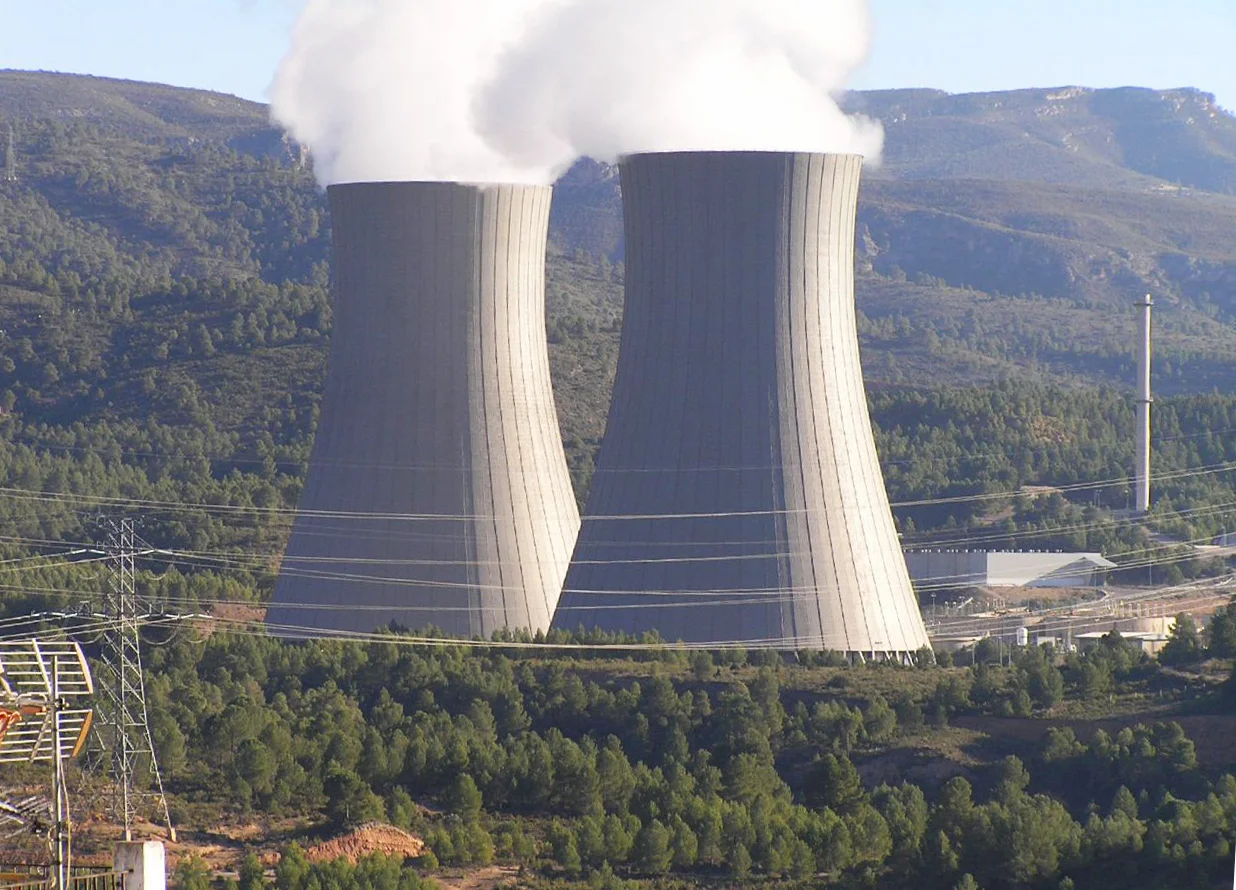

Cofrentes Nuclear Power Plant
Three kilometres apart, two very different engines heat the water of one Valencian valley. One is a dormant volcano whose magma chamber still warms the bubbling springs that gave the Hervideros spa its name. The other is a nuclear reactor that boils water drawn from the Júcar river and, in a strong year, supplies almost every household in the Valencian Community. At Cofrentes, deep geological time and the atomic age share the same stretch of ground.
A Valley of Heat
The plant stands about two kilometres southeast of the small town of Cofrentes, on the right bank of the Júcar, roughly 61 kilometres from Valencia as the crow flies and a hundred by winding road. The setting is dramatic and slightly improbable. Just three kilometres away rises the Cofrentes volcano, generally reckoned dormant rather than extinct, though its lingering underground warmth still feeds the thermal waters that draw visitors to the spa. Between volcano and reactor runs the river that makes the whole enterprise possible, cool water lifted from the Júcar to carry heat away from the reactor core. It is a landscape of energy in every sense, geological and industrial at once.
Contracts and Concrete
The project moved with the deliberate pace of a machine that cannot be rushed. Madrid's Ministry of Industry approved construction in 1972, and in March 1973 contracts were signed with General Electric to supply the reactor, the turbine and generator, and the first load of fuel. The municipal council granted its building permit in 1975, and after a decade of engineering and assembly the plant finally entered service on the 14th of October, 1984. At its heart sits a BWR-6 boiling-water reactor fed on slightly enriched uranium, wrapped in a Mark-III containment of drywell, suppression pool and steel shell, itself nested inside the reactor, fuel and auxiliary buildings. The design boils water directly, sending steam straight to the turbine.
Powering a Region
Owned outright by the Spanish utility Iberdrola, Cofrentes is a workhorse. It averages close to 8,900 million kilowatt-hours a year, roughly the domestic electricity used by the five million residents of the Valencian Community. In 2010 it ran flat out for all 365 days and generated a record 9,549 million kilowatt-hours, about five percent of Spain's entire output. Two years later it still met some 82 percent of the region's electricity demand while sparing the atmosphere an estimated 6.5 million tonnes of carbon dioxide. Over the decades, careful upgrades have pushed its original 992-megawatt rating up to 1,102 megawatts, coaxing more power from the same reactor without building anything new.
A Machine Under Watch
Few industries live under closer scrutiny than nuclear power, and Cofrentes is no exception. Spain's Nuclear Safety Council, the CSN, requires the plant to report even the smallest anomaly, and it does so at a rate of roughly ten notifications a year. The overwhelming majority rate zero on the international severity scale, meaning no safety significance at all. A handful have reached Level 1, the mildest true anomaly: in 2009 a fuel sub-element under inspection slipped and came to rest, harmlessly, on the racks of the storage pool; in 2010 a mislabelled gauge left a tank holding less fluid than its readout claimed. Both were corrected. In February 2011, activists from Greenpeace breached the perimeter in what they described as a peaceful protest against nuclear energy; the plant activated its security plan, alerted the authorities, and kept running normally throughout.
Towers on the Gorge
What a traveller actually sees is the pair of great cooling towers, their concave waists sweeping upward, releasing a slow plume of water vapour that hangs over the Júcar gorge on still mornings. To some the sight is reassuring, proof of clean, steady power that keeps the lights on across a whole region without burning coal. To others it is unwelcome, a symbol in Spain's long and unfinished argument about the atom's place in its future. Both readings are honest. Cofrentes is a genuine feat of engineering and a genuine subject of debate, standing quietly on its riverbank while the country decides what comes next.
From the Air
Cofrentes Nuclear Power Plant sits at 39.22 degrees N, 1.05 degrees W, on the right bank of the Júcar river in a rugged inland valley west of Valencia. The unmistakable visual markers are the two hyperboloid cooling towers and their vapour plume, set beside the green ribbon of the river and, three kilometres off, the low cone of the Cofrentes volcano and the reservoir behind the Embalse dam. Note that active nuclear sites carry real-world airspace restrictions, so treat this as a landmark to identify from a distance rather than overfly. Best viewed from 4,000 to 7,000 feet in clear morning air, when the plume stands out sharply. Valencia (LEVC) lies about 61 km to the northeast; Alicante-Elche (LEAL) roughly 130 km to the southeast.
Nearby Stories
- Albufera Natural Park 1.8 km away
- Monastery of Santa Maria, El Puig 5.9 km away
- Battle of Bairén 8.7 km away
- La Bastida de les Alcusses 24 km away
- Llíria 26 km away
- Castle of Alarcon 65 km away
- Cuenca Cathedral 85 km away
- 2011 Lorca Earthquake 148 km away