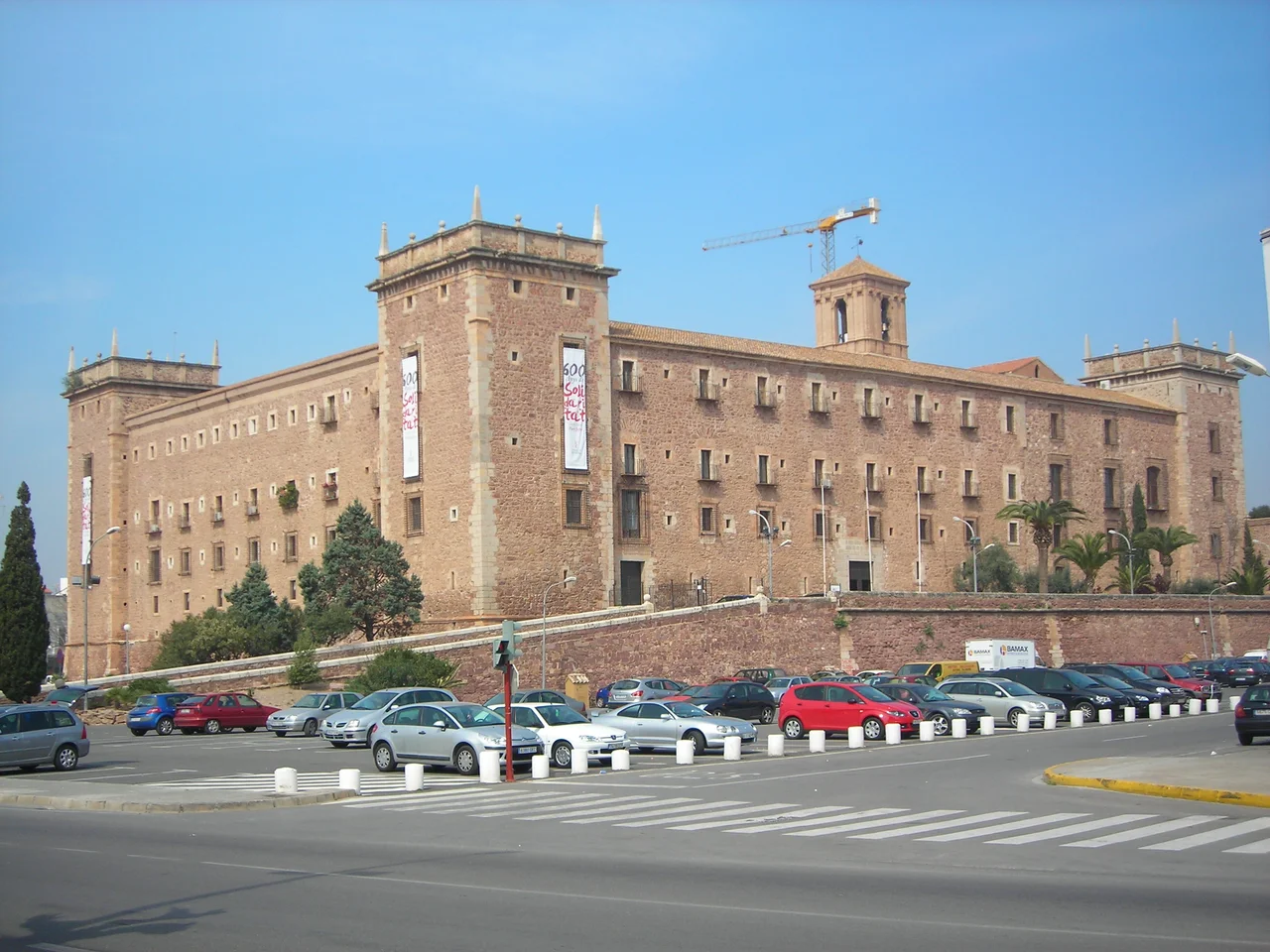

Monastery of Santa Maria, El Puig
The story begins with a bell in the ground. In 1237, on a low hill north of Valencia, the friar Peter Nolasco is said to have dug beneath a fallen, buried bell and found a stone-carved Byzantine image of the Virgin - Our Lady of the Angels - that had lain hidden, so the tradition holds, all through the centuries of Muslim rule. To the king camped nearby, Jaume I of Aragon, the discovery seemed a sign from heaven at a moment when he needed one. He was in the middle of a war for Valencia, and this hill, El Puig, was the place he had chosen to break his enemy. The monastery that rose here binds those two events together: a battlefield and a miracle, on the same rise of ground.
The Hill That Opened Valencia
El Puig - the name simply means "the hill" - was a strategic prize. It rose between the Christian advance and the walls of Muslim Valencia, and whoever held it commanded the approach to the city. In August 1237 the forces of the Crown of Aragon, led by Bernat Guillem d'Entença, met the army of the Taifa of Valencia under Zayyan ibn Mardanish in the Battle of El Puig. The Aragonese victory was decisive. It cleared the last major obstacle before the capital, and the following year Valencia itself would fall to Jaume I. The king did not forget the hill that had made his conquest possible. He founded a sanctuary here, and had the buried Virgin enthroned as the patroness of his new Kingdom of Valencia.
The Order of Ransom
The friar who found the image was no ordinary priest. Peter Nolasco had founded the Mercedarian order, a brotherhood with a startling and humane mission: to buy back Christian captives held in bondage across the Muslim Mediterranean, and, when money ran short, to offer themselves as hostages in the prisoners' place. Jaume I entrusted the new shrine on El Puig to Nolasco's Mercedarians, making them its guardians in perpetuity. It was a fitting match. An order devoted to freeing the captive took charge of a site that stood, in the mind of its age, for deliverance - and the little Byzantine Virgin became a magnet for the faithful of the whole kingdom.
From Chapel to Royal Monastery
The first church was finished by 1240, but it could not hold the crowds. Pilgrims poured toward the patroness of Valencia in such numbers that a far larger Gothic church replaced it around 1300, and in 1588 the great monastery that frames the complex today went up around it. Inside, the building keeps the memory of its royal founder close. Visitors pass through the cloisters into the Salón Real, the hall reserved for monarchs on their journeys to Valencia, and the Salón Gótic named for Jaume I himself, alongside a hall devoted to ceramics. Gothic below and Renaissance above, the monastery reads like a stone record of the centuries it took to build.
What Endures
Not every century was kind to it. Since the 1800s the monastery has served many purposes beyond the religious, passing through uses that had little to do with pilgrims or prayer, as so many Spanish monasteries did after the era of dissolution. Yet it survived, and in 1969 it was formally protected as a national landmark - today classed as a Bien de Interés Cultural. The hill still holds its two intertwined stories: the battle that gave Jaume I his kingdom, and the buried Virgin who became its patroness. Nearly eight hundred years on, the faithful still climb El Puig to stand before the small stone image that a friar is said to have lifted from the earth.
From the Air
The Monastery of Santa Maria stands at 39.5886°N, 0.3033°W in the town of El Puig, about 15 km north of Valencia on the coastal plain - look for the large monastery complex with its square towers rising above the low town, set back a short distance from the Mediterranean. Best viewed from 1,500-3,000 ft AGL in clear conditions. Valencia Airport (LEVC) lies about 18 km southwest; Alicante (LEAL) is roughly 145 km south. The monastery sits between Valencia and Sagunto, useful as a waypoint along the coast road north.
Nearby Stories
- Sanctuary of St. Paschal Baylon 7.8 km away
- Vía Verde de Ojos Negros 14 km away
- Albufera Natural Park 16 km away
- Cova de les Dones 23 km away
- La Tomatina 25 km away
- Illa Grossa 41 km away
- Peniscola Castle 51 km away
- Illa Conillera 86 km away