
La Tomatina
It began with a costume malfunction. On the last Wednesday of August 1945, young people crowded the main square of Buñol to watch the parade of Giants and Big-Heads - the towering papier-mâché figures beloved at Spanish festivals. One participant's oversized head toppled off. The wearer, furious, began lashing out at everything within reach, a nearby vegetable stall got knocked over, and in the chaos the crowd started flinging tomatoes at one another until the local police broke it up. It should have been a one-off. Instead, eighty years later, that accidental brawl has become the biggest food fight on Earth.
It Began With a Falling Giant
The young people of Buñol clearly enjoyed the mess, because the following August some of them staged a rematch - a pre-arranged quarrel, this time with tomatoes brought from home. The police broke that up too, but the pattern was set, and every year the crowd grew. There was no grand tradition behind it, no saint's day, no ancient rite. La Tomatina was simply a thing the town's youth did for the joy of it, a summer ritual invented on the spot and repeated until it became a custom. That informal, unofficial origin would soon get it into trouble.
Banned, Buried, Reborn
In the early 1950s the government of Francisco Franco banned La Tomatina precisely because it had no religious significance. Participants who threw tomatoes anyway were arrested. But the townspeople pushed back, and in 1957 they staged one of the great protests in the history of festivals: a tomato funeral. A coffin bearing an enormous tomato was carried through the streets behind a band playing funeral marches, mourning the death of the fight. The point was made. The authorities relented, and La Tomatina became an official festival at last. It has been cancelled only twice since - in 1957, for politics, and again in 2020 and 2021, for the COVID-19 pandemic.
The Morning of the Ham
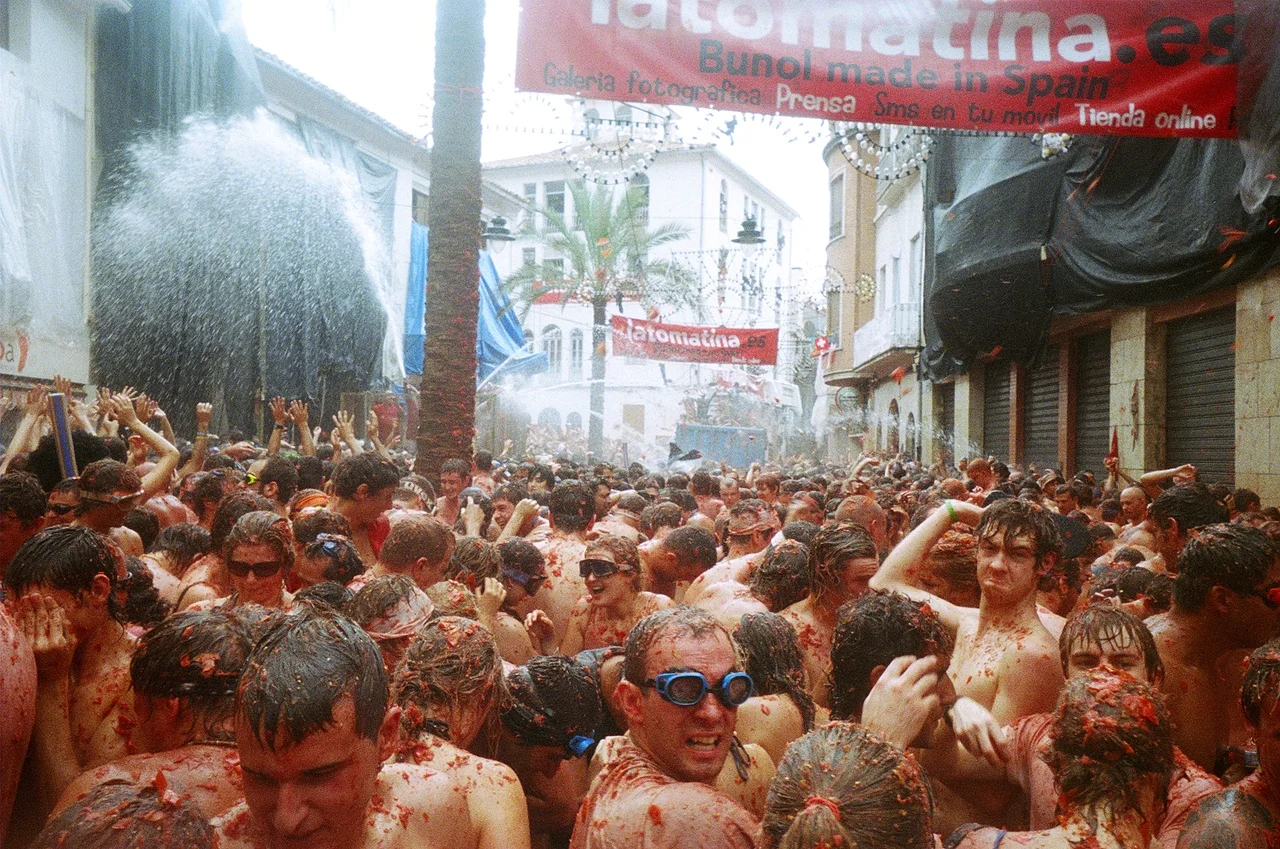
The battle is only the climax of a longer celebration. In the days beforehand Buñol holds a paella contest, sets off tomato-themed fireworks, and fills its medieval centre with music and parades. On the Wednesday morning, the fight cannot begin until someone wins the Palo Jabón - a tall greased pole with a leg of ham fixed at the top. Competitors clamber over one another, sliding down the slippery wood, while the crowd sings and hoses spray water over everyone. Only when the ham is finally knocked loose does a signal sound and the real event begin. Then the trucks roll in, loaded with overripe tomatoes, and the throwing starts.
One Red Hour
For about an hour, the streets of Buñol run with pulp. The rules are simple and sensible: throw nothing but tomatoes, squash them first so they can't hurt anyone, keep clear of the trucks, and stop the moment the second pistol fires. When it ends, the town is ankle-deep in red, and fire trucks hose down the streets while soaked participants rinse off with borrowed garden hoses or head to the Los Peñones pool to wash. Here lies one of the festival's odder truths: the citric acid in the tomatoes acts as a mild cleaner, so some of Buñol's surfaces end up cleaner after the fight than they were before it.
A Town of Nine Thousand Against the World
For decades anyone could join, and the crowds swelled until they overwhelmed a town of only about 9,000 people. So in 2013 the organisers capped attendance at 20,000 ticket-holders. Even limited, the reach is global - recent editions have drawn participants from more than 75 countries. The festival's fame spread first through Spain in the 1970s, after the broadcaster Javier Basilio featured it on the television program Informe Semanal, and by 2002 it was declared a Fiesta of International Tourist Interest. Since then it has turned up everywhere from Bollywood films to video games, its image instantly recognisable: a river of strangers, laughing, drenched in red, in a small Valencian town that never meant to start any of it. That, in the end, is the charm of La Tomatina - a world-famous spectacle with no ancient meaning behind it, invented and defended by ordinary people simply because it brought them joy.
From the Air
La Tomatina takes place in Buñol at 39.420°N, 0.790°W, in a valley about 38 km west of the city of Valencia. From the air, look for the compact medieval town centre nestled among inland hills, where the narrow streets that funnel the tomato battle are clustered. Nearest airport is Valencia (LEVC) to the east; Alicante–Elche (LEAL) and Murcia (LEMI) lie to the south. The festival runs on the last Wednesday of August, when the region bakes under hot, dry, reliably clear summer skies. A low viewing altitude of 2,000–4,000 ft best shows the town in its valley setting west of the Valencian coastal plain.
Nearby Stories
- City of Arts and Sciences 0.9 km away
- Sack of Cullera 9.1 km away
- Cova de les Dones 9.8 km away
- La Vall d'Uixó 15 km away
- Rock Art of the Iberian Mediterranean Basin 15 km away
- Castle of Alarcon 59 km away
- Cuenca Cathedral 73 km away
- 2011 Lorca Earthquake 168 km away