
City of Arts and Sciences
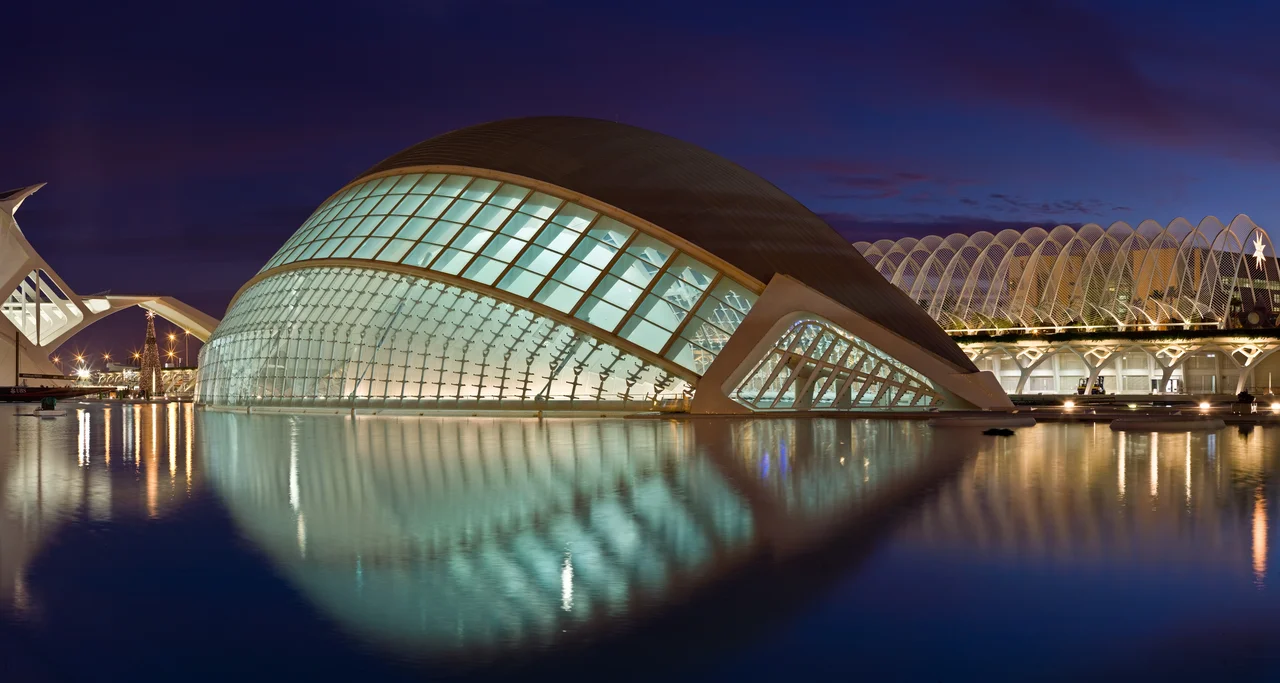
It looks like a fleet of enormous white creatures beached in the bed of a vanished river - a blinking eye, the ribcage of a whale, a giant water lily, a bird's folded feather - all cast in pale concrete and mirrored in shallow blue pools. This is the City of Arts and Sciences, Valencia's temple to the modern age, rising at the seaward end of the old Turia riverbed that a flood emptied in 1957. Its lines are so strange and so severe that filmmakers keep borrowing it to stand in for the future, from Tomorrowland to a version of Los Angeles in 2053. In real life it is one of the 12 Treasures of Spain, and the single image most travelers now carry home from Valencia.
The Eye That Opens
The complex began with an eye. L'Hemisfèric, opened in 1998, was the first piece completed, and its architect Santiago Calatrava built it in the unmistakable shape of a human eye - locals call it the "eye of knowledge." A curved shell of aluminum slats forms the eyelid, folding upward to reveal the domed planetarium within, the iris. The whole structure floats above a reflecting pool whose glass bottom completes the illusion, so that eye and reflection together read as a single open eye gazing at the sky. Inside, the acoustics play tricks: stand at one of the pillars and a whisper carries clean across the vault to a companion at the far side.
A Whale, a Lily, a Feather
Each building wears its own metaphor. The Príncipe Felipe science museum, opened in 2000, arcs like the skeleton of a great whale and holds the largest exhibition space in Spain, where visitors walk a "Chromosome Forest" that maps human DNA. Nearby, the Oceanogràfic of 2003 - the work of the Spanish-Mexican architect Félix Candela, shaped like a water lily - is the largest aquarium in Europe, home to more than five hundred species from belugas to sharks across recreated seas of the Arctic, the tropics, and the Mediterranean. Crowning the northern end is the Palau de les Arts Reina Sofía opera house, opened in 2005, sheathed in a sweeping metallic roof like a bird's feather and clad in more than three thousand tons of steel shell.
The Local Boy Who Built It
Calatrava was not an outsider parachuted in; he is Valencia's own son, born just outside the city, and the complex is his hometown magnum opus. His signature runs through it in white ribs, cantilevered shells, and taut cables. The tallest gesture is a bridge: the Assut de l'Or, finished in 2008, a cable-stayed span hung from a single curved pylon that rises 125 meters - the highest point in all of Valencia. From the air the complex reads as a deliberate composition, its buildings strung along the axis of the dead river like beads on a wire, water and white stone repeating the whole length of the site.
Work of the Pharaohs
The vision did not come cheap, and not everyone cheered. The idea dates to 1989, when the regional president Joan Lerma, inspired by a science museum he had seen in Paris, commissioned a scientist to draft a "city of science" for Valencia. Opponents in the Popular Party mocked it as a "work of the pharaohs," built to swell politicians' egos - and then, once in power, spent far more on it than the original plan, expanding the complex into a monument that heavily indebted the city. A planned telecommunications tower was scrapped and replaced with the costlier opera house. The debt was real and the criticism fair. Yet the gamble also gave Valencia the face it now shows the world - proof that a city can spend recklessly on beauty and still, somehow, come out ahead in the eyes of everyone who sees it.
From the Air
The City of Arts and Sciences lies at 39.4545°N, 0.3504°W, strung along the southeastern end of the dry Turia riverbed between central Valencia and the port - from above, look for the line of white structures and blue reflecting pools, with Calatrava's 125 m Assut de l'Or bridge pylon the tallest marker in the city. Best viewed from 1,500-3,000 ft AGL in the region's typically clear light. Valencia Airport (LEVC) sits about 10 km west-northwest; Alicante (LEAL) is roughly 130 km south. The complex is one of the most recognizable aerial landmarks on Spain's Mediterranean coast.
Nearby Stories
- Cova de les Dones 6.2 km away
- Cullera 7.6 km away
- La Tomatina 8.8 km away
- La Vall d'Uixó 12 km away
- Rock Art of the Iberian Mediterranean Basin 29 km away
- Illa Grossa 34 km away
- Illa de s'Espartar 78 km away
- Illa Conillera 91 km away