
Rock Art of the Iberian Mediterranean Basin
On a wall in the Cuevas de la Araña, near Bicorp in inland Valencia, a small red figure clings to a rope of woven grass, one arm plunged into a swarm of bees, a gathering bag at their side. The painting is thousands of years old, and it captures a moment as human as any you could name: a person risking stings to steal wild honey. This honey hunter is one of the most famous images in the Rock Art of the Iberian Mediterranean Basin, a body of prehistoric painting so rich that UNESCO grouped more than 700 sites of it into a single World Heritage listing in 1998.
The Honey Hunter
What sets this art apart is people. In the celebrated cave paintings of the Upper Paleolithic - the bison and horses of Altamira and Lascaux - human beings barely appear. Here, in what specialists call Levantine art, the human figure takes centre stage. Men run down deer with bows drawn; women dance; climbers raid bees' nests; warriors clash. The scenes are full of movement and story, small figures caught mid-stride, mid-shot, mid-fall. Where earlier cave art gives us animals in isolation, this art gives us drama - the earliest surviving pictures, in Europe, of humans doing the things that filled their days.
Eastern Spain, Not the Levant
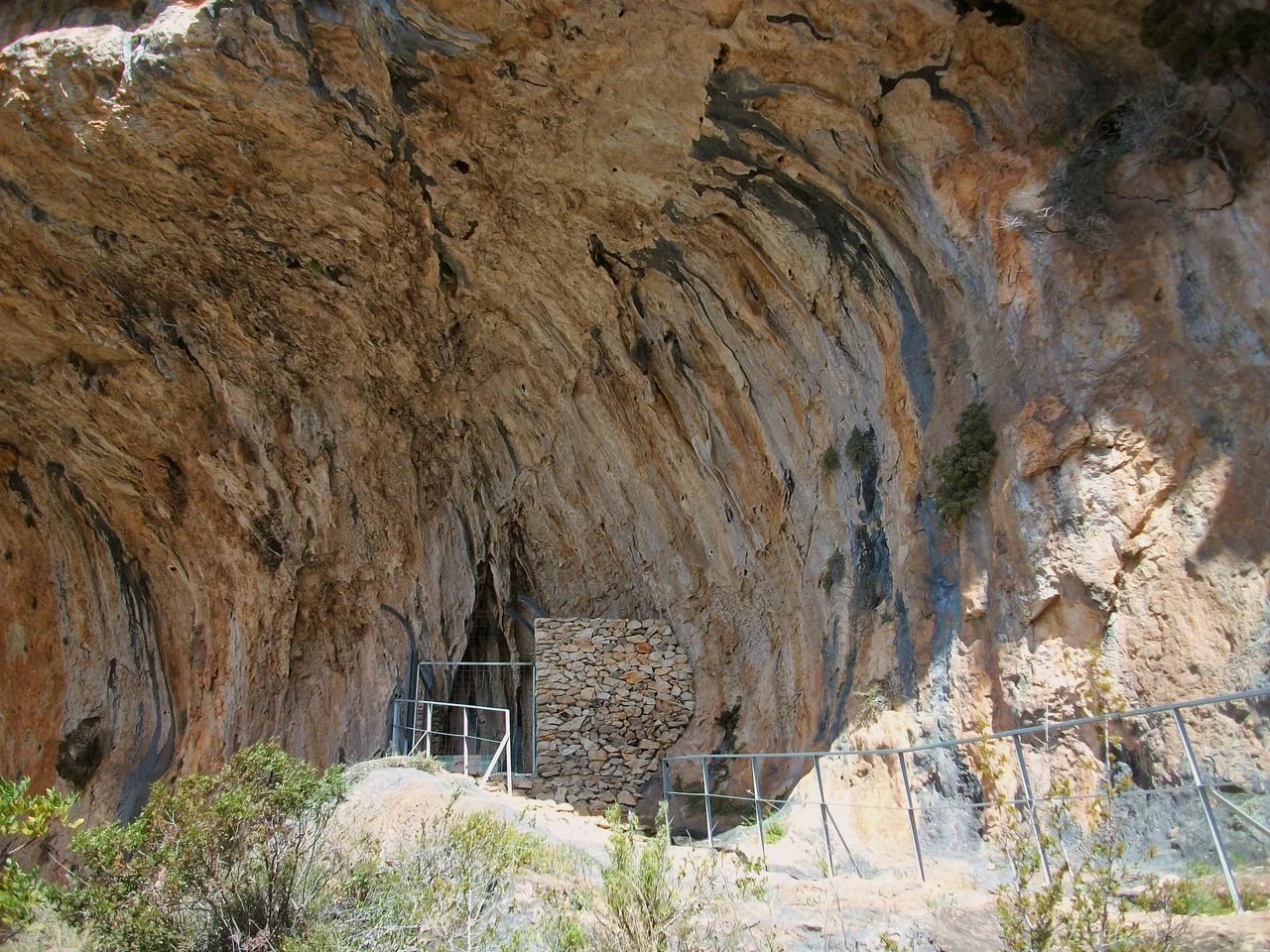
The name confuses people, so it is worth clearing up: 'Levantine' here means eastern Spain, not the eastern Mediterranean. The 727 rock shelters, caves and ravine walls recognised by UNESCO stretch from the Pyrenees south to Granada, spread across six regions. The Valencian Community alone holds 301 of them, more than any other, with major concentrations also in Aragon, Castile-La Mancha, Murcia and Andalusia. It is the largest gathering of such rock art anywhere in Europe. According to UNESCO the oldest paintings date to around 8,000 BC and the most recent to about 3500 BC - a span of some 4,500 years, during which the people who made them were slowly shifting from a hunter-gatherer life toward the first farming.
Scenes of the Hunt and the Fight
Hunting dominates, and the bow is everywhere, drawn oversized as the era's supreme weapon. Painters solved the problem of distance with real ingenuity, sketching the trail of a fleeing animal to show the gap between archer and prey. Animals gallop in the 'flying gallop' pose - all four legs stretched clear of the ground - a convention art would keep using until the invention of photography proved it wrong. There are battles, too, some crowded with dozens of figures: at Cova del Roure in Morella la Vella, three archers are ringed by four; at Les Dogue in Ares del Maestrat, eleven are set upon by seventeen. There are even scenes of execution. And there is ceremony: at the Caves of El Cogul, eleven women in skirts are painted circling in a dance that has puzzled and fascinated viewers for over a century.
Painted With Feathers
For all their drama, the figures are tiny, often only a few centimetres tall, and painted with striking economy in one or two colours. The pigments were simple - reddish mineral earths and charcoal - and the artists seem to have applied them with feathers, outlining the bodies after filling them in. What has preserved these fragile images for millennia is chance chemistry: a whisper-thin film of limescale, left by water trickling down the rock, that sealed the paint beneath a transparent glaze. The bestiary is dominated by goats, the most frequently painted animal, alongside deer, boar and cattle. One wall at Selva Pascuala even appears to show a row of mushrooms - possibly a hallucinogenic species - hinting at a symbolic world we can only guess at.
A Fragile Inheritance
This whole tradition was unknown to modern eyes until 1903, when the first examples came to light in Teruel and the prehistorian Juan Cabré began to study them. They are not easy paintings to protect. Most survive in shallow rock shelters and ravine caves - the kind of steep, sunlit gorges that were useless to farmers but ideal for ambushing game - and their state of conservation is often poor. Spain declared them cultural monuments in 1985, and communities have created cultural parks and interpretation centres to safeguard the most important sites. To stand before one of these panels is to meet the artists across an unimaginable gulf of time, and to recognise, in a running hunter or a climbing honey-gatherer, someone entirely like ourselves.
From the Air
The rock-art sites are scattered across a vast area of eastern Spain, from the Pyrenees to Granada; the coordinates here, 39.79°N, 1.033°W, fall in the inland uplands where Valencia province meets Castile-La Mancha, a country of steep ravines and rock shelters. The paintings themselves are far too small to see from the air, hidden in gorges and shallow caves, so the landscape to look for is the terrain that holds them: dry, dissected limestone valleys and narrow river canyons inland from the coast. Nearest major airport is Valencia (LEVC) to the east, with Alicante–Elche (LEAL) and Murcia (LEMI) to the south. A low pass at 2,500–5,000 ft over the ravine country, in the region's clear dry air, best reveals the kind of sheltered gorges where the ancient painters worked.
Nearby Stories
- El Cabanyal 9.2 km away
- La Vall d'Uixó 10 km away
- Penyagolosa 16 km away
- La Tomatina 16 km away
- Dinópolis 33 km away
- Castle of Alarcon 58 km away
- Cuenca Cathedral 62 km away
- Castle of Belmonte 114 km away