
Dinópolis
In 2003, on a hillside near the Teruel village of Riodeva, paleontologists began easing an enormous animal out of the rock - a long-necked sauropod that would prove to be the largest dinosaur ever found in Europe. They named it Turiasaurus riodevensis: more than thirty metres from nose to tail, and something like forty tonnes in life. It emerged from a province most Spaniards picture, if they picture it at all, as empty. Teruel turned that emptiness into an asset. Beneath its quiet hills lies one of the richest fossil grounds on the continent, and the province built an entire dinosaur empire on top of it.
The Giant of Riodeva
Turiasaurus was a genuine colossus, ranking among the largest dinosaurs known anywhere on Earth. Formally described in 2006 by Royo-Torres, Cobos, and Alcalá, it did more than break a European size record. Its anatomy was distinct enough to define a whole new branch of the sauropod family tree, a group of primitive giants that the discovery brought into focus for the first time. A single hillside near a village of a few hundred people had yielded a landmark of paleontology - the kind of find that redraws textbooks and puts a dot on the map that scientists everywhere suddenly recognize.
A Museum Among the Largest in the World
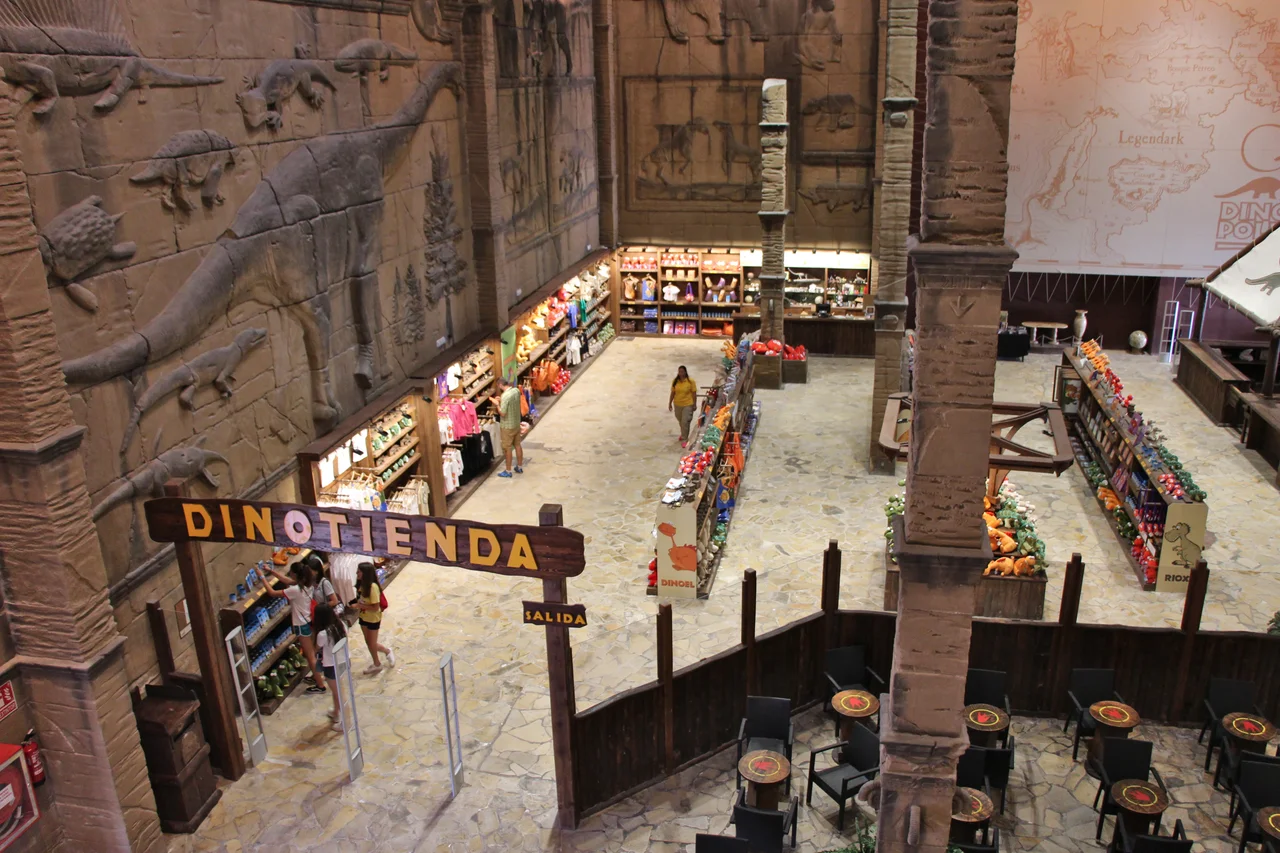
The public face of all this is Dinópolis, on the edge of Teruel city, and it ranks among the largest paleontology museums in the world. The idea took shape in 1998, when the regional government of Aragón set up a foundation to house the province's swelling collection of fossils, boost tourism, and fund further research all at once. The first building opened in June 2001. It is only half a museum in the traditional sense: the exhibition halls - devoted to aquatic life, dinosaurs, mammals, and meteorites - share the grounds with rides, shows, and restaurants, so that a serious scientific collection doubles as a genuine theme park.
Territorio Dinópolis
Dinópolis is not one place but eight. The Teruel hub anchors a chain called Territorio Dinópolis, with seven satellite sites scattered through the province, each planted in a small town near its own fossil beds: Inhóspitak at Peñarroya de Tastavins, Legendark at Galve, Región Ambarina at Rubielos de Mora, Bosque Pétreo at Castellote, Mar Nummus at Albarracín, Titania at Riodeva - built around the great Turiasaurus and the theme of gigantism - and Valcaria at Ariño. Together they form a museum the size of a province, turning a scatter of rural digs into a constellation of destinations linked by deep time.
Fossils and Fortunes
There is a quiet cleverness to what Teruel has done. This is a rural, thinning corner of Spain, the sort of place young people tend to leave. Rather than fight that, the province reached back a hundred and fifty million years and built a future on it. Tourism revenue helps underwrite a serious research team - the Fundación Conjunto Paleontológico de Teruel-Dinópolis - whose scientists keep describing new species even as families queue for the rides next door. Science and spectacle feed each other here. It is a fitting arrangement for a place whose greatest celebrity is a creature that outweighed six elephants and has been dead for an age.
Teruel Exists
There is a defiance in all of this that locals would recognize. Teruel is so overlooked within Spain that its people once rallied under the slogan Teruel existe - "Teruel exists" - a half-joking protest against being forgotten by the rest of the country. Dinópolis is that spirit made concrete. A province short on people and industry looked hard at what it did have in abundance - fossils, open space, and a hundred and fifty million years of prehistory - and built something no wealthier region could copy. Children leave clutching plastic dinosaurs; researchers next door publish papers on real ones. In turning its deep past into a living present, Teruel made an argument for its own existence that is difficult to answer.
From the Air
Dinópolis sits on the edge of Teruel city at 40.33°N, 1.08°W, in the high interior of Aragón. From the air, Teruel's compact city with its distinctive Mudéjar towers is the landmark, with the Dinópolis complex on its outskirts and the Turia valley threading the surrounding highlands. Terrain here is elevated - Teruel sits well above 900 metres - so allow generous margins and expect mountain weather, including summer thermals and winter cold. Valencia's LEVC lies roughly 130 km to the southeast; Alicante-Elche LEAL is far to the south. This is inland high-country flying; clear, stable days offer the best visibility over the fossil-rich hills.
Nearby Stories
- Penyagolosa 33 km away
- Rock Art of the Iberian Mediterranean Basin 36 km away
- Serra Calderona 43 km away
- Cuenca Cathedral 43 km away
- Morella 51 km away
- Castle of Alarcon 65 km away
- Battle of Belchite (1937) 87 km away
- Castle of Gormaz 144 km away