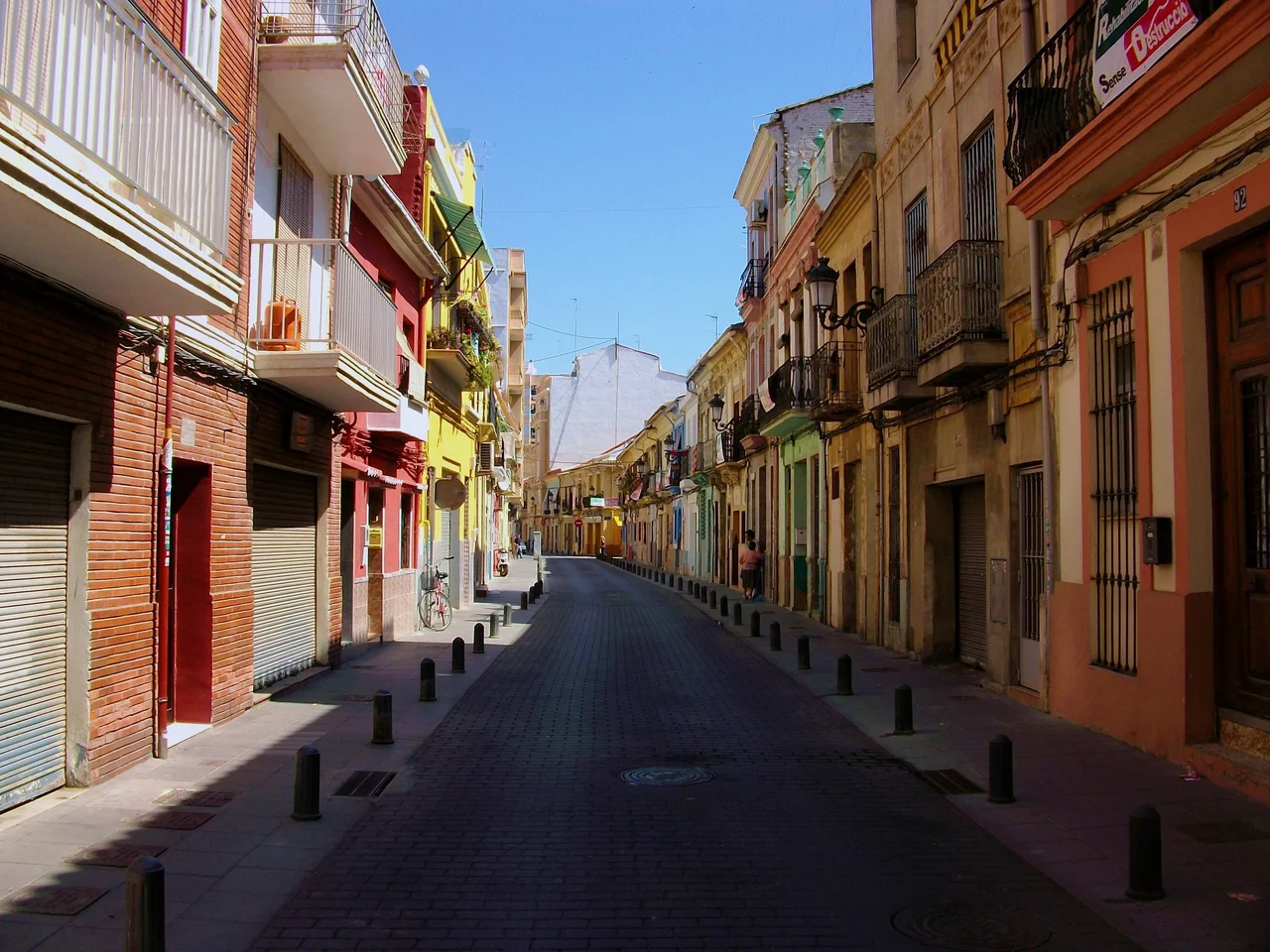

El Cabanyal
Walk the long, straight lanes of El Cabanyal and the walls seem to compete for your attention. Facade after facade is sheathed in glazed ceramic - cobalt blues, ochres, greens, geometric flowers - so that a modest two-storey fishermen's house becomes a small work of art. This is Valencia's old sea village, a dense grid running parallel to the shore just behind La Malvarrosa, the city's main beach. For most of its life it was a working quarter of fishing families, plain and salt-worn. Then it caught fire, learned to dress in tile, and much later had to fight simply to go on existing.
Color Out of Ashes
El Cabanyal began as a cluster of fishermen's huts - barracas, with whitewashed walls and steep thatched roofs - grown up outside the medieval city as early as the 13th century. Thatch and open flame are a dangerous pairing, and in 1796 a fire tore through the quarter. In its aftermath, straw roofs were banned outright. Residents rebuilt in brick, and as they did they embraced the modernista fashion sweeping the Mediterranean, cladding their new houses in brightly colored tiles in the trencadís spirit of Antoni Gaudí. The rebuilt quarter kept its old logic - modest two-storey homes packed shoulder to shoulder along narrow lanes that run in tight parallel rows down toward the water, the streets echoing the way the fishing boats once lay drawn up on the sand. What looks today like a deliberate open-air gallery was really a practical answer to disaster: fireproof homes that the fishing families made beautiful, block after block, until the whole neighborhood glowed.
The Painter's Light
The neighborhood sits where Valencia meets the sea, and that meeting has always drawn artists. Joaquín Sorolla, the great Valencian painter of sun and water, worked these maritime districts, chasing the particular brilliance of light on wet sand and billowing sail. The grid of El Cabanyal grew from the rhythms of fishing life - houses close together, lanes running down toward the boats, the whole quarter oriented to the shore. The broad avenue that borders it carries the name of Vicente Blasco Ibáñez, the Valencian novelist who chronicled the hard lives of the region's fishermen and farmers. The sea made this place, and it has never quite let go of it.
The Avenue That Never Reached the Sea
On 24 July 1998, Valencia's city government under Mayor Rita Barberà approved a plan to drive the grand Blasco Ibáñez avenue straight through to the water. The route required demolishing 1,651 houses - a wide swath of the historic quarter. But El Cabanyal was legally protected as a site of cultural interest, and the plan collided with that status. What followed was a long civic battle. Residents organized under the banner Salvem el Cabanyal - "Save Cabanyal" - and fought the scheme through the courts, winning victory after victory with lawful appeals. The mayor dismissed them as "violent," her evidence being that they filed judicial appeals. The fracture split the city for years, neighbors against town hall, homes hanging in limbo.
Third Coolest in Europe
The residents outlasted the plan. A change of city government in 2015 finally shelved the demolition and turned instead to regenerating the neighborhood rather than bulldozing it. Rescued from the wrecking ball, El Cabanyal did what neglected, characterful places often do once the threat lifts: it drew artists, cafes, and visitors charmed by exactly the tiled streets the avenue would have erased. In 2020 The Guardian ranked it the third-coolest neighbourhood in Europe, a phrase that would have sounded absurd to anyone who saw its boarded windows a decade earlier. The turnaround is worth pausing on. A working-class quarter that had been left to crumble, then marked for destruction, survived because the people who lived there refused to leave. Their reward for that stubbornness was to watch the whole world decide their home was beautiful after all - the same tiled walls, the same narrow lanes, now sought out rather than condemned. Preservation, it turned out, was not the enemy of a living neighborhood but the thing that let it keep on living.
From the Air
El Cabanyal lies at 39.4689°N, 0.3328°W, a tight rectangular grid of streets running parallel to the shore in eastern Valencia, immediately behind La Malvarrosa beach and just south of the port - from above, look for the dense low-rise grid between the old town and the Mediterranean. Best viewed from 1,000-2,500 ft AGL in clear coastal light. Valencia Airport (LEVC) sits about 12 km west; Alicante (LEAL) is roughly 130 km south. The beach, marina, and port make the neighborhood easy to locate from the air.
Nearby Stories
- Cova de les Dones 6.2 km away
- Cullera 7.6 km away
- La Tomatina 8.8 km away
- La Vall d'Uixó 12 km away
- Rock Art of the Iberian Mediterranean Basin 29 km away
- Illa Grossa 34 km away
- Illa de s'Espartar 78 km away
- Illa Conillera 91 km away