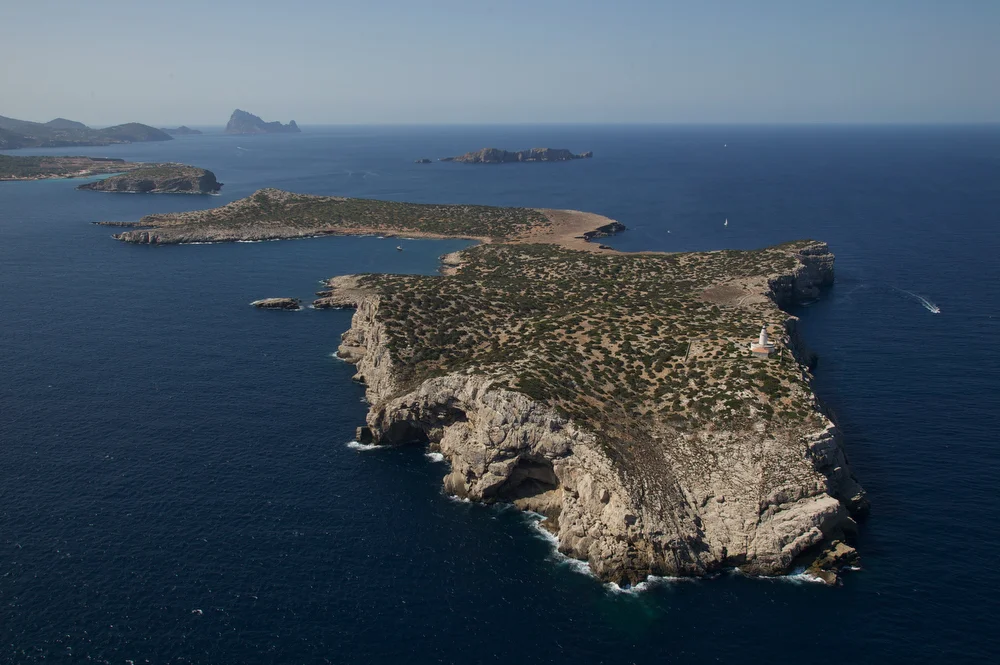

Illa Conillera
The island is named for its rabbits. Sa Conillera — Rabbit Island — is a low, arid ridge of rock six kilometres off Sant Antoni, and its most numerous residents really are the rabbits that swarm its slopes. But the humble name hides a strange double history. Local legend claims this modest islet as the birthplace of Hannibal, the general who nearly broke Rome. And in its stony ground, centuries later, someone buried the tortured bodies of executed pirates. For a place best known for rabbits, Sa Conillera keeps unusually dark company.
A Ridge in Deep Water
Sa Conillera is essentially a single long ridge dropped into the sea. It runs roughly 2.1 kilometres from north to south and covers about a hundred hectares, its edges falling away in steep coast to deep water on nearly every side. It lies some six kilometres west of the resort town of Sant Antoni de Portmany, close enough to see clearly from Ibiza yet cut off enough to have kept its own wildlife and its own stories. Among the many small islands scattered around the Balearics, it is one of the more modest — a rock, some scrub, and a great deal of history for its size.
The Lighthouse at the North End
At the island's northwest tip stands its one significant building: a lighthouse raised in 1857. A tower rises from a low circular structure, flanked by two rooms added half a century later, in 1908. The lantern sits 85 metres above the sea, and its light carries some 18 nautical miles across the water, flashing in a distinctive rhythm — a group of four quick flashes every twenty seconds. By day, sailors see it differently: an 18-metre whitewashed tower, bright against the arid rock, marking the western approaches to Sant Antoni and the channel beyond.
Wind-Beaten and Alive
Life on Sa Conillera is a study in endurance. The ground is rocky and dry, and little grows here but toughened shrubs and herbs — rosemary, thyme and rue in abundance, along with mastic, juniper and stunted pines that the wind has flattened into low, shrubby shapes, dotting the harsh slopes with green. The animal life is stranger and richer than the plants suggest. A native cicada fills the air with a monotonous, rattlesnake-like buzz; an endemic subspecies of the Ibizan wall lizard basks on the stones; and a colony of the endangered Eleonora's falcon nests on the cliffs, sharing the island with gulls and cormorants. Above them all, in sheer numbers, reign the rabbits that gave the island its name.
The Birth of Hannibal
The grandest of the island's legends concerns a birth. The story goes that Hamilcar Barca, the Carthaginian general, was sailing past Ibiza with his heavily pregnant wife when a fierce storm caught their warship. Hamilcar ordered his captain to find shelter, and they slipped into an inlet on the island's southern side, carrying the woman ashore to a cave in the cliffs. There, the legend says — at the will of the Carthaginian gods Tanit and Bes — she gave birth to Hannibal, the commander who would one day march elephants over the Alps and bring Rome to the brink. The cave on the southern shore is called sa Casa d'Annibal, 'Hannibal's house,' to this day.
Three Skeletons
The island's other buried story is grimmer and, unlike the first, left physical proof. Some years ago three skeletons were found on Sa Conillera and carbon-dated to the early 16th century. They are believed to be the remains of pirates brought to the island to be executed. The bones tell a hard tale: one man had a lead bullet lodged in his spine, and the other two bore the marks of torture. One had been beheaded — and his skull was nowhere to be found on the island. There was no marker and no record of a trial, only the bones and what they plainly said about the manner of these men's deaths. Whoever they were, they died badly on this lonely rock, and the sea has kept its silence ever since.
From the Air
Illa Conillera lies at 38.98°N, 1.21°E, about 6 km west of Sant Antoni de Portmany on Ibiza's northwest coast. From 2,000–3,500 ft the island reads as a long, narrow north-south ridge with the whitewashed lighthouse tower marking its northwest tip — a clean visual waypoint for the western approaches to Sant Antoni bay. The smaller islets of Illa des Bosc and S'Espartar lie just to the south, completing the chain visible from Cala Comte. Ibiza Airport (LEIB) is about 20 km to the southeast on the island's southern plain.
Nearby Stories
- Cape Sant Antoni, Spain 46 km away
- Penyal d'Ifac Natural Park 55 km away
- Andratx 71 km away
- Illa Grossa 78 km away
- Puig de sa Morisca Archaeological Park 89 km away
- Calpe 103 km away
- Santa Ponsa 113 km away
- Battle of Cape Cherchell 200 km away