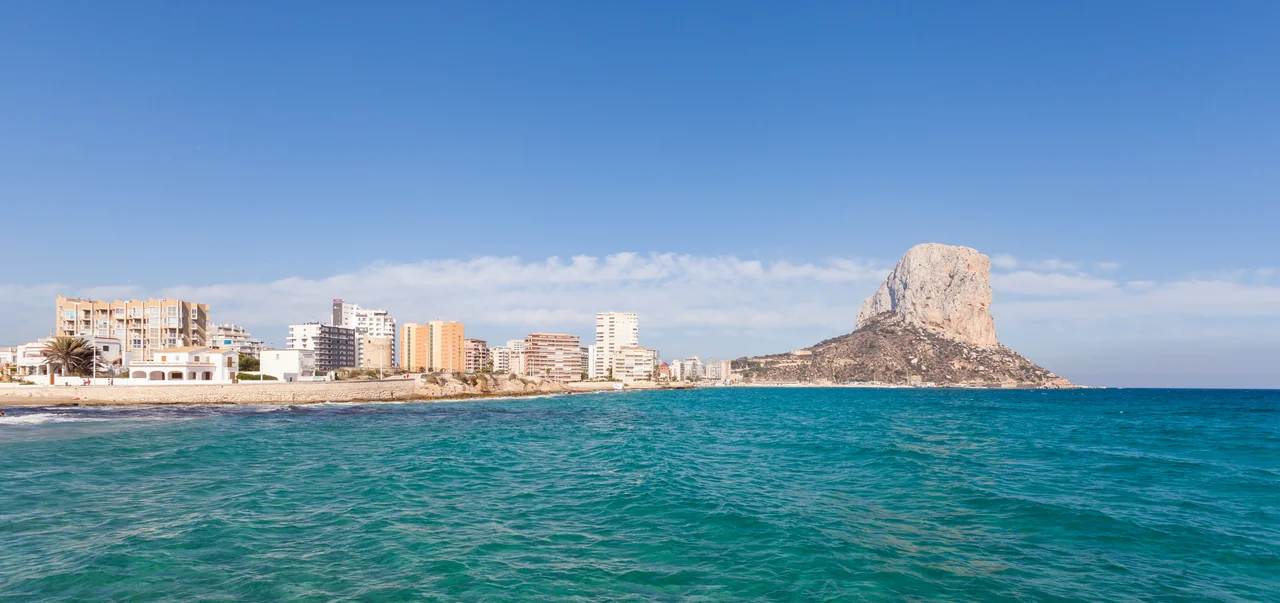

Penyal d'Ifac Natural Park
Sailors saw it long before they could name their position any other way. The Penyal d'Ifac rises 332 metres straight out of the Mediterranean, a single blade of pale limestone tethered to the Spanish shore by a slender neck of rubble. The Phoenicians, threading this coast three thousand years ago, called it simply the Northern Rock, the counterpart to a far more famous mass of stone at the other end of their sea, the Rock of Gibraltar. Between those two landmarks lay the known world, and almost everything human on this coast has, at one time or another, taken its measure from the Penyal.
The Northern Rock
To understand why the name stuck, you have only to see the rock from a distance. It dominates everything. From the flat coast around Calpe there is nothing to compete with it, no rival height for tens of kilometres, so that any vessel could fix its bearing on the Penyal alone. A causeway of fallen debris links it to the mainland, the geological equivalent of an afterthought, and it is this thread that lets walkers reach the base at all. Everything about the outcrop reads as vertical: cliffs on three sides, sheer faces scoured by the wind that never quite stops coming off the water.
The Smallest Park in Spain
For all its presence, the Penyal d'Ifac Natural Park, established in 1987, is tiny, the smallest natural park in Spain and possibly in all of Europe. It runs from sea level to that 332-metre summit and not much further. Behind the rock lies a lagoon, penned off from the sea by strips of sand; it is the last surviving fragment of the once-vast wetlands of the Marina Alta, drained and built over across the centuries. In a remarkably small compass the park protects a slice of coast that has otherwise almost entirely vanished, the shallows still busy with the birds that the wider marshes once fed.
A Garden Standing on End
The rock is really a vertical garden, its three wind-battered faces folded into microhabitats that shelter more than three hundred animal species and a roster of specialised plants. Lower down, where deeper soil holds moisture, grow dwarf palms, juniper, lavender, and white pine. Higher up, in cracks raked by sun and wind, alpine species take hold. One plant, the Ifac silene, was first discovered on this very rock, and has since disappeared from it, with no more than twenty individuals thought to survive anywhere in the wild. A species can be named for a place and still be slipping away from it. Date palms, Phoenix dactylifera, have naturalised across the lower slopes as well, their seed drifting in from the great plantations that ring the rock.
The Human Rock
People have always used the Penyal to orient themselves, and not only at sea. For the Iberian and later inhabitants of the surrounding valleys it was the natural watchtower, a place from which an entire stretch of coast could be surveyed at a glance. Today the traffic runs the other way: visitors climb it for the view rather than the vigilance, following the path that winds up from Calpe toward the summit. The rock that once told sailors where they were now tells walkers how small the coastline really is, folded beneath them between the lagoon and the sea.
Falcons, Cats, and a View to Ibiza
The cliffs belong to birds. Peregrine falcons and the long-winged Eleonora's falcon nest on the ledges, alongside gulls and cormorants, while a small population of half-wild cats has staked out territory near the peak. Below the waterline the seabed shifts between rock, stone, and sand, sheltering a marine community as varied as the one above. And from the summit, on a clear day, the reward is a sight the Phoenicians would have understood at once: across the open water to the east floats the island of Ibiza, low and blue on the horizon. That the seabed below is guarded as closely as the cliffs above is the whole point of the park: the Penyal is protected in a single vertical sweep, from the marine community at its foot to the falcons at its crown.
From the Air
The Penyal d'Ifac is one of the most unmistakable landmarks on the entire Spanish Mediterranean coast: a lone 332-metre limestone tower at 38.63 degrees north, 0.07 degrees east, jutting into the sea beside Calpe and tied to shore by a low sandy neck. From the air it casts a long shadow and stands utterly alone, ideal for a low coastal pass at 2,000 to 3,500 feet. Alicante-Elche (LEAL) lies about 60 km southwest; Ibiza (LEIB), sometimes visible from the summit itself, sits east across roughly 90 km of open water. Expect good visibility outside summer haze.
Nearby Stories
- Canelobre Cave 9.7 km away
- Monastery of the Corpus Christi (Llutxent) 12 km away
- Ciudad de la Luz 16 km away
- Cova Foradà 23 km away
- Es Vedrà 43 km away
- Cala d'Hort 57 km away
- Tabarca 59 km away
- Battle of Cape Cherchell 205 km away