
Tabarca
The island's name belongs somewhere else. More than a thousand kilometers to the south, off the coast of Tunisia, sits another Tabarka, a rocky islet the first settlers here were forced to abandon. They did not come by choice. The people who built this little walled town were coral divers and their families, born into a Genoese community that had thrived in North Africa for generations, until war and captivity scattered them across the Mediterranean and a Spanish king brought the survivors here to begin again.
Two Islands, One Name
For three centuries, red coral from the Tunisian Tabarka was among the Mediterranean's most prized commodities, and the settlement that harvested it, some two thousand people of mostly Genoese origin, grew wealthy on the trade. The Genoese Lomellini family had held the coral concession from the Bey of Tunis since 1542, and over the generations the settlers put down roots, becoming a distinct community that came to be known as Tabarquinos. In 1741 the Bey of Tunis overran the island and enslaved many of its residents, carrying hundreds off in a single stroke. The kings of Spain and Sardinia offered sanctuary to those who escaped and paid ransoms to free those still held. In 1768 Charles III of Spain secured the release of sixty-nine captive families, who were carried by boat to Cartagena that October. Rather than scatter them, the crown gave them an island of their own off Alicante and let them carry their old home's name to it. From 1770 the place was known as Nova Tabarca, New Tabarca.
A Walled Town on Bare Rock
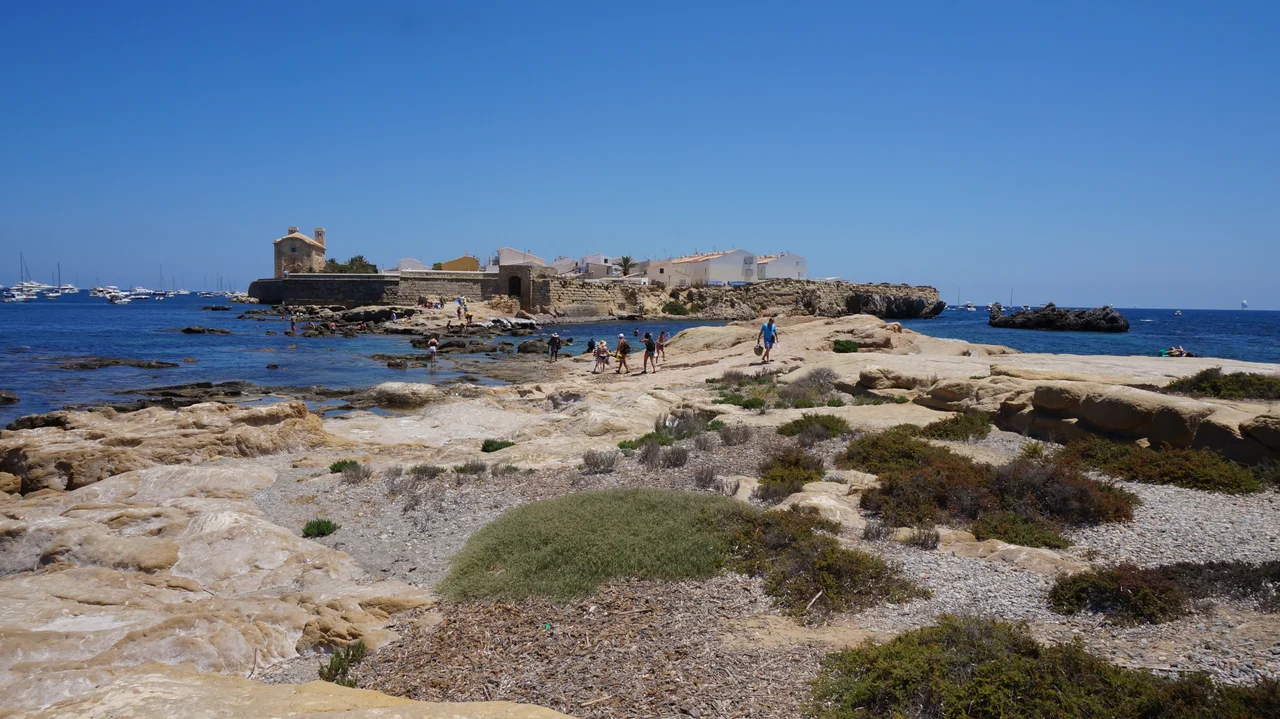
Charles III did not simply drop the refugees on a barren isle. He ordered it fortified and repopulated, and the military engineer Fernando Méndez Ras drew up a proper walled town: ramparts, bulwarks, warehouses, and barracks, entered through three monumental gates that still stand. One of them, the San Gabriel gate, carries a Latin inscription crediting Charles III with its making. The Governor's House survives, now a hotel; the church of Saints Peter and Paul was finished in 1779; and at the island's edge stands the Torre de San José, a stout three-story watchtower designed by the engineer Baltasar Ricaud around 1790, which later served a grimmer turn as a state prison in the 19th century. In that same century the island's fishing families swelled its population toward a thousand. Today barely fifty people live here year-round, a figure that multiplies tenfold each summer. It is the only inhabited island in the Valencian Community and one of the smallest permanently settled islands in Spain, a grid of low sun-bleached houses ringed by 18th-century walls. No cars disturb it. On foot, the entire island can be circled in under three hours, past the old gates, the lighthouse, and coves of impossibly clear water.
The Sea That Saved Itself
The waters around Tabarca were declared a marine reserve in 1986, the first of its kind in Spain. The distinction was earned. Beneath the surface lies a vast meadow of posidonia seagrass, the largest such prairie in the Spanish Mediterranean and a nursery for astonishing biodiversity. Sea bass, grouper, conger eel, and gilthead shelter in its blades, and an artificial reef laid by the reserve authorities shields the whole system from fishing pressure. The clarity of the water is not an accident but a record: Tabarca was the last place along Spain's Mediterranean coast where the critically endangered Mediterranean monk seal successfully bred, before vanishing from these waters in the 1960s. The EU has since named the island a Zone of Special Protection for Birds.
Island Time
Geologically, Tabarca is a foundation of volcanic rock overlaid with limestone and later deposits, a hard little platform that the Mediterranean has polished for millennia. Getting there is part of the pleasure. Ferries leave from Santa Pola on the mainland roughly every hour, crossing the same channel the ransomed families sailed two and a half centuries ago. There is no rush once you arrive, because there is nowhere to rush to. You walk, you swim in water the color of green glass, you eat the caldero the islanders make from the day's catch, and you let the pace of a car-free island reset your sense of time.
From the Air
Tabarca lies at 38.16°N, 0.48°W, a small low island roughly 11 nautical miles southeast of Santa Pola and about 4 km offshore. From 2,000-4,000 feet the walled old town and its 18th-century gateways are visible at the island's western end, with the lighthouse marking the flatter eastern tip; the surrounding water shows the pale turquoise of shallow seagrass beds. Alicante-Elche Airport (LEAL) is the nearest field, roughly 20 km to the northwest; Región de Murcia (LEMI) lies farther southwest. As a protected marine reserve and bird zone, the island rewards slow, high passes rather than low overflight. Clear Levantine mornings offer the best visibility before sea haze rises.
Nearby Stories
- Cresta del Gallo 1.5 km away
- Canelobre Cave 10 km away
- La Muralla Roja 16 km away
- Kingdom of Murcia 25 km away
- San Pedro del Pinatar 27 km away
- Monte Arabí 30 km away
- Penyal d'Ifac Natural Park 45 km away
- Battle of Cape Cherchell 228 km away