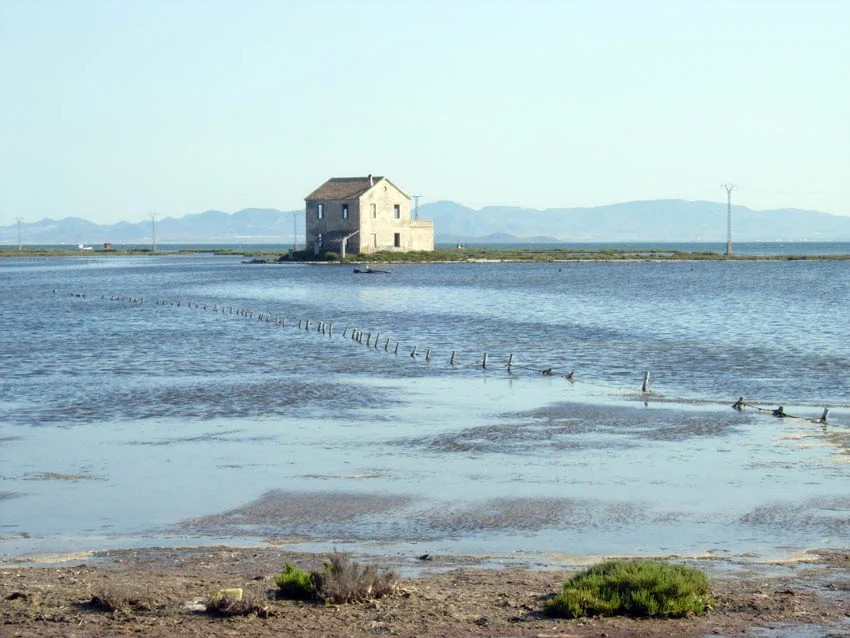

San Pedro del Pinatar
The Romans came to this corner of the Murcian coast for one thing: salt. They worked the salt pans behind the beaches to cure fish and, above all, to make garum — the pungent fermented fish sauce that Romans splashed on nearly everything, and that modern noses would struggle to love. Two thousand years later, salt still defines San Pedro del Pinatar. Its salt flats and dunes, the Salinas y Arenales, spread in bright geometric ponds along the northern edge of the Mar Menor, where Murcia's warm Costa Cálida runs up against the border of Alicante province. The town sits on a sliver of land with the sea on one side and the lagoon on the other, so the water is never out of sight.
A Coast Built on Salt
San Pedro sits at the very top of Murcia's Mediterranean coastline, a town of roughly thirty thousand people almost surrounded by water. The salt that drew the Romans is still harvested here, and the pans that produce it now sit inside a protected natural park, the Salinas y Arenales — a shimmering patchwork of shallow, pink-tinged ponds and low sand dunes that has become one of the coast's richest wildlife habitats. Long before the birdwatchers arrived, though, this was working ground. Its value lay not in scenery but in the white crystal raked from evaporating seawater, shipped out to cure fish and season the tables of an empire. That industrial past and the wild present now share the same shoreline.
Reed Traps and a Change of Rulers
In 711, Muslim armies crossed into the Iberian Peninsula, and within a few years they held much of it, this coast included. They left a lasting mark on the Mar Menor in the form of the encañizadas — ingenious fish traps built from reeds and cane, set in the shallow channels to funnel fish into enclosures, a technique still bound up with the lagoon today. Rule changed hands in 1243, when King Muhammad Ibn Hud offered his allegiance to the Crown of Castile. That April, the Treaty of Alcaraz formally recognized Castilian sovereignty, and the former Taifa of Murcia passed under Castilian rule. The reed weirs outlasted the kings who oversaw them.
Losing and Winning Its Own Government
For a small town, San Pedro spent a surprising amount of its history fighting over who governed it. During the War of the Spanish Succession, the people of the Kingdom of Murcia sided with Philip V; in 1706, supporters of his rival, the Habsburg claimant Charles VI, attacked Cartagena, its port, and the Mar Menor. A century later the townsfolk seized on the liberal fervor of the Trienio Liberal to form their own local government in 1820, only to lose it again when the old order returned in 1823 and folded them back into the municipality of Murcia. Not until 1836, after the death of Ferdinand VII reopened the door to reform, did San Pedro win back its independence for good, on the sixteenth of September.
The Sea, Blessed Each July
For a town that has always lived off the water, the biggest day of the year falls in high summer. Every 16 July, San Pedro honors the Virgin of Carmel, patron of sailors and fishermen, with a seaborne procession that goes back to the eighteenth century. Her image is carried out onto the boats of the local fleet, riding the water she is meant to protect; the vessels are blessed in turn, and the community pauses to remember those who went to sea and never came home. The ritual is older than the town's hard-won political independence, and it distills something essential about the place. From the Roman salt-makers curing fish for garum to the crews still working the pans and the lagoon, San Pedro del Pinatar has always been a town whose fortunes rise and fall with the water at its door.
From the Air
San Pedro del Pinatar lies at 37.836°N, 0.789°W, at the northern tip of the Mar Menor where Murcia meets Alicante province. From the air the giveaway is the salt works: a grid of bright, geometric evaporation ponds edging the lagoon, unlike anything around them. Fly at 2,500–4,500 ft to pick out the salt pans, the dune-backed beaches, and the encañizada channels that link the lagoon to the sea. The nearest airport is Murcia–San Javier (LELC), a military air base just a few kilometers south on the Mar Menor's shore; Región de Murcia International (Corvera, LEMI) sits inland to the west, and Alicante–Elche (LEAL) about 50 km north. The Costa Cálida lives up to its name, with clear, sunny skies for most of the year.
Nearby Stories
- Sierra Minera de Cartagena-La Unión 1.7 km away
- El Fondo Natural Park 12 km away
- 2011 Lorca Earthquake 24 km away
- Villajoyosa 41 km away
- Benidorm Island 72 km away
- German submarine U-602 93 km away
- Cabo de Gata-Nijar Natural Park 111 km away
- Castle of Alarcon 167 km away