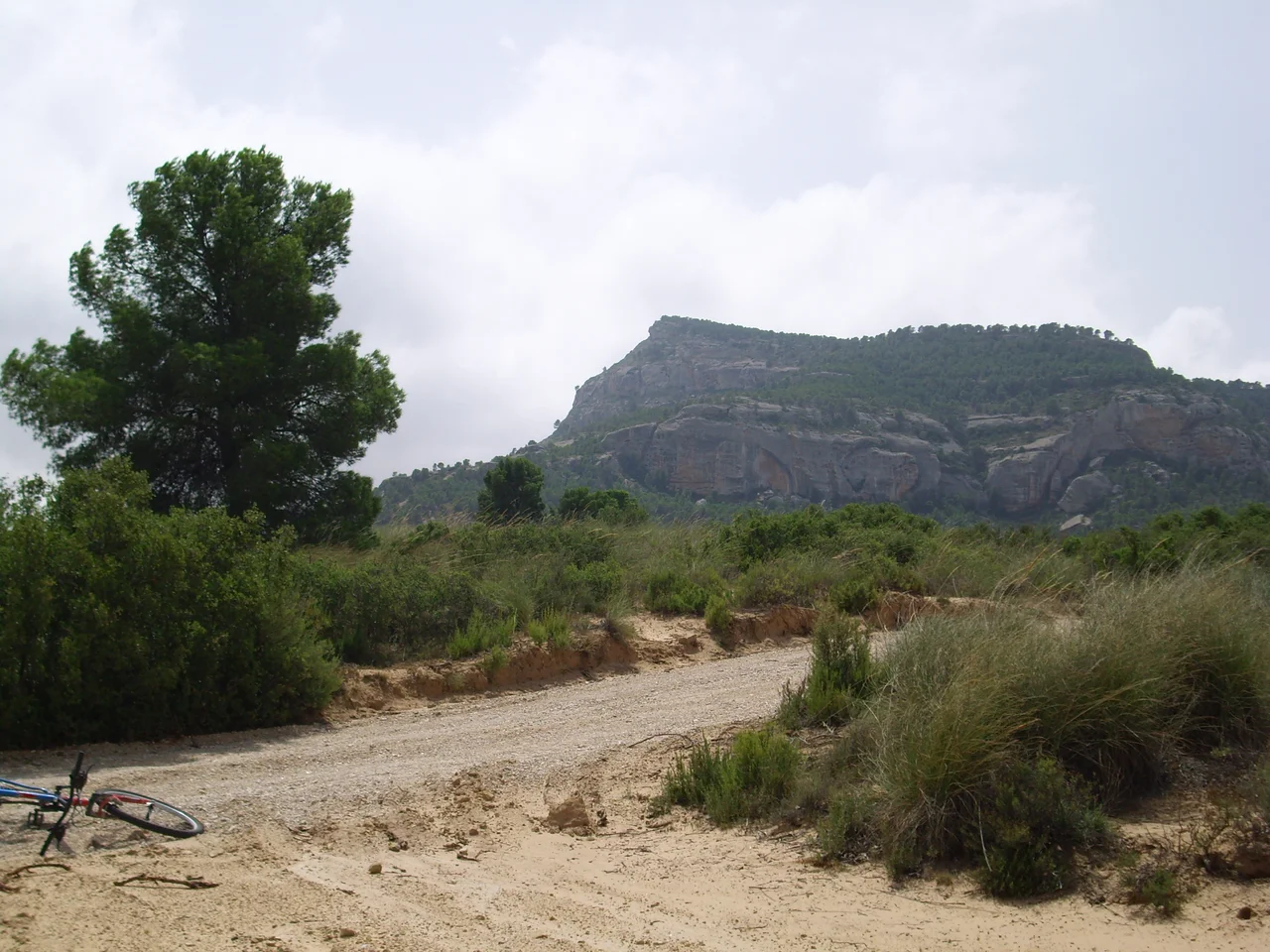

Monte Arabí
From the vineyards around Yecla, Monte Arabí rises by itself — a hump of pale limestone standing apart from any range, too small to count as a mountain chain yet impossible to ignore. A ravine cuts it off from a lower hill the locals call the Arabilejo, the 'Little Arabí.' For at least four thousand years, and almost certainly far longer, people climbed toward this solitary summit not only to look but to leave marks: paintings pressed in red, cups and channels ground into the stone, whole settlements clustered at its feet. Some places simply feel set apart. Monte Arabí has felt that way to nearly everyone who ever found it.
A Mountain Apart
At 1,068 metres, Monte Arabí is modest by the standards of Spanish peaks, but its isolation gives it presence, and the region has recognised as much: in March 2016 it was declared a Natural Monument, valued at once for its geology, its wildlife and its dense record of human use. That record begins at the base, where remains span from the second millennium BC down to the age of Roman rule. On the neighbouring Arabilejo stand the ruins of a walled Bronze Age settlement, gathered around a single great rock hollowed by a natural basin and fed by channels cut on purpose — perhaps to collect rainwater, perhaps for reasons we can now only guess at.
The Cupules and the Feet
At the foot of the Arabilejo runs a long spine of limestone, some 340 metres end to end and around 25 wide, carved with one of the richest fields of petroglyphs in the Spanish southeast. More than fifty separate groups cover the stone. There are hemispherical hollows — cupules — linked by fine, winding channels, as if the rock had been mapped with tiny rivers. There are circles. And there are podomorphs: carvings shaped like human feet, pressed into the stone by people who wanted, for reasons long since lost, to leave the print of a foot in living rock. No one can read these marks with certainty. That very silence is part of their pull.
Cantos de Visera
The mountain's greatest treasures are its paintings, sheltered in two rock overhangs known as the Cantos de Visera, formed where nearby cliffs once collapsed. In the first shelter, forty-three figures in red — horses, cattle, goats and deer — capture a naturalistic world from the transition between the Paleolithic and the Neolithic, some six or seven thousand years ago. The second shelter is busier still, with eighty figures: bulls, horses, deer and goats, and among them a long-legged wading bird, a stork or a crane, standing patient on the stone. Threaded through the animals are stranger, schematic signs — serpent-forms, grids, broken lines, dots and eye-like motifs. This art, Levantine and schematic together, helped earn the mountain a place on UNESCO's World Heritage list in 1998.
Ten Thousand Years of the Sacred
Stand back and the timescale is dizzying. The oldest of the Levantine paintings reach back roughly ten thousand years; the schematic images some six and a half thousand; the Bronze Age builders came later still, and the Romans later than that. Generation upon generation returned to the same lonely mountain and added their own mark to those already there. Barely two kilometres away, across the boundary into Montealegre del Castillo, lies the Iberian sanctuary of Cerro de los Santos, home to the Lady of Cerro de los Santos — a work spoken of beside the famous Lady of Elche and Lady of Baza. This corner of the interior was holy ground for a very long time, and the mountain at its centre still keeps the fullest record of it.
From the Air
Monte Arabí rises to 1,068 m at 38.70°N, 1.28°W, standing alone above the plains north of Yecla in the Region of Murcia — a genuine terrain feature and a fine visual landmark, with the lower Arabilejo hill just to its east across a ravine. The nearest airports are Alicante–Elche (LEAL) to the east, Región de Murcia / Corvera (LEMI) to the south, and Albacete (LEAB) to the northwest. Give the summit safe clearance and watch for the gusty, thermal-driven winds that isolated peaks throw off on warm afternoons.
Nearby Stories
- Castle of Banyeres 6.3 km away
- Jumilla 8.4 km away
- Agost 8.4 km away
- Castle of Ayora 16 km away
- Battle of Lauron 27 km away
- Castle of Alarcon 65 km away
- Castle of Belmonte 120 km away
- Battle of Las Navas de Tolosa 157 km away