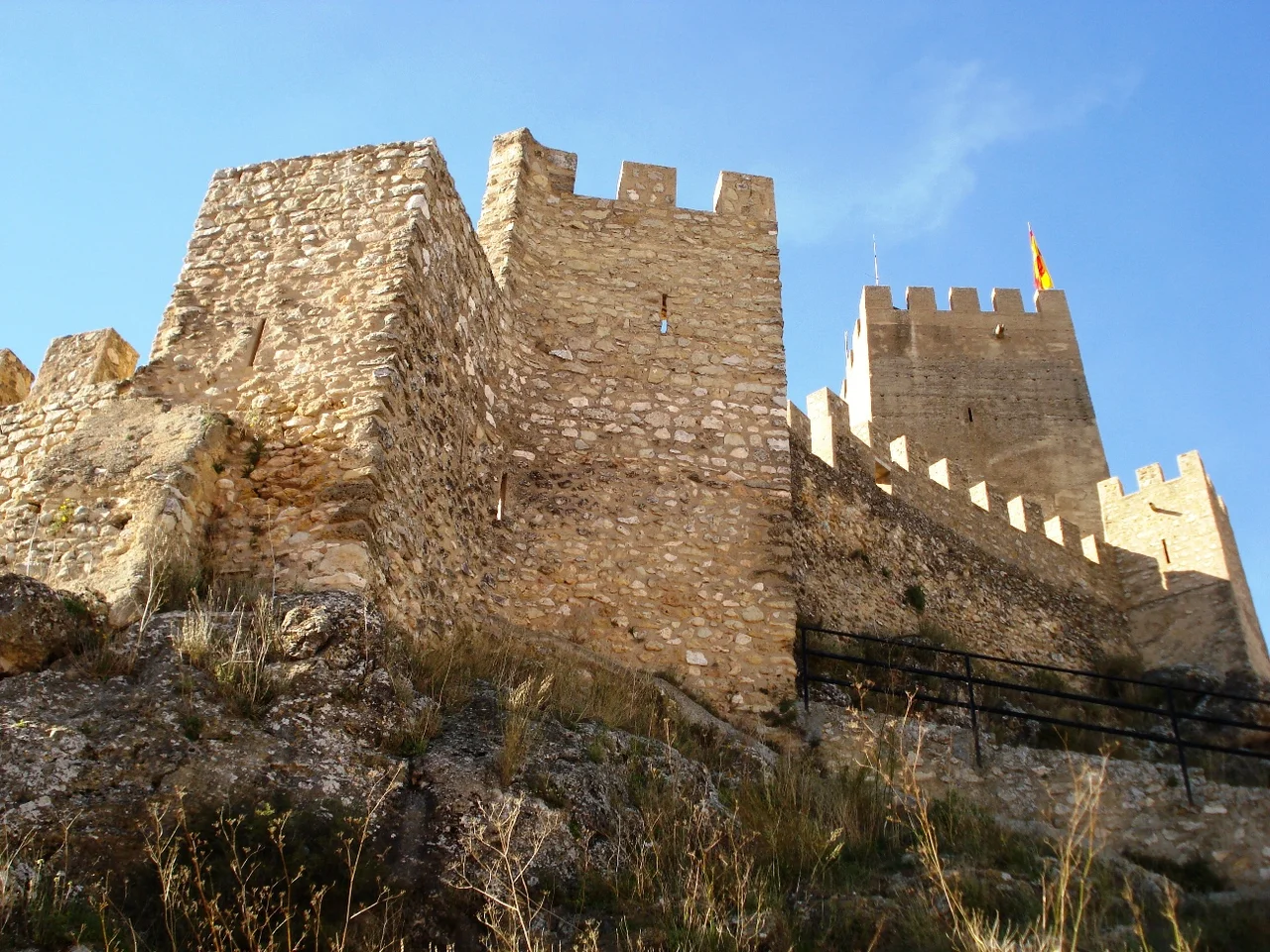

Castle of Banyeres
Most castles that survive eight centuries are built of cut stone. The Castle of Banyeres is built largely of mud. Raised by Almohad hands in the 13th century from rammed earth, its 17-meter tower still stands square and solid on the tossal de l'Àguila, the Hill of the Eagle, at the very center of Banyeres de Mariola. That a fortress packed from earth and lime should outlast the empires that fought over it is the first surprise here. The second is how much history this modest, weathered stronghold managed to absorb.
Built of Earth
The castle is irregular by design, its two enclosures shaped to fit the contours of the rock beneath. Its defining feature is that tower: 17 meters tall, square in plan, rising through three stories, all of it rammed earth. The surviving walls are made the same way, mud packed hard and later patched with pockets of masonry and arches turned with voussoirs. Inside the grounds sit a cistern to hold water through a siege and a small chapel to hold the faith. It is a lesson in medieval economy, a serious fortress conjured from the cheapest material at hand, and proof of how far skill could stretch a humble one.
The Hill of the Eagle
The Valencians named the outcrop the tossal de l'Àguila, the Hill of the Eagle, and it earns the title. Rising 830 meters above sea level in the heart of the Serra Mariola highlands, it commands the town that grew up around it and the valleys beyond. Banyeres did not spread out beneath a castle on its edge; it wrapped itself around a fortress at its geographic center, so that the stronghold and the settlement have always shared a single heartbeat. Climb to the tower today and the reward is the same long, eagle's view that made the site worth fortifying in the first place.
From Almohad Hands to Aragon
The castle steps into the written record in 1249, when King James I of Aragon granted both fortress and town to the knight Jofré de Loaysa and his wife Jacometa, folding this Muslim-built stronghold into the expanding Christian kingdom. Its later story is one of shifting ownership. In the 15th century the castle was sold to the neighboring town of Bocairent and passed under its jurisdiction, an arrangement Banyeres chafed against for generations. Not until 1628 did the town regain its independence, reclaiming authority over the fortress that had always sat, quite literally, at its core.
Three Sieges and Four Words
The castle's proudest hour came during the War of the Spanish Succession. In 1705, with Spain split between rival claimants to the throne, Banyeres held its walls for Philip V and became a stronghold of his cause. Three times the troops of Archduke Charles laid siege, and three times the castle held. When the fighting settled, the king repaid that loyalty with a title for the town: noble, faithful, loyal, and royal. Those four words are no dusty footnote. They still ride across the municipal coat of arms, a civic memory of the days the earthen tower refused to fall.
Where the Fiesta Lives
The fortress no longer defends anyone, but it has not gone quiet. Today the Castle of Banyeres houses the Museu Fester, the town's festive museum, devoted to the Moors and Christians celebrations that these highland communities hold so dear. There is a fitting circularity to it: a castle raised on the frontier between Muslim and Christian worlds now safeguards the costumes, music, and memory of the festivals that reenact exactly that history. The old stronghold has traded its garrison for a collection, its watch over the valley for a watch over the town's own story.
From the Air
The Castle of Banyeres stands at 38.716 N, 0.658 W, at 830 meters on the tossal de l'Àguila in the center of Banyeres de Mariola, deep in the Serra Mariola highlands of interior Alicante province. From the air, look for a squat earthen tower and irregular walls crowning a hill ringed tightly by the town, with forested sierra rising on all sides. Nearest major airport is Alicante-Elche (LEAL), roughly 65 km southeast; Valencia (LEVC) lies about 95 km north. Recommended viewing altitude 2,500-3,500 ft AGL. The rammed-earth walls read as tawny and low-contrast against the hillside, so oblique morning or late-afternoon light picks the tower out best.
Nearby Stories
- Castle of Ayora 3.9 km away
- Benissa 6.6 km away
- Killing of Lasa and Zabala 9.5 km away
- Castle of Almansa 13 km away
- Battle of Lauron 16 km away
- Battle of Helike 23 km away
- Illa Grossa 114 km away
- Battle of Cape Cherchell 262 km away