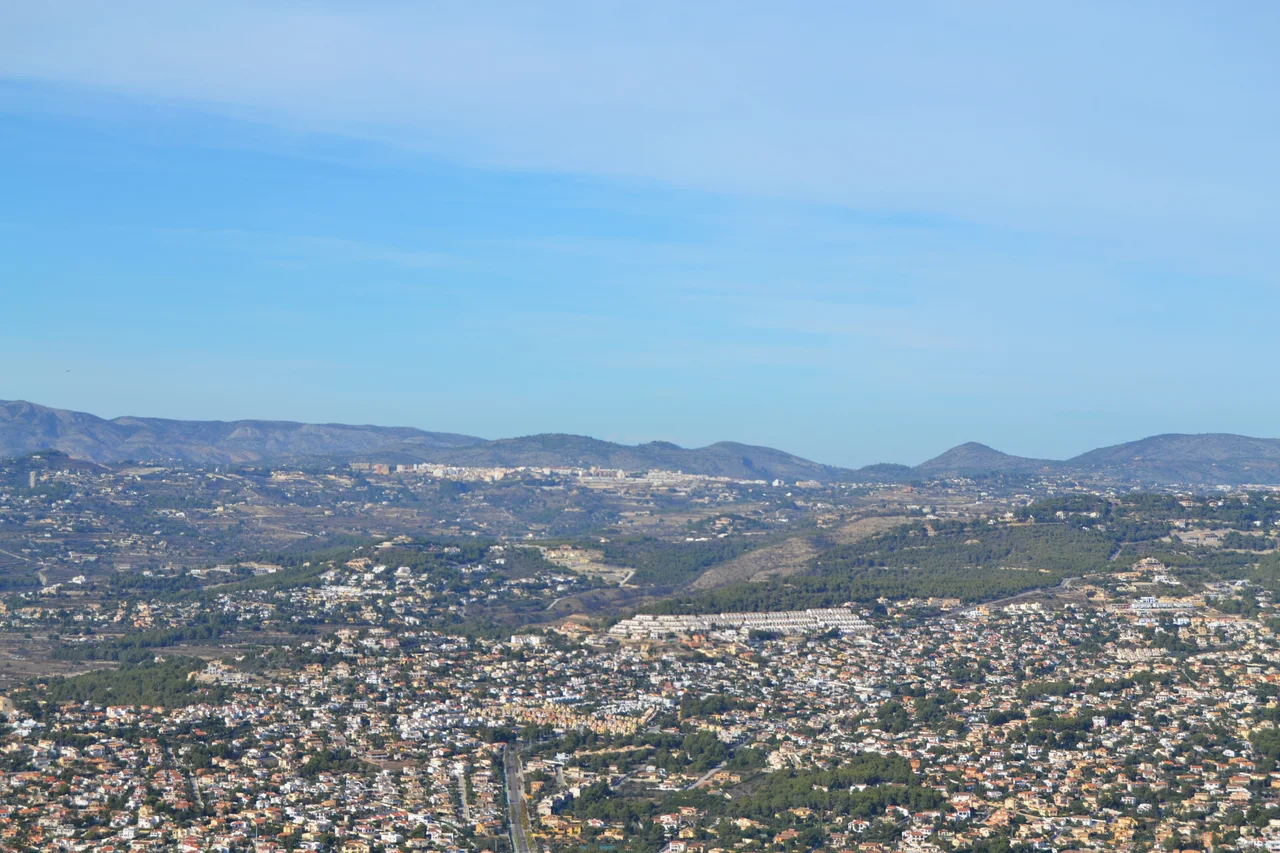

Benissa
Benissa is a town of some twelve thousand souls, and it has a cathedral. Not officially, the great Neo-Gothic church at its heart holds no bishop and carries no such title, but the people of the Marina call it the Catedral de la Marina all the same, and standing in its shadow you see why. Its stone spires rise absurdly, gloriously out of proportion to the small hill town around them, visible from the vineyards and the coast road long before the streets themselves come into view.
The Cathedral That Isn't
The church anchors a medieval centre that Benissa has kept remarkably intact. Narrow streets wind between houses whose doorsteps open straight onto the paving, their plain fronts hiding internal courtyards and rooms that prove far more spacious than the exterior suggests. Ironwork balconies and carved heraldic shields mark the older buildings, and the Palace of Torres-Orduna, once a noble house, now serves the town as a cultural centre and library. Benissa's Catholic tradition runs deep enough to have supported a Franciscan seminary that trained friars sent out across Spain, a serious religious institution for a town of this size.
Sons of an Older Name
The name itself carries the region's tangled history. Benissa descends from an Arabic tribal name, Beni-Hisa, from the centuries when this was Muslim land. After the Christian reconquest of 1248, settlers arrived from the Pyrenees, Catalonia, and Aragon and moved in among the existing inhabitants, but the population stayed largely Muslim for generations more. That long coexistence ended harshly. In 1609 the last Muslim residents were expelled under royal decree, families uprooted from homes their ancestors had held for centuries, part of a mass expulsion that emptied villages across the kingdom. Even so, the town's Arabic name endured, a quiet monument to the people who were forced to leave.
The Admiral's Four Towns
For much of the Middle Ages Benissa did not stand alone. Together with Altea, Calp, and Teulada it formed a single lordship, and among the lords who held it was Roger of Lauria, the formidable Sicilian admiral who commanded the fleets of Aragon. The arrangement did not spare the town from the sea's dangers. Through the fifteenth and sixteenth centuries North African pirates raided this coast repeatedly, and Benissa's position, set back and up, 254 metres above the water, was as much defence as scenery. It remains one of the oldest towns on the Costa Blanca. That threat shaped everything, from the town's inland perch to the watchtowers strung along the coast below.
A Coast Held at Arm's Length
Benissa owns roughly four kilometres of shoreline, yet the town keeps its distance from it, perched inland among terraced vineyards and palm trees while its beaches lie a drive downhill. That coast, the Benissa Costa, is a string of cliff tops and small coves, La Fustera, Baladrar, Cala l'Advocat, linking the resort towns of Moraira and Calp. Old finques, the region's country estates, sit on wide plots among the vines with the Mediterranean glinting far below. It is a landscape that rewards those willing to trade a beachfront address for a view of the whole sea. Reaching the town is easy enough today: it sits just off the A-7 motorway and the old N332 coast road, about seventy kilometres from Alicante's airport, and it keeps its own stop on the Alicante TRAM, the narrow-gauge line that threads the Costa Blanca by way of Benidorm. For four years, from 2016 to 2020, the trains fell silent while the line was rebuilt, but the carriages run again now, carrying day-trippers up from the beaches to the hill town above.
Moors and Christians, Every June
Benissa keeps its history alive by staging it. In January the Fira i Porrat de Sant Antoni fills the streets with a medieval fair. Late April brings the Festes Patronals de la Purissima Xiqueta, honouring the town's patron saint with concerts, processions, bull-running, and sport. And at the end of June comes Moros i Cristians, the pageant of Moors and Christians in which townspeople re-enact the very battles that decided who would rule here six and seven centuries ago, the long conflict that gave Benissa both its name and its faith.
From the Air
Benissa sits inland at 38.72 degrees north, 0.05 degrees east, 254 metres above the Costa Blanca between Calp and Moraira; from the air, find the outsized Neo-Gothic church rising from the compact old town, with terraced vineyards spreading around it and the coastline a few kilometres east. A gentle pass at 2,500 to 4,000 feet frames the town against the sea and the mountains behind. Alicante-Elche (LEAL) lies about 70 km southwest; Ibiza (LEIB) is east across the water. Coastal haze is common on summer afternoons.
Nearby Stories
- Killing of Lasa and Zabala 6.2 km away
- Monastery of Aguas Vivas 7.3 km away
- Cocentaina 7.9 km away
- Cueva de Bolomor 37 km away
- Es Vedrà 45 km away
- Mutxamel bombing 55 km away
- Cala d'Albarca 58 km away
- Battle of Cape Cherchell 221 km away