
Cueva de Bolomor
Someone banked a fire on this ledge a quarter of a million years ago, and the ash is still here to prove it. High on a cliff above the Valldigna valley, with a view stretching to the coast and the town of Cullera, the Cueva de Bolomor holds fifteen ancient hearths, some of them deliberately ringed with stone. They belong to Neanderthals and the earlier humans who came before them, people who lit fires, cooked their meals, and looked out over the same green valley you can see today. Few places let you stand so close to the daily life of the deep past.
A Ledge Above the Coast
Bolomor sits in the La Valldigna valley, hemmed by the eroded ridges of the Les Creus range to the north and the Monduver range to the south, where the land opens eastward toward a marshy, dune-fringed coastal plain. The cave is a karst hollow perched about a hundred meters up the right side of a cliff, though what survives today is more a rock shelter than a cave, roughly thirty-five meters long and twenty deep. It was once far larger, until its dome collapsed, probably shaken down by an earthquake. Its mouth still overhangs the valley, framing the coastline and Cullera in the distance, the same view its inhabitants would have known.
Fires a Quarter-Million Years Old
The most human thing at Bolomor is its fireplaces. Archaeologists are studying fifteen hearths here, ranging in age from roughly 250,000 to 100,000 years old, and some were lined with stone, a small act of design that turns a fire into a fixed home. Fire was used habitually, not by rare accident, which puts Bolomor among the sites that document one of the great thresholds in human life: the moment our ancestors made warmth, light, and cooked food a routine part of living. To ring a hearth with stones is to plan, to return, to expect a tomorrow in the same place. These are the fingerprints of people making a home.
Elephants Up the Cliff
The people of Bolomor ate remarkably well and worked remarkably hard for it. Their diet ran across ungulates of every size, tortoises, and birds, and throughout the long occupation they ate young elephants, every carcass hauled up that steep hundred-meter slope to the shelter. Stranger still are the rabbits. Their cut-marked bones turn up often here, and small, fast prey like that is unusual for the Middle Pleistocene, hinting at a resourcefulness that sets this place apart. Catching a rabbit takes a different kind of cleverness than bringing down an elephant, and the people here seem to have mastered both.
Reading Time in the Dirt
What makes Bolomor extraordinary is not a single spectacular find but its depth in time. Archaeologists have identified seventeen distinct layers stacked within the shelter, laid down between roughly 350,000 and 120,000 years ago, with three main pulses of occupation: one around 350,000 years past, another between 200,000 and 150,000, and a last near 120,000. Each band of sediment is a slice of a different world, its climate, its animals, and its people subtly changed from the layer below. To dig here is to turn the pages of an enormous, slow book, written not in words but in ash, bone, and chipped stone. Few sites in Europe preserve so long and so legible a record of how our distant relatives actually lived, generation after generation, in one place they kept coming back to.
The People in the Bones
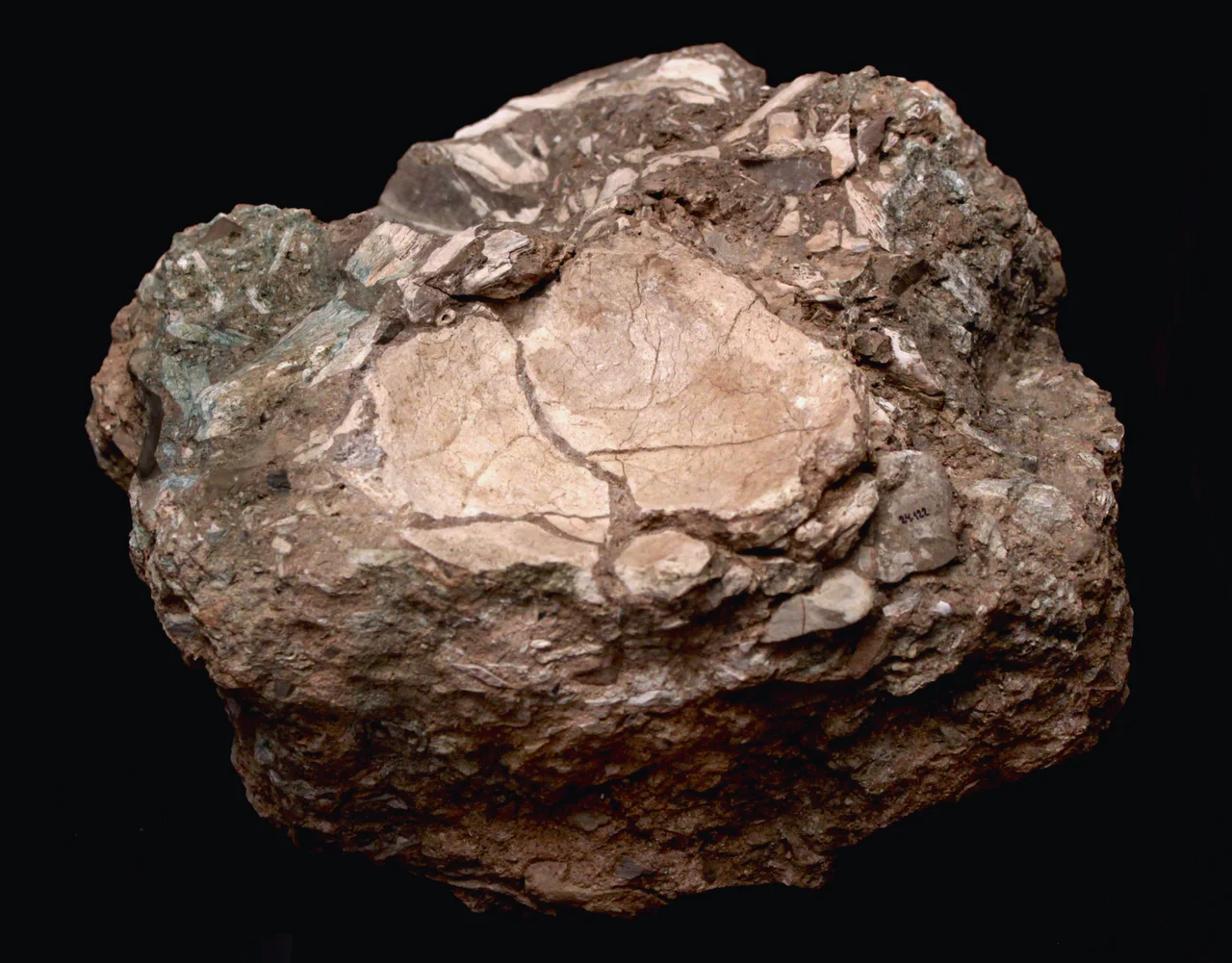
Since digging began in 1989, four Neanderthal remains have surfaced from the layers: a fragment of a fibula, two teeth, and a nearly complete parietal bone from the top of an adult's skull. The thickness of the fibula's bone marks it as belonging to a non-modern human, a cousin on the human family tree rather than one of us. Their toolmaking is legible in the stone too. They favored flake production over the older tradition of large handaxes and rarely used the sophisticated Levallois method, placing Bolomor at a transition between the ancient Acheulean way of life and what came after. Excavated for thirty days every year and now held in the Prehistory Museum of Valencia, the site keeps offering up the same quiet revelation: these were people, and this was their home.
From the Air
Cueva de Bolomor lies at 39.0598 N, 0.2499 W on a cliff in the La Valldigna valley near Tavernes de la Valldigna, in the Valencian Community south of Gandia. From the air the setting is the key landmark: a broad valley boxed between the Les Creus and Monduver ranges, opening east toward the coast near Cullera, with the site set about a hundred meters up a karst cliff face on the valley's flank. Best viewed at 1,500 to 3,000 feet; the cave itself is small and tucked into the rock, so navigate by the valley, the ridgelines, and the nearby coastline. Valencia (LEVC) is the nearest major airport, about 50 km north; Alicante-Elche (LEAL) lies to the south. Clear light gives the sharpest read of the cliff and the surrounding hills.
Nearby Stories
- La Tomatina 9 km away
- Cova de les Dones 9.2 km away
- La Bastida de les Alcusses 9.2 km away
- Taifa of Dénia 11 km away
- El Cabanyal 17 km away
- Illa Grossa 65 km away
- Illa de s'Espartar 75 km away
- Capture of the galleon Lion Couronné 89 km away