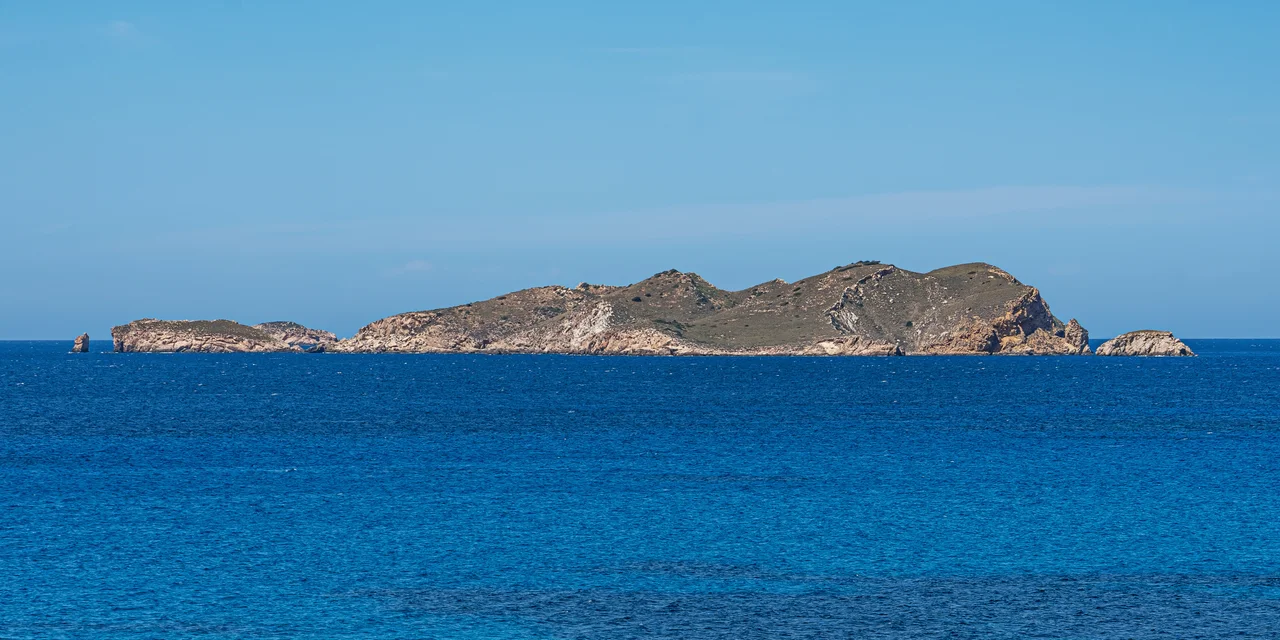

Illa de s'Espartar
Long after the last ferry wake has flattened and the day boats have turned back toward Sant Antoni, a sound returns to this bare rock offshore - a low churring, purring call, traded between birds no larger than a swallow. European storm petrels spend nearly their whole lives over open water, coming to land only to breed, and only under cover of darkness. Illa de s'Espartar shelters the largest colony of them in the entire western Mediterranean. They arrive at night for a reason. By day, this island belongs to hunters.
The Night Shift
A storm petrel weighs almost nothing, and it nests in cracks and burrows where a wingtip's worth of shelter is enough. Slipping ashore in darkness lets the colony dodge the gulls that patrol the daylight and the falcons that own the summer sky. Those falcons are Eleonora's falcons, a Mediterranean specialist that breeds unusually late in the year, so its chicks hatch just as millions of small migratory birds stream south across the Mediterranean each autumn. s'Espartar hosts a colony of these falcons too, along with cormorants and red-billed gulls wheeling over the swell. The result is a single island running two shifts - predators by day, petrels by night - a rhythm set entirely by light and hunger. Nothing about it is arranged for human convenience, and that is exactly why it works.
A Lizard of Its Own
Sun-warmed and skittering across the stone is a creature found on this islet and almost nowhere else: a distinct subspecies of the Pityusic wall lizard, catalogued by biologists as Podarcis pityusensis kameriana. The rocks scattered off Ibiza's coast work like a natural laboratory, each isolated islet nudging its lizards down a slightly different evolutionary path - shifts in size, in scale pattern, in the blues and greens that flare across their flanks. Cut a population off long enough and it becomes unmistakably, measurably its own. Here the lizards share the ground with endemic beetles and snails, small lives that exist on this rock and no other. It is a useful reminder that isolation is not emptiness. Given enough time, a lonely island simply invents its own inhabitants.
Named for the Grass
The island's name comes from espart - esparto grass - the tough, wiry plant that once carpeted much of this land and that people across the Pityusic islands harvested for rope, mats, and baskets. Little of that trade survives, but the grass gave the rock its identity. The soil is thin and arid, yet it still supports 131 recorded species. Among them grows one of the Mediterranean's genuine botanical rarities: Medicago citrina, a woody, tree-like relative of alfalfa that clings to a handful of islets and sits on the international red list of threatened species. Rosemary, thyme, and rue crowd the crevices, releasing their oils into the heat, while rabbits browse whatever green they can reach. For a place with almost no fresh water, s'Espartar is improbably, stubbornly alive.
Kept Wild on Purpose
No one lives on Illa de s'Espartar, and that is the whole point of it. The rock lies roughly eight and a half kilometres west of Sant Antoni de Portmany, one of the cluster of western islets - the Illots de Ponent - protected together as a nature reserve. Landing is difficult and discouraged, because the island's value lies precisely in being left alone. The whole cluster is closed to casual visitors for a reason: a single introduced predator or a careless season of disturbance could undo colonies that took thousands of years to establish. From a passing boat it reads as a low, pale hump against the horizon, easy to mistake for just another Balearic outcrop with nothing to say. But the fuller story is written after dark, when the petrels feel their way back to burrows on a place that has been kept quiet enough for them to keep returning, season after season, as they have for far longer than anyone has been watching.
From the Air
At 38.9587 N, 1.1958 E, Illa de s'Espartar sits about 8.4 km off Ibiza's west coast and roughly 12 km northwest of Ibiza Airport (LEIB). From 1,500-3,000 ft it reads as a pale, isolated hump of rock west of Sant Antoni's bay, one of a string of western islets (Illots de Ponent) that includes the far more dramatic pinnacle of Es Vedra to the south - a useful visual anchor. Arriving from the Spanish mainland and Alicante-Elche (LEAL), some 150 km east across open water, these islets are among the first land to break the horizon. It is a protected reserve, so hold altitude and give the seabird colonies a wide, quiet berth. Best light and visibility come in calm morning air, before the afternoon sea breeze builds.
Nearby Stories
- Cape Sant Antoni, Spain 46 km away
- Penyal d'Ifac Natural Park 55 km away
- Andratx 71 km away
- Illa Grossa 78 km away
- Puig de sa Morisca Archaeological Park 89 km away
- Calpe 103 km away
- Santa Ponsa 113 km away
- Battle of Cape Cherchell 200 km away