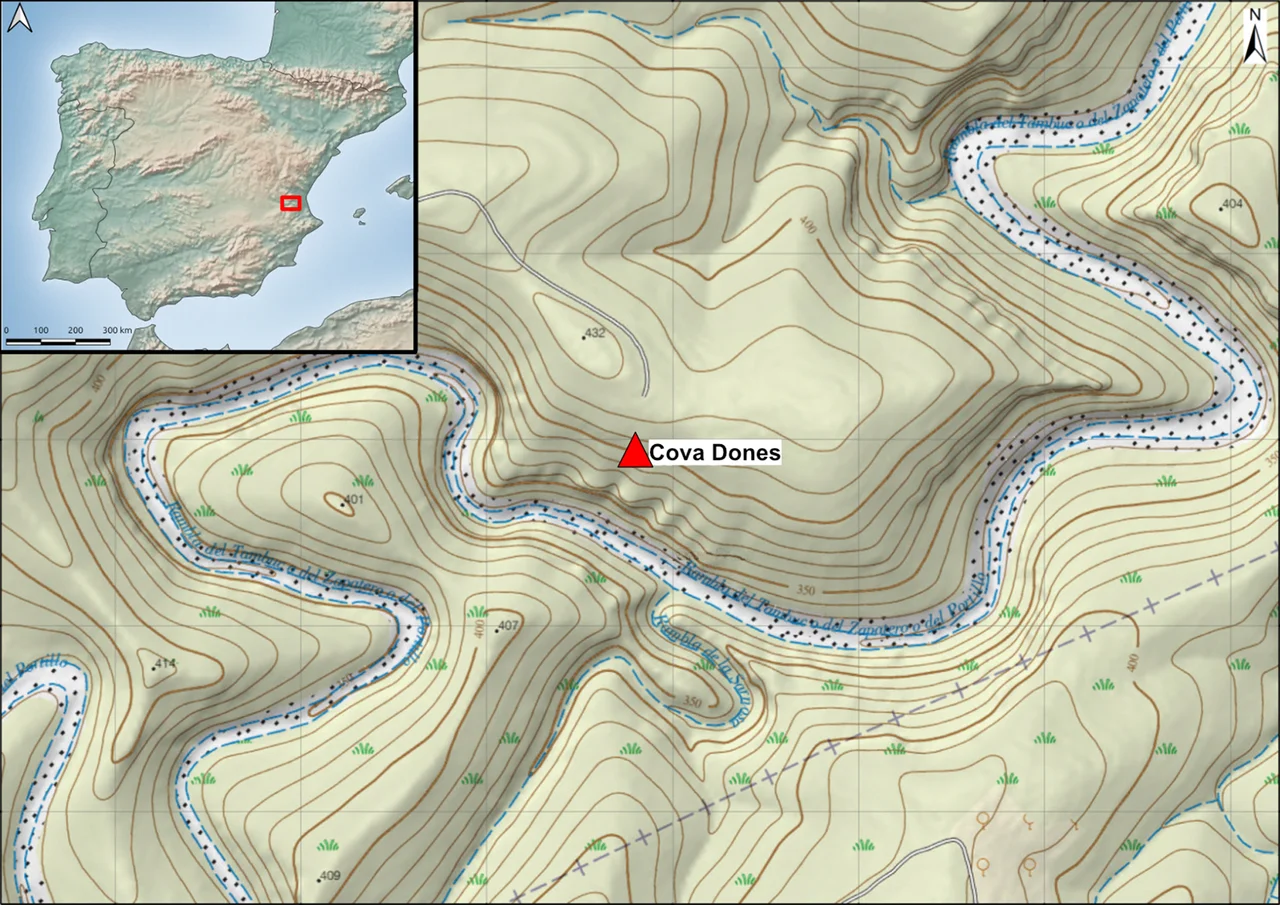

Cova de les Dones
Five hundred meters inside a cave near the Valencian town of Millares, on a wall far beyond the reach of daylight, someone once dragged their fingers through soft red clay. The grooves are still there. So is something pressed over them — the claw mark of a cave bear. Because that animal's kind vanished from Europe some 24,000 years ago, in the depths of the last Ice Age, the human fingermarks beneath must be older still. Cova de les Dones, the "Women's Cave," had guarded that secret in absolute blackness for hundreds of centuries, and almost no one knew it was there.
Older Than the Bears
Most of the art here is abstract — rectangles, lines, and the sinuous tracks called finger fluting, made by drawing fingertips down a soft surface. Such tracings are notoriously hard to date, but these are old enough to have grown a patina, and in one striking case old enough for a cave bear to have clawed across the top of them. Among the geometry live nineteen animals: seven horses, a pair of aurochs, eight deer — seven slender hinds and a single stag — and two others too worn to make out. When the archaeologists studied the aurochs and the horses, the styles pushed at least some of the images back before the Magdalenian, deep into the Ice Age when much of Europe lay under glare and cold.
Painted With Bare Hands
Almost everything here was made with the body itself. Fingers and palms were pressed and trailed across the stone, with only the faintest evidence of sharpened tools. The favorite medium was red clay, present in more than eighty of the surviving works and scooped from at least twenty-eight separate cracks in the rock. In places the gesture survives as a single fluid motion — a hand digging clay from a fissure, then dragging it along the wall to finish a figure. The painters also used moonmilk, a soft white mineral paste, to shade their designs, a technique unknown anywhere else in Iberian cave art and rare across all of prehistory. It is startlingly intimate work. Stand before it and you can almost feel the wet stone yield under a stranger's palm. Whoever they were, they returned again and again to these deep galleries, far past the last reach of daylight.
A Map Redrawn
For a long time, the story of Ice Age art in Spain belonged to the north — the famous Franco-Cantabrian caves near the Atlantic coast. Cova Dones has redrawn that map. A cave on the Mediterranean side of Iberia turns out to hold one of the richest bodies of Paleolithic art in the entire eastern half of the peninsula, which is exactly why the discovery matters so much to the field. The Spanish botanist Antonio José Cavanilles first noted the cave in 1795. A dig in 1960 turned up Iron Age remains. Yet the paintings themselves went unrecognised until 2021, when researchers spotted a mere four of them. By 2023 the archaeologists Aitor Ruiz-Redondo, Virginia Barciela and Ximo Martorell had counted more than a hundred and ten. That number places the site among the most important Paleolithic discoveries anywhere in Europe this century, and the researchers argue that finding art so far from the northern caves reshapes the whole picture of Ice Age Iberia.
Broken Stalagmites and a Roman Coin
The deeper the team pushed, the stranger the cave grew. In 2024 they identified speleofacts — stalagmites deliberately snapped and rearranged by human hands. More than a hundred have now been catalogued, their broken ends resealed by slow calcite growth that vouches for their great age; some may echo the mysterious 175,000-year-old structures in France's Bruniquel Cave. Then, in 2025, two hundred meters from the entrance, came a jolt from a far more recent past: dozens of Roman inscriptions and a coin of the emperor Claudius, tucked into a hollow in the ceiling beside a stalactite. Whoever wedged it there walked the same lightless corridors as the Ice Age painters, thousands of years after them — drawn, like them, into the dark for reasons we can only guess.
From the Air
Cova de les Dones opens in rugged limestone country near Millares, at roughly 39.177°N, 0.769°W, inland and west of the city of Valencia. The cave itself is underground and invisible from the air, but the surrounding landscape is a landmark in its own right — the deep gorges and canyons of the Júcar (Xúquer) river system, where pale rock walls fold through pine-covered hills. Best appreciated from 4,000–7,000 ft, with the small white town of Millares marking the site. Nearest major airport is Valencia (LEVC), about 55 km to the east-northeast. Clear inland light is common, though the canyon shadows deepen quickly in late afternoon.
Nearby Stories
- La Bastida de les Alcusses 7.7 km away
- Monastery of Santa Maria de la Valldigna 8.6 km away
- City of Arts and Sciences 8.8 km away
- La Tomatina 9.2 km away
- Taifa of Dénia 19 km away
- Castle of Alarcon 61 km away
- Castle of Belmonte 122 km away
- 2011 Lorca Earthquake 129 km away