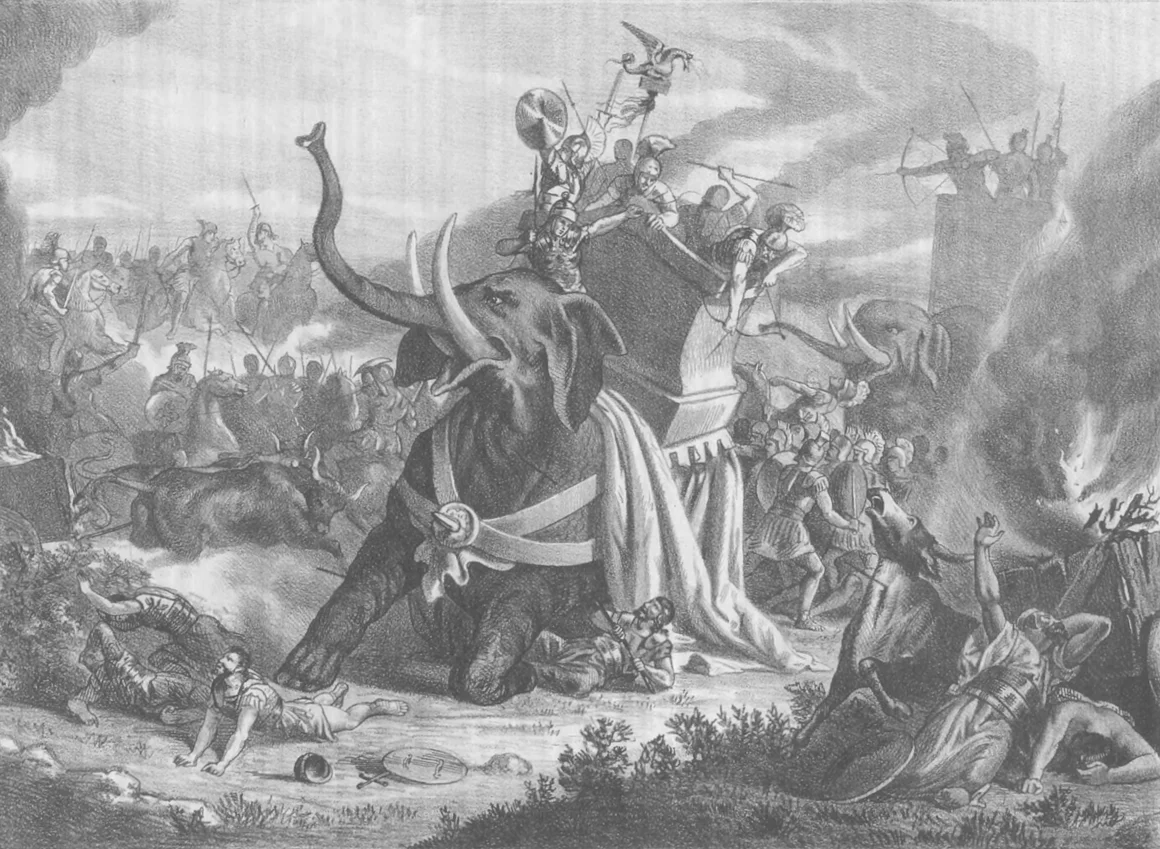

Battle of Helike
The oxen came on with fire streaming from their horns. According to the ancient accounts of the Battle of Helike, the Iberian leader Orissus turned the beasts loose against the Carthaginian vanguard, blazing vines or burning wagons driving the terrified animals straight into disciplined ranks that had never trained for such a thing. The lines broke. In the chaos that followed, one of the most formidable commanders of the age went down, and the man who died that day in inland Iberia was no minor officer. He was Hamilcar Barca, the general who had nearly won the First Punic War for Carthage and whose sons would carry his ambitions to the gates of Rome itself.
A General's Long Game
Hamilcar Barca had come to Iberia to rebuild an empire. Carthage had lost the First Punic War to Rome and, with it, Sicily and a crushing indemnity. Rather than accept decline, Hamilcar crossed to the Iberian Peninsula in 237 BC and began carving out a new power base among its silver mines and warlike tribes, a campaign later historians would call the Barcid conquest of Hispania. For roughly a decade he pushed inland, subduing peoples and gathering the wealth and manpower his family would need. By 228 BC his reach had extended deep into the eastern interior. It was there, far from the coast, that his long project ran into a wall.
The Siege at Helike
Hamilcar laid siege to the town of Helike. Its defenders were not alone for long. Orissus, chieftain of the Oretani, marched to their relief with warriors from other allied peoples, the kind of shifting coalition that made the Iberian interior so dangerous to any invader who assumed a single victory would settle matters. Where exactly this drama unfolded remains disputed. The evidence points inland, to the eastern peninsula, and the likeliest candidate is the town of Elche de la Sierra in the province of Albacete, in the rugged uplands where the Segura River gathers its early waters. The precise ground has been lost, but the outcome was remembered.
Fire and Deception
The Iberians won by cunning as much as courage. By some accounts Orissus first approached the Carthaginians as though he were coming to join them, an ally rather than an enemy, lulling their commanders into confidence. Only when the battle opened did the trap spring shut: the burning ox-drawn chariots hurtled into the Carthaginian front, scattering the vanguard and opening gaps that Orissus and his men poured through. It is one of the oldest tricks in the ancient repertoire, weaponizing the panic of animals, and against a professional army it worked with devastating effect. The Iberian troops carried the field.
The Death of a Dynasty's Founder
Hamilcar Barca died in the fighting, though exactly how has never been pinned down. The tradition holds that he succumbed to wounds taken in the battle; other threads of legend wrap his end in the same story of the flaming beasts loosed by an alliance of towns. However he fell, his death did not end the Barcid dream, it deferred it. His sons Hannibal and Hasdrubal inherited both his army and his grievance against Rome, and within a generation Hannibal would march elephants over the Alps in the war his father had spent his last years preparing. A quiet town in the sierras of Albacete, its identity still half-uncertain, holds the memory of where that chain of events took one of its strangest turns.
From the Air
The most probable site lies near 38.38 degrees N, 1.28 degrees W, in the mountainous interior of Albacete province around Elche de la Sierra, in the upper watershed of the Segura River. This is folded limestone country, ridges and dry valleys dotted with small whitewashed towns rather than any single dramatic landmark, so navigate by the town clusters and the winding river courses of the Sierra del Segura. A viewing altitude of 4,000 to 7,000 feet above the terrain gives the best sense of the rugged relief that made this interior so defensible. The nearest airfield is Albacete-Los Llanos (LEAB) to the north-northeast; Region de Murcia International (LEMI) lies to the southeast and Alicante-Elche (LEAL) further east toward the coast. Clear, dry days are common inland.
Nearby Stories
- Monte Arabí 5.3 km away
- Castle of Banyeres 6.2 km away
- Agost 6.5 km away
- La Fonteta Phoenician Port 6.7 km away
- Al-Andalusian Palatial Complex of San Esteban 19 km away
- Castle of Alarcon 101 km away
- Castle of Belmonte 151 km away
- Cabo de Gata-Nijar Natural Park 154 km away