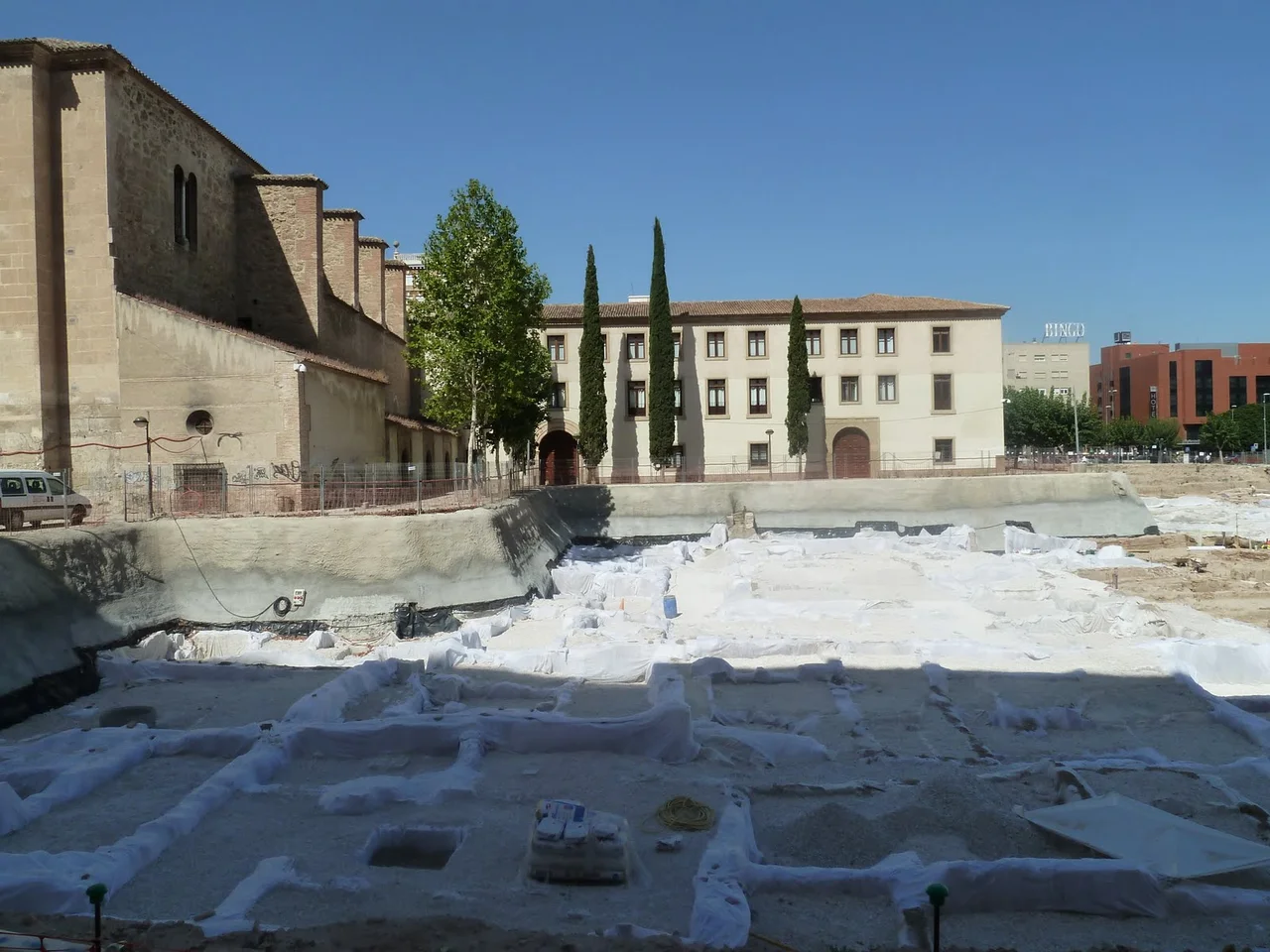

Al-Andalusian Palatial Complex of San Esteban
The city wanted a car park. What it uncovered instead, in the old Garden of San Esteban, was a neighborhood that had been asleep for seven centuries. Beneath the surface of central Murcia lay more than 10,000 square meters of an Islamic quarter: streets and courtyards, houses and gardens, and a corner set aside for the dead. It is one of the largest windows ever opened onto the daily life of medieval al-Andalus in this region, and its discovery would set off a fight between concrete and memory that spilled into the city's own streets.
A Suburb of Gardens
In its own day this was the Arrabal de la Arrixaca Nueva, an outlying suburb of the walled medina. The word arrabal covers everything from outskirts to slum, but the reality here was leafier than that suggests. The land was dotted with almunias, country residences set among agricultural holdings and lush recreational gardens. As the excavation revealed, that pattern reached back at least to the twelfth century, spreading outward from the medina's walls along the roads leading out of town. The houses themselves followed the classic Islamic plan: a planted central courtyard, the main room set to the north, and an entrance that turned a corner before reaching the interior, so that no passerby could see straight into the home. Underneath ran something Murcia would not have again for a long time, a network of drains connected to a public sewer.
When the Sewers Went Silent
That buried plumbing is one of the site's quiet revelations. The Islamic city managed its wastewater through a coordinated system of drains, a piece of urban infrastructure that fell out of use after the Christian conquest. Murcia, the archaeologists note, would not recover public sewerage until well into the twentieth century. The houses tell a subtler story too. Judged purely as buildings, they are of medium construction, no grander than plots dug elsewhere in the city. Their value lies in scale and completeness, the chance to read a whole quarter at once, including a religious sector in the northwest corner with a burial ground and, most likely, a small mosque serving the neighborhood at the end of the thirteenth century. Read together, the streets, the drains, and the graves amount to a rare full portrait of a medieval quarter, the ordinary fabric of a life rather than a single grand monument.
Conquest and Departure
The neighborhood's life was reshaped by conquest. In 1243, Ferdinand III of Castile made Murcia a protectorate, and Christian settlers began pouring in from across the Iberian Peninsula, encouraged as a loyal base. The pressure told. A Muslim revolt broke out in 1264 and was put down by James I of Aragon in 1266, who brought still more settlers with him. Alfonso X of Castile ordered the local Muslim population moved into the Arrixaca suburb as Christian settlers took over the former medina. These were families with homes, workshops, and gardens of their own, displaced within their own city, and the excavated quarter is in part a record of the lives they left behind.
The City That Embraced a Ruin
Seven centuries later, the site nearly vanished a second time. The city hall had planned an underground car park exactly where the ruins came to light. In November 2009, some 300 artists and writers gathered in the Plaza Mayor and issued a Manifesto for San Esteban. A Facebook group in defense of the site drew more than 20,000 members within days. A university professor convened Sunday gatherings, forming a human chain around the ruins under the slogan Abraza San Esteban, embrace San Esteban. In December, roughly 5,000 people marched from the city hall to the site. The pressure worked: the car park was abandoned, and the remains were slated to become a protected cultural asset, held for the city that had refused to pave over its own past.
From the Air
Coordinates 37.99 N, 1.13 W in the center of Murcia, beside the Palacio de San Esteban and a short walk from the cathedral and the River Segura. The excavated quarter sits below street level and is best appreciated on the ground, but from the air the dense historic core along the Segura, crowned by the cathedral's bell tower, marks the district. Fly at 1,500 to 3,000 feet in clear conditions. Nearest airports: Region de Murcia at Corvera (LEMI), Murcia-San Javier (LELC), and Alicante-Elche (LEAL).
Nearby Stories
- Siege of Guardamar 5.5 km away
- Bajo de la Campana Phoenician Shipwreck 6.4 km away
- Battle of Helike 7.8 km away
- Agost 14 km away
- Mazarrón 23 km away
- Cabo de Gata-Nijar Natural Park 116 km away
- Castle of Alarcon 139 km away
- Alcazaba of Almería 149 km away