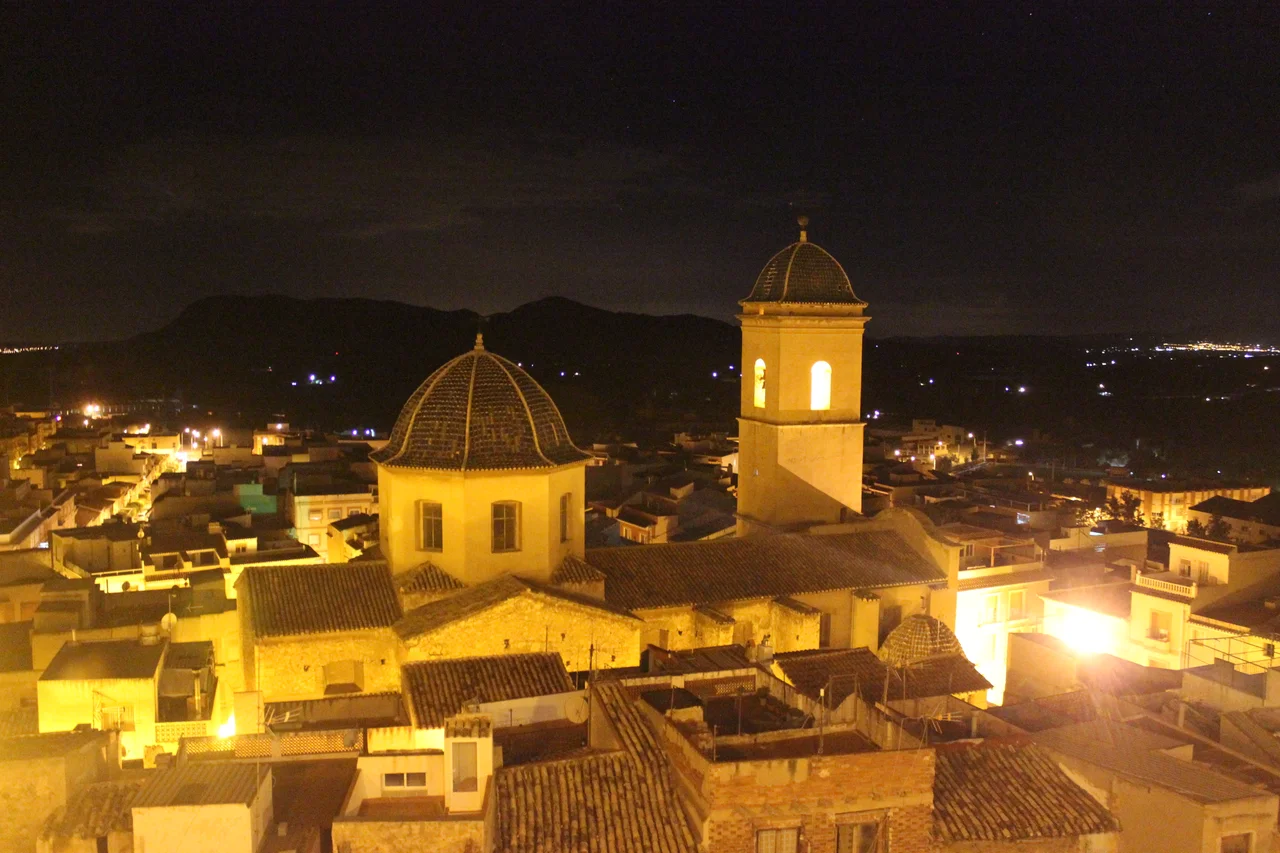

Agost
There is no ice in it and no machinery, nothing but baked earth and a pinch of salt, and yet the water inside stays cool through the fiercest Alicante afternoon. The clay jug is called a botijo, and no town in Spain makes more of them than Agost. Set eighteen kilometers inland from the capital, far enough from the coast that the tour buses never found it, this small town of some 5,200 people has turned the ground beneath its feet into a livelihood for centuries. The trick lives in the clay itself.
The Physics of a Clay Jug
A botijo works by sweating. Fired at the right temperature, the local clay stays faintly porous, so a thin film of water seeps to the outer surface and evaporates in the dry heat. Evaporation pulls warmth away, and the water still inside drops several degrees below the air around it. Agost's version is prized for a reason beyond its shape: the clay here fires to a pale, almost white finish, and a small measure of salt worked into the mix gives it particular qualities. The jugs are hand-turned and baked in Moorish-style kilns, the same way they have been for generations. Farmers carried them into the fields for centuries, and the design that cooled a laborer's water in 1700 still does the job on a modern terrace today, refrigeration or no. There is even an art to drinking from one. The practiced way is to hold the botijo high and tip a thin arc of water toward your open mouth without ever touching the spout with your lips, a communal skill that let a whole work crew share a single jug in the field.
Why the Clay Is Here
None of this would exist without geology. Just outside the town lie rich deposits of clay, the raw material that pulled Agost toward pottery in the first place and held it there. The craft is old, reaching back before the 17th century, but its great boom came at the turn of the 20th, when Agost's white wares were shipped across the Mediterranean to North Africa and to the south of France. At its height the town supported a dense cluster of workshops. Many have since fallen silent, but eleven potteries still operate, and six of them continue to turn out traditional wares by hand. That persistence matters in a country where industrial ceramics long ago undercut the village kiln. In Agost the craft never became a museum piece, even as the town also built an actual museum to honor it.
Layers of Settlement
People have been reading this landscape for a very long time. The Iberians settled here first, and the Moors followed, raising a castle on the hilltop at the center of town that now stands in ruins above the rooftops. After the Reconquista the town belonged briefly to the Crown of Castile before being folded into the Kingdom of Valencia in the late 13th century, and it finally won municipal autonomy in 1705, breaking away from Alicante's jurisdiction. Each of those rulers came and went, but the clay outlasted all of them, and so did the potters who knew what to do with it.
A Town the Coast Forgot
Distance has been Agost's quiet good fortune. Because it sits away from the beaches, mass tourism never swept through, and the town kept its own identity, its economy still resting on ceramics and agriculture rather than sunburn and souvenirs. In late winter the surrounding almond groves break into pale blossom, a brief snowfall of petals across the hills. To understand the rest, visit the pottery museum. It fills a ceramics factory that opened in 1902 and fell silent in 1975; a German ethnologist, Ilse Schütz, founded the museum inside it in 1981 and ran the place for nineteen years before the town council took it over. The factory's Arab-style kilns and clay-settling basins survive intact, and the shelves hold more than four thousand five hundred pieces gathered from Agost and across Spain. It is a working town's tribute to the humble jug that made its name.
From the Air
Agost lies inland at 38.44°N, 0.64°W, about 18 km northwest of Alicante at the foot of low hills. From 3,000-5,000 feet, look for the compact town wrapped around a low central hill topped by its ruined Moorish castle, with pale almond and clay-country terrain spreading out around it and, in late winter, groves flushed white with blossom. Alicante-Elche Airport (LEAL) sits roughly 25 km southeast toward the coast; Región de Murcia (LEMI) lies farther south. The dry inland air of the Alicante hinterland gives long, clear visibility, though summer afternoons can bring haze and thermals off the baked ground.
Nearby Stories
- Barxell Castle 2.1 km away
- Benissa 6.5 km away
- La Fonteta Phoenician Port 12 km away
- Fonda Milagros Nightclub Fire 18 km away
- Battle of Helike 20 km away
- Cerro de los Santos 20 km away
- La Muralla Roja 26 km away
- Battle of Cape Cherchell 238 km away