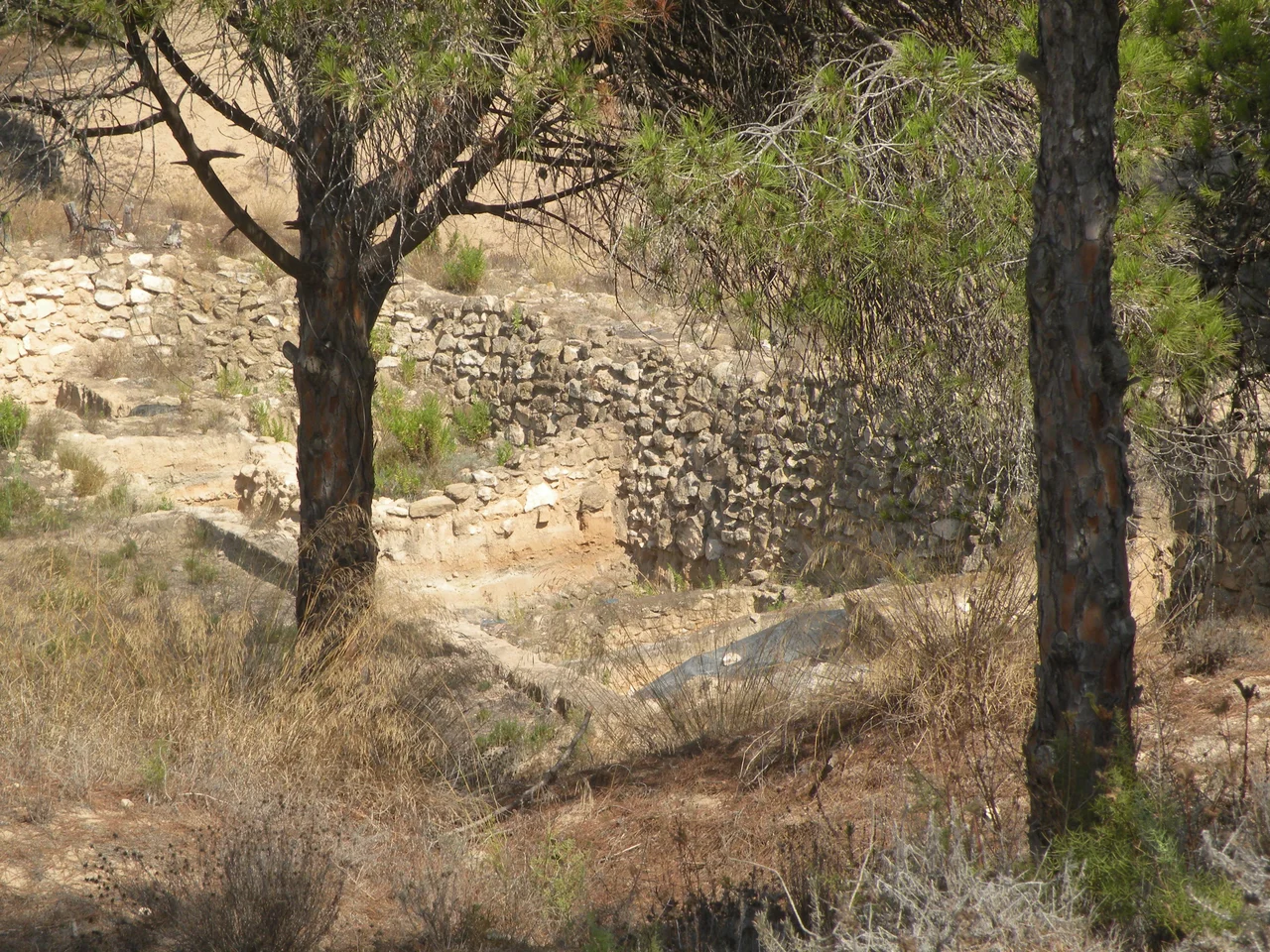

La Fonteta Phoenician Port
The sand that swallowed La Fonteta is also the reason we can still read it. Sometime after the sixth century BC, this Phoenician port at the mouth of the Segura River was abandoned, and the shifting coastal dunes of what is now Guardamar del Segura crept over its streets and walls. For more than two thousand years the sand held everything in place, sealing the city against weather, plunder, and rebuilding. When archaeologists finally dug down, they found not a scatter of foundations but one of the largest and best-preserved Phoenician cities in the whole western Mediterranean, a merchant town frozen at the moment its people walked away.
The Sand That Kept Its Secrets
Most ancient cities suffer the fate of being useful. Later generations quarry their stone, plow their fields, and build new towns on old bones, until little survives above the footings. La Fonteta escaped that cycle. Once the dunes buried it, no medieval village or modern resort rose on top to disturb the ruins beneath. The result is a rare completeness. Excavators have exposed a settlement large enough to imply an urban area of perhaps eight hectares, with a density of preservation that lets researchers study not just where the Phoenicians built but how they lived. Among the finds is an Egyptian scarab, a small carved beetle amulet that traveled the length of the Mediterranean to end up here, a reminder of how far this little port's connections reached.
A City at the River's Mouth
La Fonteta stood on the right bank of the Segura where the river meets the sea, and it thrived there from the eighth to the sixth century BC. Position was everything. A river mouth gave ships a sheltered anchorage and a road inland; a coastline gave access to the sea lanes that Phoenician traders from the eastern Mediterranean had been extending westward for generations. By the seventh and eighth centuries BC, this was among the most important Phoenician cities anywhere in the western basin, a hub where goods, metals, and ideas from Lebanon and Egypt met the products of Iberia. The town did not merely receive that trade. It helped generate it, sitting astride the exact junction where a river, a coast, and a continent came together.
Astarte's Coast
Near the port stood a sanctuary that likely drew a cult of Astarte, the Phoenician goddess who watched over sailors and the sea. That is no accident of placement. The shrine sat at a point of land crucial to marine navigation, where mariners approaching or leaving the coast would fix their bearings. For people whose lives and fortunes rode on the water, a goddess of safe passage was not a decoration but a necessity. The presence of her cult tells us something about the fears and hopes of the men who worked these routes: every voyage was a gamble, and before setting out they wanted someone on their side who commanded the waves.
Where Two Worlds Met
La Fonteta did not appear in a vacuum. Just inland, at Peña Negra in the Serra de Crevillent, local metalworkers had built a thriving center of Atlantic-style bronze production, and its wealth is exactly what would have drawn eastern Mediterranean traders to this stretch of coast. Bronze, ivory, and glass objects show contact with the Phoenicians beginning as early as the ninth century BC and intensifying in the eighth. In 1983, an expedition led by Alfredo González Prats identified Peña Negra as Herna, a flourishing marketplace named in the ancient poem Ora Maritima where several trade routes converged. Stand at the Segura's mouth and you are standing where the Atlantic world of Iberian metalworkers shook hands with the seaborne world of Phoenician merchants.
From the Air
The site of La Fonteta lies at 38.101°N, 0.650°W, at the mouth of the Segura River in Guardamar del Segura on the Costa Blanca. From the air, look for the dark ribbon of the Segura reaching the sea and, flanking it, the extensive pine-covered coastal dunes of Guardamar, planted in the late nineteenth century to stabilize the sand that once buried the ancient city. The long straight beaches run north toward Santa Pola and south toward Torrevieja's salt lagoons. Recommended viewing altitude 2,500-5,000 ft AGL to trace the river mouth and dune belt. Nearest airport is Alicante-Elche (LEAL), about 30 km north; Región de Murcia International (LEMI) lies about 45 km southwest. Clear coastal visibility is common, though onshore haze can build on humid summer afternoons.
Nearby Stories
- Murder of Miquel Grau 4.2 km away
- Fonda Milagros Nightclub Fire 8.8 km away
- Bajo de la Campana Phoenician Shipwreck 16 km away
- Battle of Helike 21 km away
- Mazarrón 31 km away
- Penyal d'Ifac Natural Park 36 km away
- La Muralla Roja 65 km away
- Battle of Mazagran 211 km away