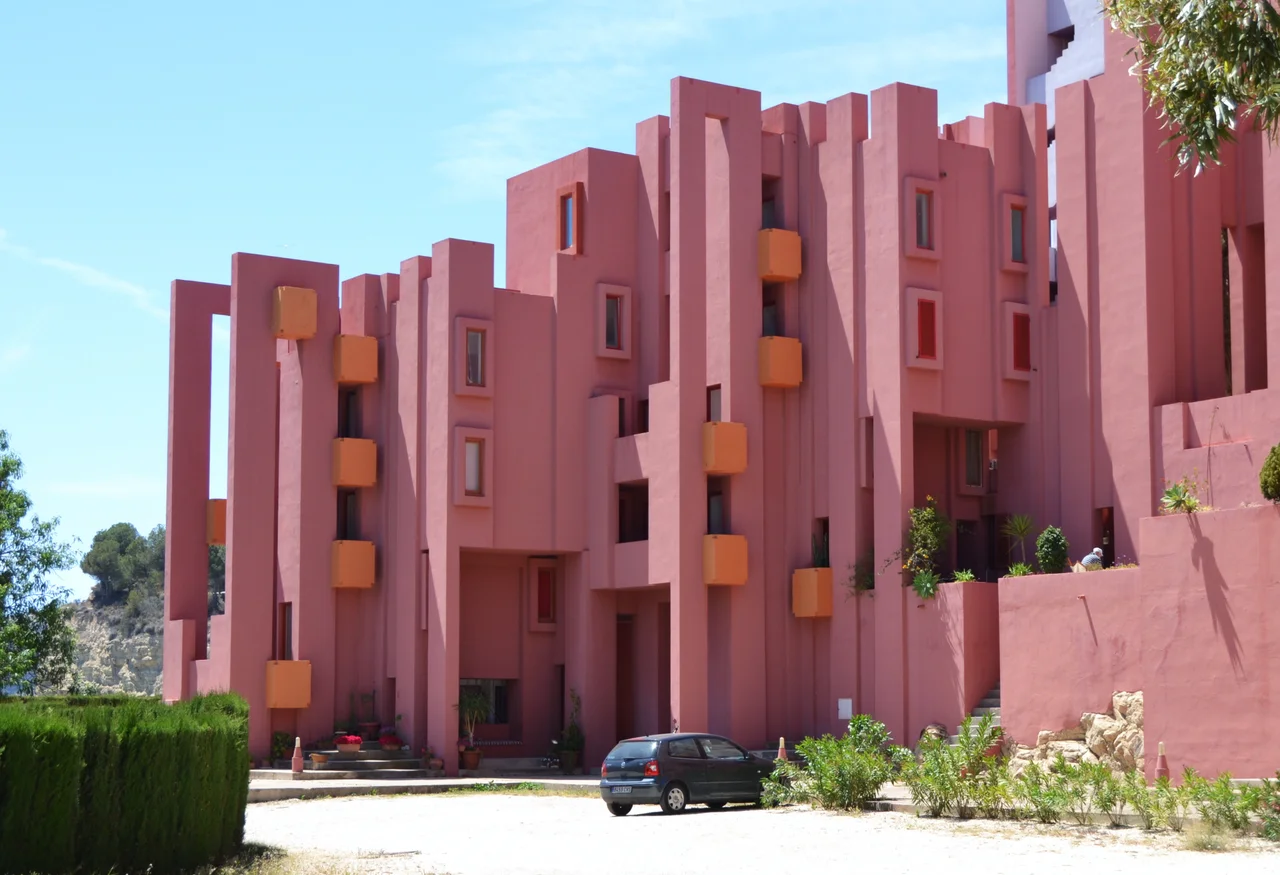

La Muralla Roja
Approach La Muralla Roja from the road and it plays a trick on the eye. There is no obvious front door, no clear top or bottom, no single facade, only a dense stack of walls washed in crimson, rose, and dusty pink, with staircases that seem to climb into the sky and stop. The name means the Red Wall. Standing beneath it on a Calpe hillside you grasp the fortress reference at once, a fortress with no enemy but the sun, even before you learn that its architect built it looking south, toward Africa.
The Casbah Reimagined
Ricardo Bofill designed the complex in 1968, and when he reached for a model he looked not to Europe but across the Mediterranean, to the casbahs of North Africa and the dense, inward-turning architecture of the Arab Mediterranean. La Muralla Roja is his avant-garde answer to them. Instead of corridors it has courtyards, or plazas; instead of a single stairwell it has a web of stairs and bridges that lace every apartment to every other. You can cross the whole building without ever touching the ground, climbing and descending through open-air passages, the sea flashing between the walls.
A Geometry of Crosses
Beneath the drama lies strict order. The plan is built from a Greek cross with arms about five metres long, and thirteen of these crosses are locked together to make the whole. The result holds fifty apartments in three sizes: compact studios of around sixty square metres, two-bedroom homes near eighty, and larger three-bedroom flats of about a hundred and twenty. The massing steps and stacks in a way that nods to brutalism, all hard edges and blunt forms, yet the colour undoes the severity. Roof terraces carry solariums and a swimming pool reserved for residents; a sauna and a restaurant occupy the lower level. Two small shops share that ground floor as well, so that a resident could, in principle, pass an entire day without leaving the walls. On the two lower blocks, which rise only three floors, the homes fold into L-shapes rather than full crosses, a quieter variation on the same underlying idea.
The Colour of the Place
The reds and pinks were a deliberate argument with the landscape, warm tones set against earth and rock and sky so that the building never disappears into its surroundings. Where the staircases turn, the walls cool toward blues and violets, and the effect, especially in hard Mediterranean light, is dizzying. This is why photographers cannot leave it alone. The complex has been ranked among Bofill's ten most iconic works, and its labyrinth of coloured stairs has become one of the most recognisable images in all of modern Spanish architecture.
On the Manzanera Hillside
The Red Wall stands in Manzanera, a hillside urbanisation on the edge of Calpe where Bofill treated the whole slope as a laboratory. Nearby rise two more of his experiments: the dark green tower called Xanadu and the Social Club of the Manzanera. Together they form a small open-air museum of late-1960s architectural ambition, a moment when a young Catalan studio believed that housing could be sculpture and that a stairwell could be a work of art. Residents today live with the consequence, a home so photogenic that strangers arrive daily to point cameras at their front walls. Bofill went on to build far larger and more celebrated works across Europe, yet the Red Wall remains among the most beloved of them, a young studio's manifesto in colour that has outlived the movement it belonged to.
A Home That Went Viral
Completed in 1973, La Muralla Roja has since led a strange double life. It remains what it was designed to be, a working apartment block where people live, hang laundry, and swim on the roof, while also serving the wider world as a backdrop. The intro of a German television show was filmed among its stairs, and the set designers of the Korean series Squid Game drew on its architecture for their own coloured maze. Millions now know the walls without knowing the town they stand in.
From the Air
Set on the Manzanera hillside on the southwest edge of Calpe at 38.64 degrees north, 0.04 degrees east, La Muralla Roja is a small target from the air: look for a block of red and pink against the green slope just inland from the coast, with the Penyal d'Ifac rock a short way northeast. Best appreciated from low level, 1,500 to 2,500 feet, on a slow coastal pass. Alicante-Elche (LEAL) is roughly 60 km southwest; Ibiza (LEIB) lies east across the sea. Midday sun makes the colours most vivid.
Nearby Stories
- Canelobre Cave 9.7 km away
- Monastery of the Corpus Christi (Llutxent) 12 km away
- Ciudad de la Luz 16 km away
- Cova Foradà 23 km away
- Es Vedrà 43 km away
- Cala d'Hort 57 km away
- Tabarca 59 km away
- Battle of Cape Cherchell 205 km away