
Cerro de los Santos
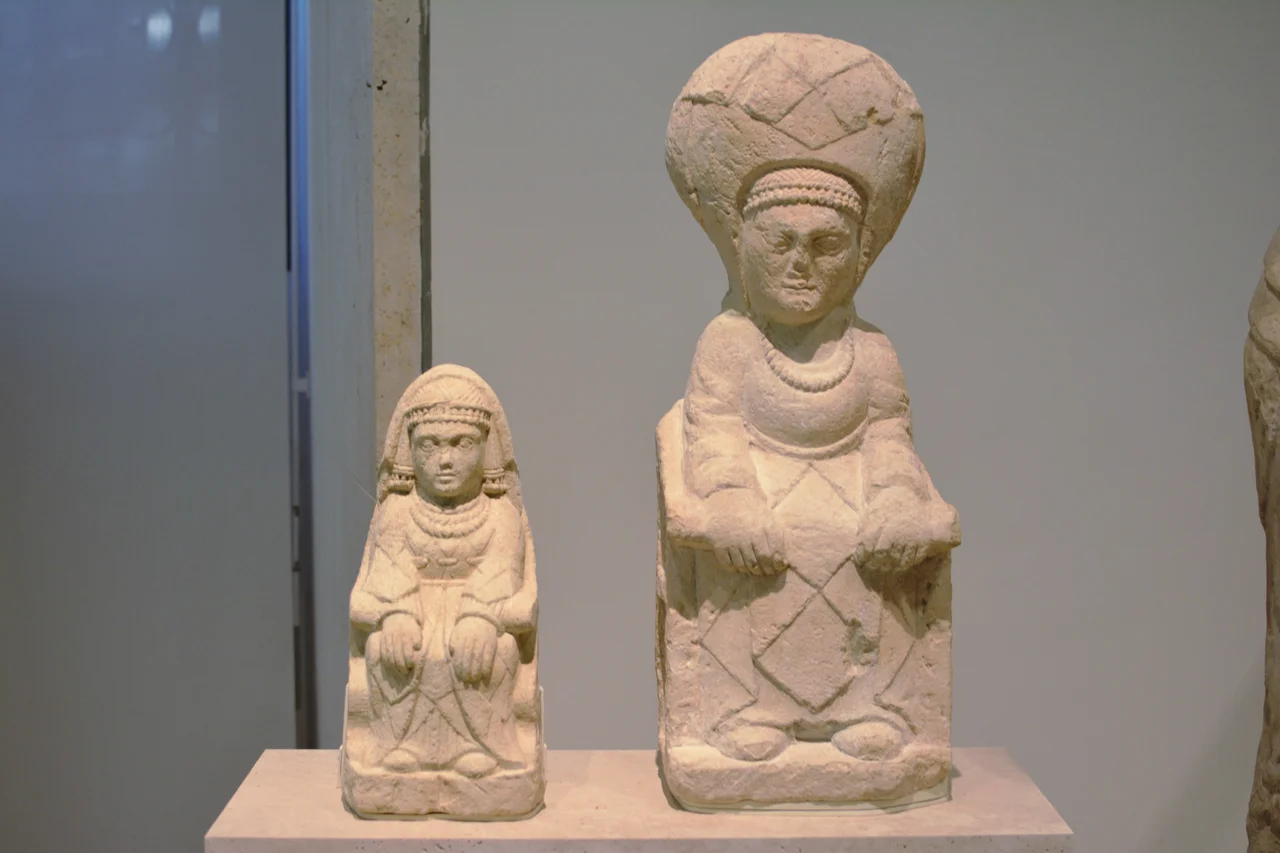
Imagine a crowd of some three hundred people standing shoulder to shoulder, each holding out a small cup as if to make an offering — and every one of them carved from stone. That was the strange gathering that once filled the sanctuary on the Cerro de los Santos, the 'Hill of the Saints,' on a rise of open country in the province of Albacete. The Iberians raised this shrine in the fourth century BCE, and over the generations they left behind an assembly of votive figures, the great majority of them women. The living came to worship; the stone was left to worship in their place.
The Hill of the Saints
Little survives above ground today. A commemorative obelisk, erected in 1929 beside the road toward Yecla, marks the spot where nineteenth-century excavators traced the outline of a temple that has since vanished completely. In its day the sanctuary stood along the Via Heraclea, the great overland route of ancient Iberia, in the borderlands of the Bastetani near their Contestani neighbours, and only a few kilometres from another Iberian site at Llano de la Consolación. The temple was a compact building reached by two flights of steps through a doorway barely more than two and a half metres wide; its walls were doubled courses of squared blocks pinned with lead clamps, its floor once laid with diamond-shaped terracotta tiles. What made the place remarkable, though, was never the architecture. It was the crowd inside.
The Lady of the Hill
The finest of the figures is the Dama del Cerro de los Santos, a woman standing a metre and forty centimetres tall, wrapped in a cloak and crowned with a tiara-like headdress, an offering cup held before her. Carved in the third or second century BCE, she belongs among the celebrated 'Ladies' of Iberian art — kin in fame to the Lady of Elche and the Lady of Baza. Her style is severe and inward-looking, owing nothing obvious to Greek or Italian sculpture; this is an Iberian idea of dignity, entirely its own. Today she and most of her stone companions reside far from the hill, in the National Archaeological Museum of Spain in Madrid, where visitors meet the steady gaze the Iberians once meant only for their gods.
Faces for the Gods
Line the figures up and they blur into one another — the same cloaks, the same zig-zag folds of cloth, the same still poses, some standing, some seated on thrones. Look closer and the eyes betray a difference, set at slightly varied sizes and angles from one statue to the next. The scholar Jaeggi reads this as deliberate: a sculptor's quiet effort to tell otherwise identical figures apart, so that each might stand for a particular person. In this interpretation the statues were avatars. A worshipper commissioned a likeness, placed it permanently in the sanctuary, and left it there to receive a deity's protection long after they had walked back home. To carve yourself in stone was a way to keep praying without ever having to stay.
Women, Then Men
The gathering changed over time. The earliest and most numerous figures are women; later ones include men, carved in a more Hellenistic manner, along with a handful of animals. Only a single figure — gripping a short sword — is clearly a warrior, and no complete male statue survives at all. The scholar Truszkowski has argued that the women belong chiefly to the years before the Punic Wars, and that the turn toward male figures came as those wars swept through Iberia, when Rome and Carthage fought for the peninsula. If so, the shrine is a quiet record of a society under strain, its offerings shifting from matrons to soldiers as the world outside grew violent. By the height of Roman rule the votives stopped altogether. The crowd of stone had said its last prayer.
From the Air
The site sits at 38.73°N, 1.27°W, on open upland outside Montealegre del Castillo in Albacete province — inland, roughly between the Costa Blanca and the central Meseta. The nearest airports are Alicante–Elche (LEAL) to the east, Región de Murcia / Corvera (LEMI) to the south, and Albacete (LEAB) to the northwest. There is little to see from altitude: look for the 1929 obelisk standing beside the Yecla road and the low hill it crowns. This is a place best appreciated low and slow, in the clear, dry light of the interior.
Nearby Stories
- Castle of Banyeres 6.3 km away
- Jumilla 8.4 km away
- Agost 8.4 km away
- Castle of Ayora 16 km away
- Battle of Lauron 27 km away
- Castle of Alarcon 65 km away
- Castle of Belmonte 120 km away
- Battle of Las Navas de Tolosa 157 km away