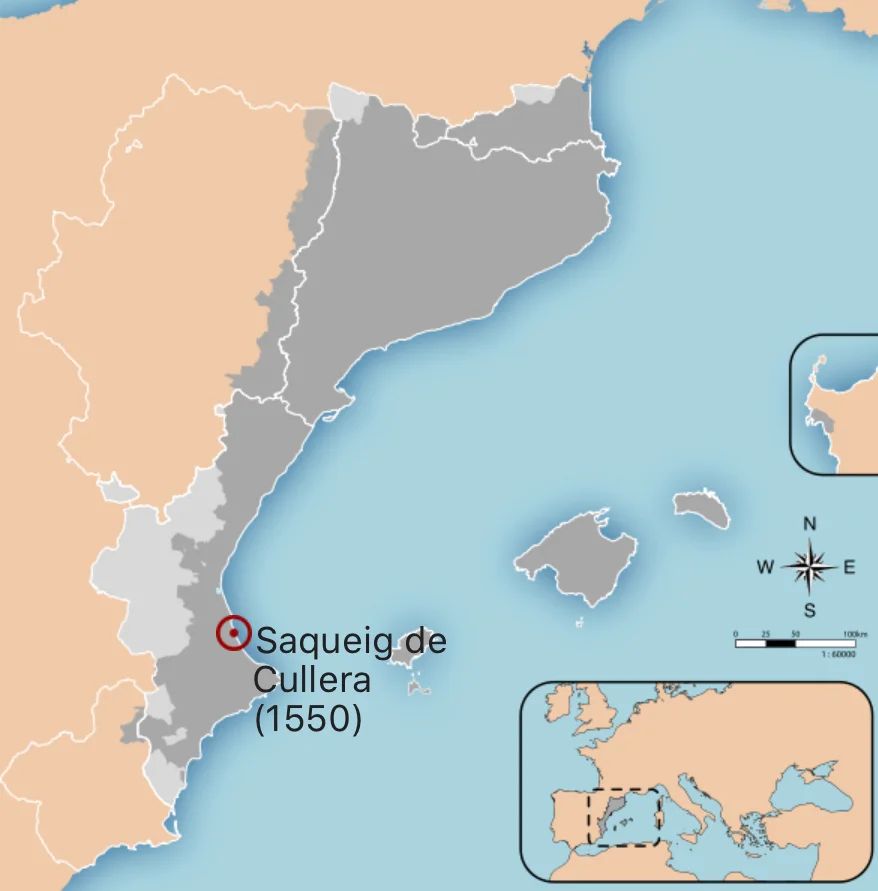

Sack of Cullera
On a spring day in 1550 - a chronicle later set it at 20 May, another at 15 May, and most local Cullera histories at 25 May - a fleet of galleys appeared off Cullera, and by evening the town had almost ceased to exist as a community. The Ottoman corsair Dragut came ashore, seized what could be carried, and took nearly every inhabitant captive. These were not soldiers or statistics but the ordinary people of a small Valencian port: fishermen, farmers, mothers and children who woke that morning in their own homes and ended the day as prisoners bound for the slave markets of North Africa.
The Sword Comes Ashore
Dragut - known in Turkish as Turgut Reis - was among the most feared naval commanders of the sixteenth-century Mediterranean, a corsair admiral who operated from North Africa and inherited the mantle of the great Barbarossa. Cullera was one stop on a raiding campaign. He had already struck Benalmádena, Benissa and Sant Joan d'Alacant with a fleet of twenty-seven galleys, then sailed north to sack Valencia itself before turning on Cullera. For a town without walls strong enough to hold off a professional war fleet, resistance was hopeless. The corsairs took the goods, and then they took the people.
The Cave and the Long Voyage
Before the captives could be shipped across the sea, they were held in a cave beneath Cullera's mountain - a holding pen for human beings about to be sold. From there they were carried to Algiers, then the busiest slave market of the Barbary coast, where captured Europeans were ransomed back to their families if they were lucky and sold into bondage if they were not. For those taken from Cullera, the raid meant the sudden, total loss of home, livelihood and often of one another. Some would have spent years in captivity; some never returned at all. It is worth pausing on that reality, because it is easy to let a word like 'sack' hide the individual grief behind it.
A Coast That Learned to Watch
Cullera's fate was not unique. Through the sixteenth century, corsair raids made the entire Valencian shore a dangerous frontier, and communities responded by building watchtowers along the cliffs and headlands, manned to raise the alarm when strange sails appeared. The scattered towers that still stand on this coast are monuments to a century of fear, links in a coastal alarm network meant to give villages a few precious minutes to flee inland. For those already taken, hope often rested with the religious redemption orders, which raised money across Spain to ransom Christian captives home from North Africa - though many were never bought back at all. Dragut, meanwhile, sailed on. After Cullera he crossed to Majorca and struck Pollença, where roughly 130 more people were killed or captured. His name would echo along these coasts for decades as a byword for sudden violence from the sea.
Remembering the Raid
The cave where the captives were held has become the town's memorial to what happened. Today it holds a museum commemorating the attack, and - in a strange twist of historical memory - a statue of Dragut himself, the raider now cast as a fixture of local legend. Much of what is known about the event comes from the Valencian chronicler Pere Joan Porcar, whose diary preserved the date and the memory for later generations. Standing in the cool dark of that cave, it is not hard to imagine the frightened people once crowded there, and to feel how close the past can still be.
The Place Today
Cullera is now a sunlit resort of long beaches and busy restaurants, and most visitors climb its castle-topped mountain for the view rather than the history. But the story of 1550 is woven into the town's sense of itself, a reminder that this gentle coast was once a raw edge of a wider Mediterranean struggle. To know the raid is to see Cullera differently: not only as a beach town, but as a place that endured one of the darkest days in its long history and chose to remember it.
From the Air
The events centre on Cullera at 39.166°N, 0.255°W, about 40 km south of the city of Valencia at the mouth of the Xúquer River. From the air the site is marked by Cullera's isolated castle-crowned mountain rising from a flat coastline; the commemorative cave sits within that hill. Nearest airports are Valencia (LEVC) to the north and Alicante–Elche (LEAL) to the south, with Murcia (LEMI) farther south. Dragut's 1550 campaign traced this whole coastline - Alicante's environs, Valencia, then Cullera - so the flight path itself follows the raid. A low viewing altitude of 2,000–4,000 ft in clear Mediterranean weather best shows the fortified hill above the sea.
Nearby Stories
- La Tomatina 9 km away
- Cova de les Dones 9.2 km away
- La Bastida de les Alcusses 9.2 km away
- Taifa of Dénia 11 km away
- El Cabanyal 17 km away
- Illa Grossa 65 km away
- Illa de s'Espartar 75 km away
- Capture of the galleon Lion Couronné 89 km away