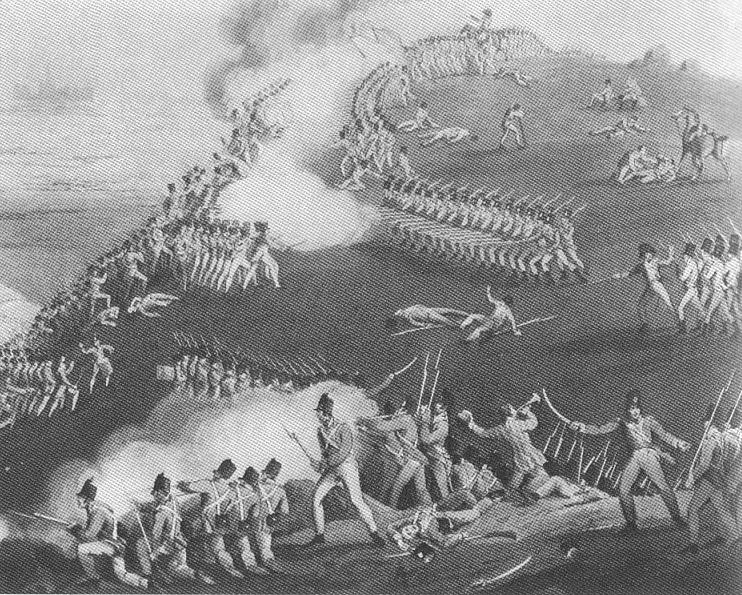

Battle of Castalla
The victory at Castalla was really won the day before, at a mountain pass called Biar. On 12 April 1813, Colonel Frederick Adam and a mixed brigade of barely two thousand men - British, King's German Legion, Italian, and Spanish - fought a five-hour holding action in the pass to keep Marshal Suchet's French army off the back of their retreating comrades. When Suchet's cavalry tried to turn the retreat into a slaughter, three companies of the 2/27th Foot sprang a neat ambush and stopped them cold. That stubborn stand bought Lieutenant-General Sir John Murray the hours he needed to draw up his whole army on strong ground near Castalla. The next day, the French would break themselves against it.
The Pass at Biar
By the spring of 1813 an Anglo-Sicilian force, thickened out with Spanish troops, had been sitting at Alicante for months, changing generals and achieving little, until Murray took command of a reinforced army of some eighteen thousand. Then Marshal Suchet moved to surprise him. After a Spanish force was routed at nearby Yecla - four hundred killed and a thousand taken prisoner in a sudden cavalry attack - Murray fell back toward Alicante and left Adam's brigade to hold the pass of Biar. For five hours Adam fended off the French pursuit, trading two of his four cannon and more than three hundred casualties for the time his commander needed. The retreat did not become a rout, and Murray's army reached Castalla intact.
A Castle-Topped Ridge
The position Murray chose was made for defence. A ridge crowned by the old castle of Castalla overlooked a deep stream bed, with a spur jutting forward that would tend to split any attack coming up the slope, and a flooded stream guarding his right flank. Murray arranged his divisions across this natural rampart: Samuel Ford Whittingham's Spaniards fortified on the left, Adam's weary brigade in the left-centre, John Mackenzie's division in the right-centre, and William Henry Clinton's on the right, with cavalry and reserves tucked behind the castle. It was, in short, exactly the kind of ground on which infantry that stood firm could shred an attacker - and Murray's men intended to stand firm.
Suchet's Gamble
Louis Gabriel Suchet was the one marshal who had won his baton by his victories in Spain, and he tended to treat the provinces of Aragon and Valencia as a private kingdom. Confident that a hard blow would send the Spanish and Italian infantry running, he planned to drive his columns straight at the centre of Murray's line while light companies threatened the far left and his cavalry swung wide to envelop the right. It was the assumption behind the whole plan - that these Allied troops would crack under pressure - that would prove wrong. On the ridge above Castalla, the men Suchet expected to flee were waiting behind good cover with loaded muskets.
Musketry on the Slope
At noon on 13 April the French surged forward. Whittingham's steady Spaniards threw back the right-hand attack columns and their skirmishers; the left-hand columns ran into Adam. In a short, close-range musketry duel, Adam's 2/27th Foot, drawn up in line, poured fire into the 121st Line's dense column and inflicted 369 casualties on it in minutes. Mackenzie blocked the French general Habert in the centre, while Boussart's cavalry, sent to turn the Allied right, could not even get across the flooded stream. With his infantry beaten, his horsemen stranded on one flank, and his men outnumbered, Suchet found himself in real trouble - his gamble on Allied panic overturned on the slope.
A Victory Not Followed
And then Murray let it slip. Slow to seize his advantage, he allowed the French to disengage and retreat almost unmolested, their rearguard once again defending the pass of Biar to cover the withdrawal. The arithmetic still favoured the Allies: about 440 casualties on Murray's side against a likely 1,300 or more for the French. Yet Murray drew no reward from it, simply continuing his march back to Alicante as though he had lost. Clear Allied wins were rare on this coast, and Castalla was one of them - a battle whose hard soldiering, from the pass at Biar to the ridge above the town, deserved a more decisive hand than the one that commanded it.
From the Air
The battle was fought on the ridge above Castalla at roughly 38.6 degrees N, 0.667 degrees W, about 35 km north-northwest of Alicante, in the inland Foia de Castalla basin. The town's medieval castle still stands on its rocky outcrop above the valley, and the pass of Biar - key to both the retreat and the withdrawal - lies a short way to the northwest. From the air the castle-topped ridge and the surrounding hill passes are easy to trace across the open valley floor. Alicante-Elche Airport (LEAL) is about 35 km southeast; Valencia (LEVC) lies further north. The interior generally offers clear, dry visibility.
Nearby Stories
- Ciudad de la Luz 1.3 km away
- Castle of Almansa 4.3 km away
- La Muralla Roja 7.1 km away
- Oratory of the Borgias 13 km away
- Monte Arabí 24 km away
- Kingdom of Murcia 28 km away
- Es Vedrà 104 km away
- Battle of Cape Cherchell 250 km away