
Palmeral of Elche
There should be no oasis here. Europe's climate does not make them, and the land around Elche is genuinely harsh: summers steadily above 30 degrees Celsius, less than 250 millimeters of rain in a year, and a river, the Vinalopó, that runs brackish and unreliable. Yet spread across this city and its outskirts stand roughly two hundred thousand date palms, a green sea of fronds that is the largest palm grove on the continent and the only one anywhere in Europe with North African roots. It did not happen by accident, and it did not happen quickly. The Palmeral of Elche is the work of two thousand years and four civilizations, each of which added water, palms, or law to keep the desert garden alive.
An Oasis That Should Not Exist
The first date palms went into this ground around the fifth century BCE, planted by Carthaginian settlers at the town they called Ilici. Palms alone, though, do not make an oasis; water management does. When Rome conquered the peninsula, its engineers built a dam in the mountains north of Elche and ran aqueducts down to the fields, the first serious attempt to bend this dry land to agriculture. What the Romans began, later masters would perfect. Today UNESCO protects the result as a World Heritage Site, recognizing it both as a rare living transplant of North African landscape into Europe and as a working monument to the layered irrigation systems that Roman, Islamic, and Christian hands built one atop another.
Water Is the Whole Trick
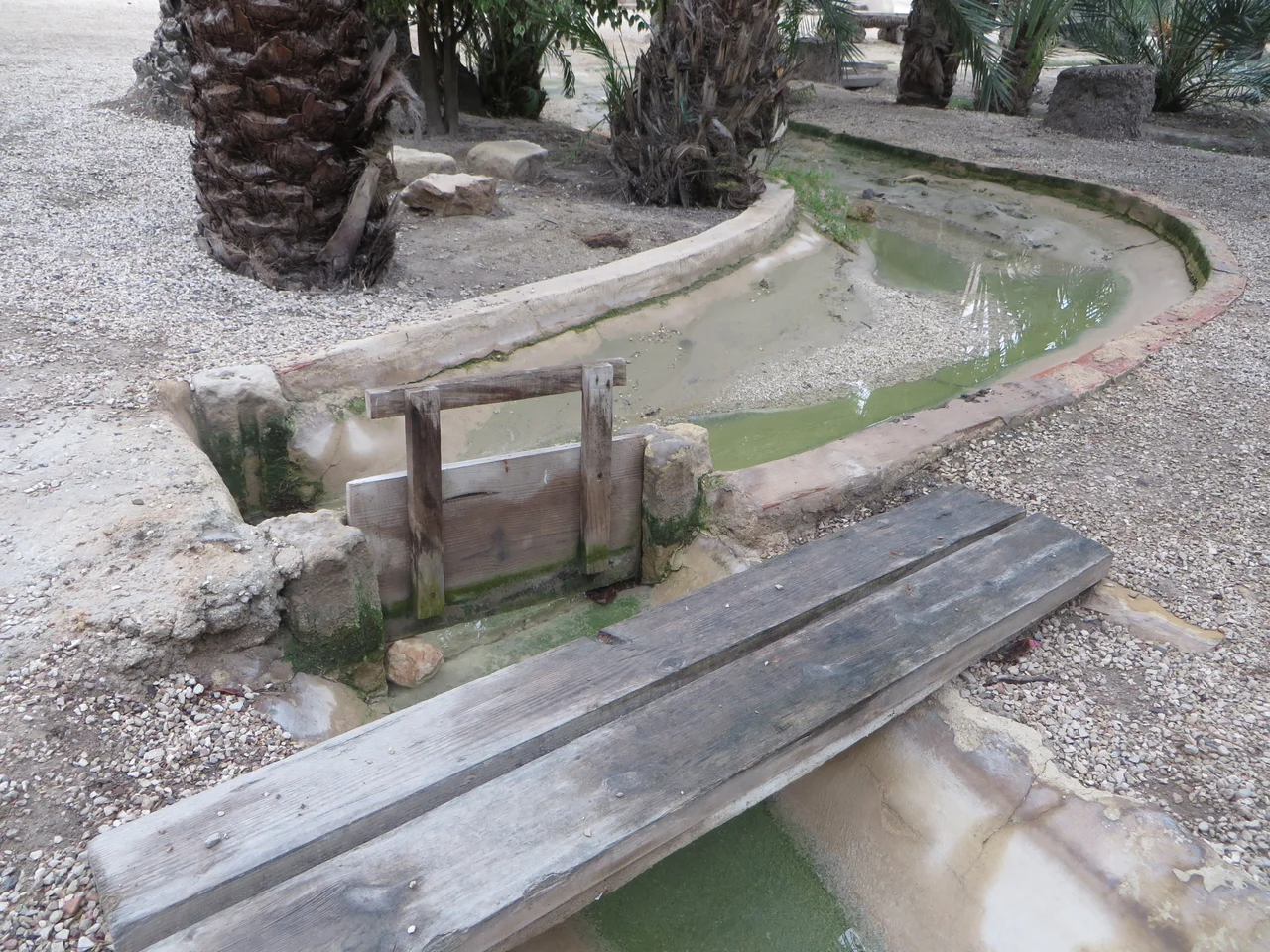
The oasis as we know it is an Arab creation. In the tenth century the Caliphate of Córdoba moved the city seven kilometers to its present site and set about turning scarcity into abundance. Applying North African techniques, its engineers expanded the waterworks into a complex network centered on the great canal, the Acequia Mayor, which split into more than twenty branches to carry even brackish river water to the fields. The palms were the genius of the plan. Planted in grids along the edges of rectangular plots called huertos, they broke the wind, threw shade, slowed evaporation, and held the soil, creating beneath their canopy a cooler, sheltered microclimate where cereals, alfalfa, and pomegranates could grow. The grove was never merely ornamental. It was infrastructure, a machine made of trees.
A Garden Meaning Paradise
For the people of Al-Andalus, a garden was more than a farm. In Islamic culture the walled garden symbolized paradise itself, and poets used it as a figure for love, memory, and the passing of time. The tradition of the garden-estate had crossed into Iberia in the eighth century with Abd al-Rahman I, the Umayyad prince who fled Syria for Córdoba, and it flowered in cities like Toledo, Seville, Granada, and Elche. When Christian rulers took the city in the thirteenth century, they kept the machine running, redistributing the canals between the new Christian tenants and the Muslim residents who had built and still worked the land. It was those Christian residents who added the craft the grove is now famous for: weaving the pale, desiccated white palms carried through the streets each Palm Sunday.
The Imperial Palm and the Palmereros
Amid a grove of hundreds of thousands, a few trees became celebrities. The most beloved is the Imperial Palm in the garden called the Huerto del Cura, a remarkable palm of many stems that the city named for Empress Elisabeth of Austria, the beloved Sissi, after she visited in 1894. The grove's ornamental collection now holds palms of some seventy species, chiefly the date palm, Phoenix dactylifera. The knowledge that sustains all this lives in people, not just plants. The Palmereros, the palm workers, still climb the trees, harvest the dates each November and December, and plait the white palms by hand, skills demonstrated today at the Palm Grove Museum, housed in two nineteenth-century homes joined by a skybridge.
A Grove Under Siege
An oasis that survived a thousand years of history nearly fell to the twentieth century. As Elche grew into a booming shoemaking city, industry and sprawling housing swallowed one huerta after another, and the grove that had once been the whole economy shrank to a cultural relic. Spain and the Valencian government fought back with law, declaring the palms an Artistic Garden in 1943, passing a dedicated protection statute in 1986, and winning World Heritage status in 2000. The threats have not stopped, only changed. Where bulldozers once menaced the Palmeral, now it is climate change, pests, and disease, the slow pressures that no single law can hold back. The oldest garden in Europe still needs tending, exactly as it always has.
From the Air
The Palmeral spreads across Elche and its surroundings at 38.269°N, 0.698°W, in southern Alicante province, concentrated on the east bank of the Vinalopó River. From the air it is unmistakable: a dense, dark-green forest of date palms woven through the city grid and reaching into the farmland beyond, covering some 3.5 square kilometers, an oasis-like canopy with no equal in Europe. The blue dome of the Basilica of Santa María rises from the old center, and the ancient Acequia Mayor irrigation lines still thread among the orchards. Recommended viewing altitude 3,000-6,000 ft AGL to grasp the scale of the grove against the drier surrounding country. Alicante-Elche Airport (LEAL) lies just a few kilometers east, so the palms are frequently visible on approach and departure; Región de Murcia International (LEMI) is to the southwest. The region's clear, dry light offers frequent excellent visibility.
Nearby Stories
- Cresta del Gallo 1.5 km away
- Canelobre Cave 10 km away
- La Muralla Roja 16 km away
- Kingdom of Murcia 25 km away
- San Pedro del Pinatar 27 km away
- Monte Arabí 30 km away
- Penyal d'Ifac Natural Park 45 km away
- Battle of Cape Cherchell 228 km away