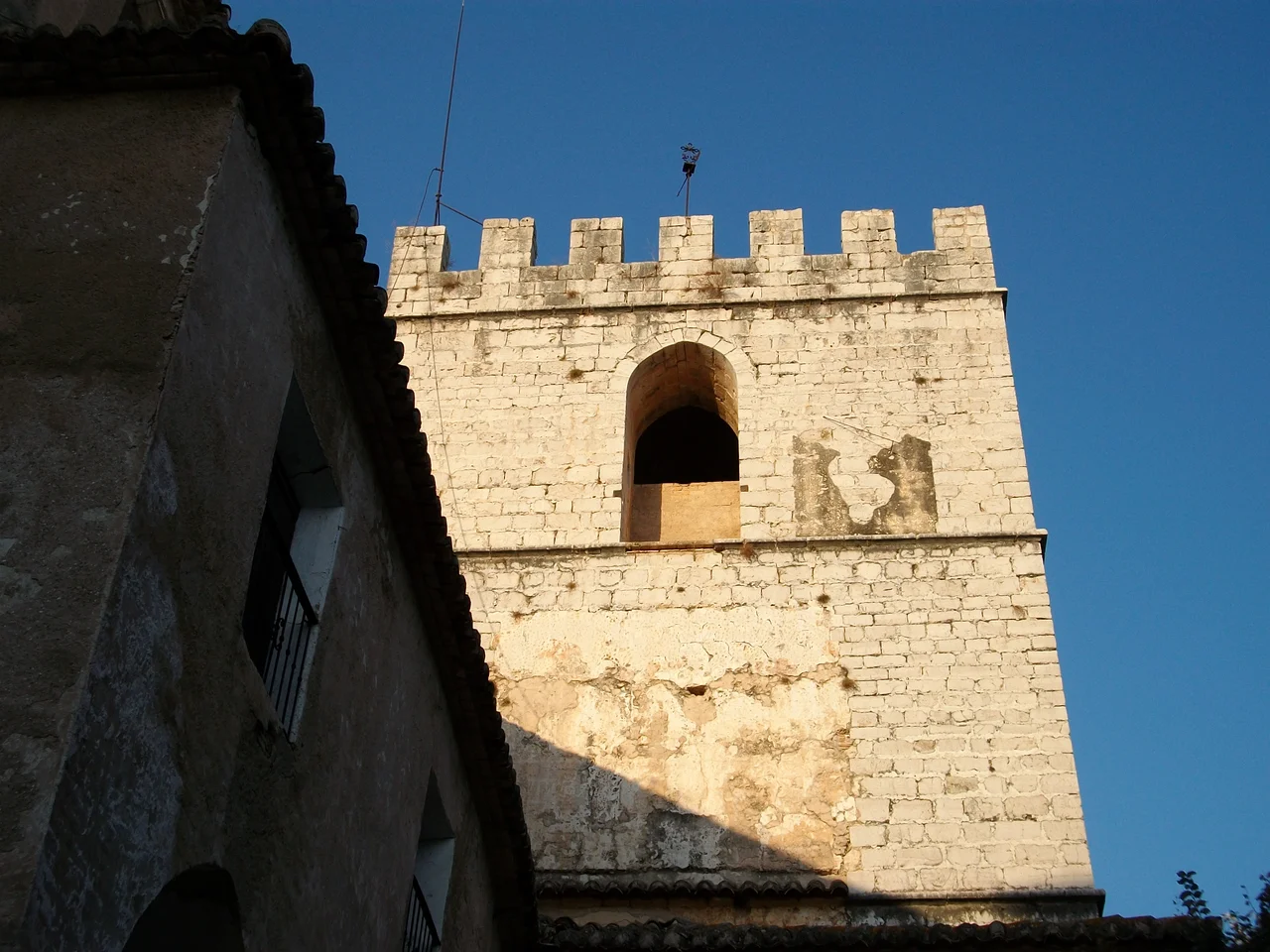

Monastery of Sant Jeroni de Cotalba
The monks tried the coast first, and the coast tried to kill them. Their original monastery near Xabia was raided by pirates in 1387, and afterward the survivors were too frightened to return. So in 1388 Duke Alfonso of Aragon bought the more sheltered lands of Cotalba, tucked into the hills near Alfauir some eight kilometers from Gandia, and moved his monks inland out of the raiders' reach. What he built for them would grow across four more centuries into one of the most historic monastic buildings in Valencia, and it is still standing.
Founded Twice, Then Fortified
The idea began in 1374, when Pope Gregory XI authorized a hermit of Xabia to found a monastery for the Hieronymite order. The coastal site lasted barely more than a decade before the pirates ended it. When Alfonso of Aragon and Foix, Royal Duke of Gandia, refounded the community at Cotalba in 1388, he understood the threat had not vanished, so he wrapped the monastery in a fortress to shield the monks from Berber raiders reaching up from the sea. This was a house of prayer that had learned to think like a castle. Tradition holds that Saint Vincent Ferrer, the great Valencian preacher, once addressed crowds from its walls.
Where Córdoba Echoes
The building grew slowly, gathering styles the way a river gathers silt: Valencian Gothic, Mudejar, Renaissance, Baroque, and finally Neoclassical, laid down between the 14th and 18th centuries. Its most beautiful survival is the lower cloister, where pointed arches of brick and pale mortar create a two-color rhythm in the Mudejar manner, the work of Islamic craftsmen and their traditions living on under Christian rule. The pattern deliberately recalls the striped arcades of the Great Mosque of Cordoba, a piece of Al-Andalus carried into a Valencian monastery. Four galleries on two floors ring a central garden, and at its heart sits a cistern that stored the community's water. In the chapter house lie the tombs of Prince John and Princess Blanche of Aragon, children of the medieval duke who gave the monks their refuge.
The Borgia Duchess
In the 16th century the monastery fell under the protection of the House of Borgia, and one woman shaped much of what visitors see today. Maria Enriquez de Luna, widow of Duke Giovanni Borgia and daughter-in-law of Pope Alexander VI, financed the enlargement, including the upper cloister and the cistern of the Orange Tree Patio. Her descendant Saint Francis Borgia came here often. His wife, Leonor de Castro, a lady and close friend of the Empress Isabella of Portugal, retreated to the monastery to recover from her illness and instead spent her final days within its walls, dying on the 27th of March, 1546. Her death would help turn her grieving husband toward the religious life that made him a saint.
The Painter Who Paid in Brushwork
The Renaissance painter Nicolas Borras, born in Cocentaina and trained under Juan de Juanes, was so moved by his stay that he asked to join the order, offering his art as his only payment. The monks accepted. He took the habit in 1575 and spent the rest of his life painting, leaving twelve altarpieces in the church alone and spending his own money on sculptors and builders to embellish the house. Most of his work scattered after the monastery closed, but one piece never left. His fresco of The Last Supper still occupies the room that was once the refectory and later, in the monastery's decline, became an oil mill, the sacred meal keeping watch over the earthen jars where oil was stored.
One Family, Almost Two Centuries
The end came with the Ecclesiastical Confiscations of Mendizabal, which sold off religious property to pay state debts. The monks walked out on the 6th of August, 1835. Eight years later the Trenor family bought the monastery, and it has stayed in their hands ever since, serving briefly as a military hospital during the Spanish Civil War and gaining romantic gardens in the early 20th century. Declared a cultural monument in 1994 and reopened to visitors in 2005, Cotalba now anchors the Route of the Monasteries of Valencia and sits along the Route of the Borgias, the start of a walk through the region's monastic and dynastic past.
From the Air
The monastery stands at 38.9407 N, 0.2461 W in the hills near Alfauir, roughly eight kilometers inland and west of Gandia. From the air it appears as a walled complex of stone ranges and tiled roofs set among terraced hillsides and orange groves, with its main and priory towers rising above the mass and an aqueduct trailing off toward its water source. Best viewed at 1,500 to 3,000 feet; the sheltered valley setting that once protected it from pirates also keeps it partly tucked into the terrain, so a lower approach reveals more. Valencia (LEVC) lies about 70 km north, Alicante-Elche (LEAL) to the south. Clear morning light off the nearby coast gives the sharpest detail.
Nearby Stories
- Route of the Castles of Vinalopó 6.6 km away
- Barony of Polop 6.9 km away
- La Bastida de les Alcusses 16 km away
- Albufera Natural Park 17 km away
- La Tomatina 26 km away
- Illa de s'Espartar 73 km away
- Illa Grossa 83 km away
- Battle of Cape Cherchell 255 km away