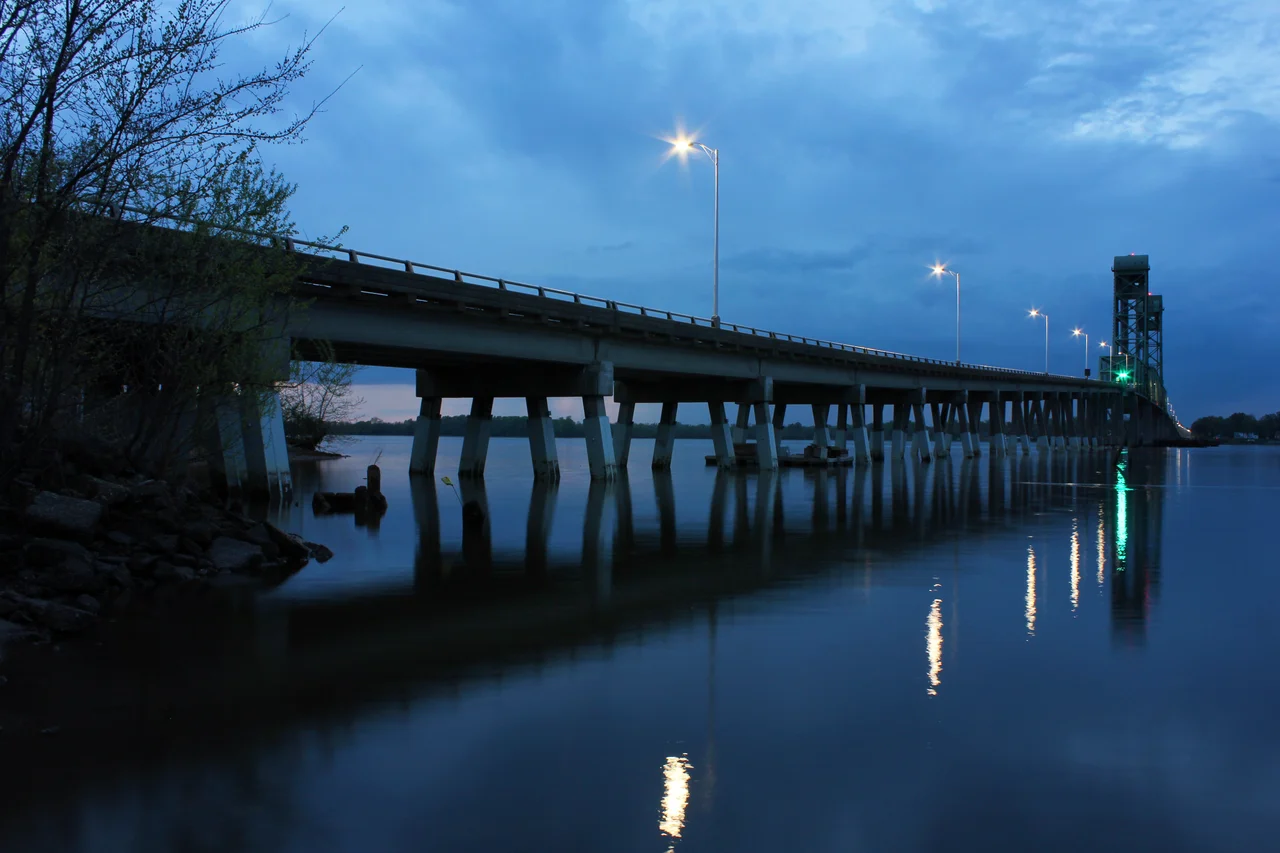

Benjamin Harrison Memorial Bridge
The drivers waiting behind the warning gates on the morning of February 24, 1977, saw the ship first. They were sitting in their cars, the lift span raised above them so the tanker could pass underneath, when the 523-foot Marine Floridian veered out of the channel and came straight at the bridge. Six emergency blasts on the ship's horn. Engines into reverse. Anchor dropped. None of it mattered. The drivers got out of their cars and ran for the south end. The ship hit the north tower with thousands of tons of momentum. One section of bridge deck and two unoccupied vehicles tumbled into the James. No one died — but the Benjamin Harrison Memorial Bridge would not carry traffic again for twenty months.
A Signer's Bridge
The bridge is named for Benjamin Harrison V, who signed the Declaration of Independence and served three terms as Governor of Virginia. He lived two miles west, at Berkeley Plantation — the same plantation where William Henry Harrison was born in 1773 and Benjamin Harrison (the twenty-third President, William Henry's grandson) traced his ancestry. Three other family members later served as American presidents in some sense: William Henry (briefly), Benjamin (1889-93), and a fourth cousin's son who became president of Princeton. The Harrison family wove itself into the early Republic. The bridge, completed in 1966, replaced ferry service across the James and connected Hopewell on the south bank to Charles City County on the north. Hardesty & Hanover, the New York engineering firm, designed the 360-foot vertical-lift span — a section of road that rises straight up between two towers to let ships pass underneath.
The Day the Ship Hit
On February 24, 1977, the small World War II-surplus tanker Marine Floridian was heading downriver from Allied Signal in Hopewell when her rudder steering gear failed. The drawbridge was raised in anticipation of her passage; cars waited. The ship slid out of the channel, headed for the bridge, and could not be stopped. She missed the open lift span and struck the fixed approach instead. The north tower collapsed onto her deckhouse, which stopped her forward motion. The bridge tender was trapped in his control booth at the south end of the still-raised lift span. Ten days later the damaged south tower also collapsed onto the ship under the weight it could no longer support. State troopers, Coast Guard divers, and the tugboat Virginia B all responded. No one was killed, and the closest call — the two abandoned cars tumbling into the James — became a story everyone in Hopewell still tells.
What Twenty Months Without a Bridge Looks Like
The next downstream crossing was the James River Bridge, 130 miles of additional driving. The next upstream crossing was Interstate 95 at Richmond, fifty miles away. The Jamestown Ferry, thirty-five miles downstream, was already at capacity. For commuters between Charles City County and Hopewell, this was a disaster. The Kepone chemical contamination of the James prevented dredging the old ferry landings deep enough for car ferries, so VDOT improvised. Richmond-based Virginia Overland Transportation set up passenger-ferry and shuttle-bus service in three business days. Vans and school buses connected ferry docks on each side to schools and workplaces — including Fort Lee (now Fort Gregg-Adams), where many south-bank workers commuted. A barge-and-tugboat car float later supplemented the passenger service, but commuters considered it unstable and most stuck with the buses until the bridge reopened in fall 1978. Total cost: $9.7 million, recovered from the shipping company's insurer through federal court.
Peregrines on the Towers
Today the bridge's most famous tenants are not human. In partnership with the College of William & Mary's Center for Conservation Biology, VDOT installed nesting boxes on the high steel of the Harrison Bridge and nine other Virginia bridges. Peregrine falcons — the world's fastest birds, capable of diving at 240 miles per hour — were federally endangered in 1970, virtually wiped out east of the Mississippi by DDT-induced eggshell thinning. The recovery has been slow and deliberate. Today bridge-nesting pairs make up roughly 30 percent of Virginia's peregrine population. In spring 2003 three chicks hatched on the Harrison Bridge; two were released later at Shenandoah National Park to encourage cliff-nesting populations in the mountains. The VDOT employees who go up the tower to maintain the lift mechanism can see directly into the falcons' nesting box. The birds barely notice when the drawbridge opens — three or four times a day in summer.
What You See From Above
The bridge crosses the James at a sharp bend. From altitude that bend explains the 1977 accident — the channel curves at the bridge, making it hard for any large ship that loses steering to recover before reaching the structure. The lift span shows as a distinct rectangular section of road between the two towers. To the east, the Harrison Lake and the National Fish Hatchery; to the west, Berkeley Plantation's brick mansion among its formal gardens; downstream, the wide industrial waterfront of Hopewell. On a still morning you might see a peregrine on the tower steel, watching for pigeons.
From the Air
The Benjamin Harrison Memorial Bridge crosses the James River at 37.319°N, 77.224°W, between Hopewell on the south bank and Charles City County on the north. From 2,500 to 4,000 feet AGL the bridge's two lift towers stand out against the river's bend, and the long causeway approaches on both shores are clearly visible. Nearest airports: Richmond International (KRIC) about 14 nm northwest, Petersburg's Dinwiddie County (KPTB) about 12 nm southwest. The bridge sits in Class E airspace below the Richmond Class C shelf. Best viewing from a westbound or eastbound transit at 3,000 feet, ideally early morning before the haze builds — and yes, watch for peregrines diving from the towers.
Nearby Stories
- Rosewell Plantation 6.4 km away
- Christopher Newport University 13 km away
- Cactus Hill 18 km away
- Huguenot Memorial Chapel and Monument 24 km away
- Lewis Ginter Botanical Garden 27 km away
- Fort Christanna 44 km away
- USS Texas (1892) 50 km away