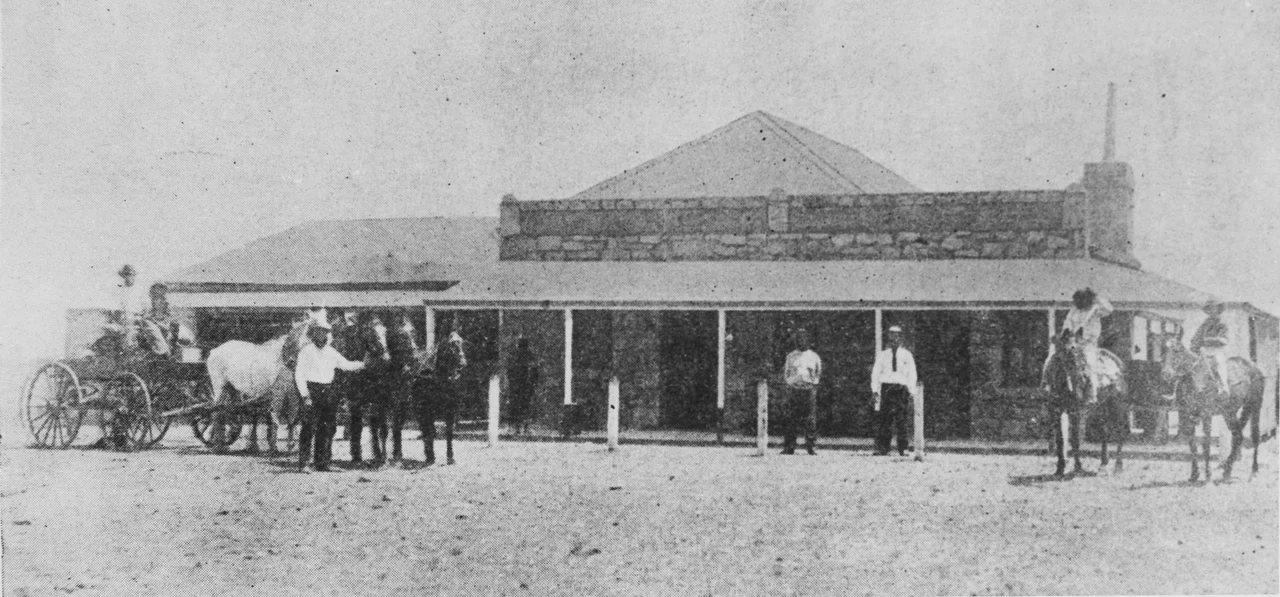
Betoota, Queensland
For years, the census recorded Betoota's population as zero. Not nearly zero, not a handful of stubborn holdouts: zero, a town with no residents at all. Yet it kept its name, its racetrack, its airstrip and its single surviving building, the Betoota Hotel, standing alone on a gibber plain 170 kilometres east of Birdsville and 227 kilometres west of Windorah. To call Betoota a ghost town undersells it. It is closer to an idea of a town, a dot on the map of the Channel Country that refuses to disappear, and once a year it fills with people who drive for days across the outback to be there.
The Town That Outlived Its People
Betoota was surveyed in 1887, on the lands of the Karuwali people, whose Country takes in this corner of far western Queensland. The Betoota Hotel went up in the late 1880s and proved more durable than the settlement around it. In 1895 police were stationed here, drawn not by a crime wave so much as by the rough characters that construction of a regional rabbit-proof fence had pulled into the district. The other buildings faded one by one until only the pub remained, run for decades by a single proprietor before it finally closed its doors in 1997. For more than twenty years the hotel stood shut, and Betoota became, officially, a town of nobody.
Last Drinks, Then Reopening
The pub's revival reads like outback folklore. In 2017 Robert Haken, a panel beater from Logan on Brisbane's southern fringe, bought the long-defunct hotel and set about restoring it. The plan was to reopen in time for the Betoota Races in August 2018, but the deadline slipped, the delay blamed cheerfully on paperwork. The Betoota Hotel finally reopened on 20 July 2020. Today it is again the heart of the place, a low building on an empty plain where travellers stop for a cold drink and the novelty of standing in Australia's smallest town. The pub even celebrated a hundredth birthday, a century of weathering dust, heat and isolation.
Race Day in the Middle of Nowhere
Once a year, briefly, the population is anything but zero. At the end of August the Betoota Races bring crowds streaming in from neighbouring towns and far beyond. Visitors raise food stalls, live music plays, and the desert racetrack hosts a meeting that is as much social institution as sporting event. The Betoota Horse and Motorbike Gymkhana, held over the Easter long weekend, draws another outback gathering. Nearby, the land holds older history too: among Betoota's heritage-listed sites is a protected area linked to the doomed Burke and Wills expedition, a reminder of how dangerous this country has always been to those unprepared for it.
An Unlikely Brand Name
Betoota's strangest legacy travels far from the gibber plains. The town lent its name to The Betoota Advocate, the wildly popular Australian satirical news outlet that styles itself the country's oldest newspaper. There is a deadpan joke buried in the choice. The real Betoota has never had a newspaper, or much of anything, and the masthead is actually produced in Sydney. Still, a town with no people now has a national voice of sorts, and a name far better known than its single pub on a desert road would ever suggest. It is the kind of contradiction the Channel Country seems to specialise in.
From the Air
Betoota lies at about 25.69 degrees S, 140.74 degrees E on a gibber (stony desert) plain in Central West Queensland's Channel Country, on the Birdsville Developmental Road between Birdsville (YBDV, roughly 170 km west) and Windorah (YWDH, roughly 227 km east). The town has its own dry-weather airstrip, usable only when the surface is firm; do not assume it is serviceable after rain. From the air the standout features are the lone Betoota Hotel, the racetrack and the long straight ribbon of the road across an otherwise featureless plain. This is sparsely populated outback with no nearby controlled airspace and minimal ground lighting at night, so carry ample fuel and a solid navigation plan. Visibility is usually very good, but summer heat and blowing dust can degrade it.
Nearby Stories
- Durrie Station 4.7 km away
- Lake Yamma Yamma 32 km away
- Morney Plains Station 34 km away
- Currawilla 37 km away
- Burke and Wills Plant Camp 55 km away
- Cordillo Downs 79 km away
- Pandie Pandie Station 89 km away
- Palparara 101 km away