
Betung Kerihun National Park
Twenty-four park rangers. Eight hundred thousand hectares. The math alone tells you something about Betung Kerihun National Park: this is a place where the forest still outnumbers the people who patrol it. Sprawling across the mountainous spine of western Borneo, the park occupies the headwaters of the Kapuas River in Indonesia's West Kalimantan province, a landscape so rugged that more than half its terrain tilts at slopes exceeding forty-five percent. It is one of the largest protected areas on an island famous for its vanishing wilderness, and it guards some of Borneo's most intact rainforest ecosystems at a time when the island has lost more than half its original forest cover.
Eight Forests, One Mountain Wall
From the swampy lowlands at 150 meters to the wind-scoured summit of Mount Kerihun at 1,790 meters, the park stacks eight distinct forest types along its altitude gradient. Towering dipterocarps dominate the lowland canopy, their buttress roots spreading wide across the thin tropical soil. Climb higher and the dipterocarps give way to oaks and chestnuts, the air thickening with moisture as hill forest transitions into sub-montane cloud forest. At least 97 species of orchid and 49 species of palm have been cataloged here, though botanists suspect these numbers barely scratch the surface. The park holds 67 threatened plant species and 81 threatened animal species under the IUCN Red List, and initial surveys have documented over 300 bird species, 25 of them endemic to Borneo.
The Primates Who Remain
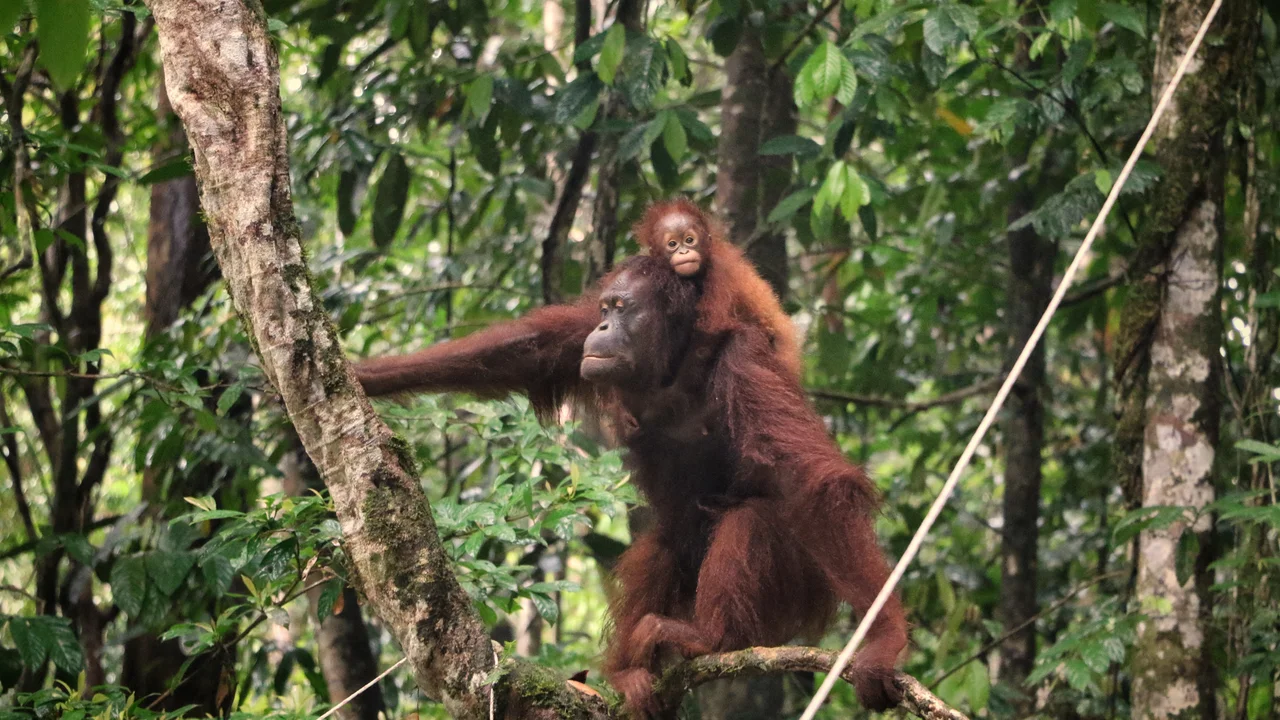
Betung Kerihun shelters the critically endangered Bornean orangutan alongside seven other primate species, from the acrobatic Mueller's Bornean gibbon to the tiny, wide-eyed Horsfield's tarsier. But protection on paper has not translated into safety on the ground. WWF data from 2002 found that roughly 31,000 trees had been illegally felled inside the park. More alarming still, reports documented 10 to 15 orangutans being trafficked every month from West and Central Kalimantan forests to supply markets in Jakarta and Denpasar. For an animal that reproduces slowly, losing one infant to the pet trade can ripple through a local population for decades. The park's vast size, which should be its greatest advantage, becomes a vulnerability when two dozen rangers must cover an area larger than the entire island of Bali.
The People of the Headwaters
Long before anyone drew park boundaries, Dayak communities lived along these rivers. Groups including the Iban, Tamambaloh, Kantu, Kayan Mendalam, and Punan Hovongan have inhabited the upper Kapuas watershed for centuries, practicing shifting cultivation and harvesting rattan, resins, and other non-timber forest products. Their relationship with the landscape is intimate and practical: they hunt, fish, and farm in patterns refined over generations. Conservation programs now work with these communities to develop sustainable livelihoods, recognizing that a park this large cannot be protected by rangers alone. The forest's future depends on the people who know it best.
A Border Without a Fence
Betung Kerihun shares its northern boundary with Malaysia's Lanjak Entimau Wildlife Sanctuary, a 2,000-square-kilometer reserve that creates a combined protected area spanning the international border. Together, the two reserves have been proposed as a UNESCO World Heritage Site under the name Transborder Rainforest Heritage of Borneo. The concept is elegantly simple: orangutans and hornbills do not carry passports, and a forest fragmented by national boundaries cannot function as a single ecosystem. Whether the nomination succeeds may depend on how well two governments can cooperate on a challenge that neither can solve alone, protecting one of the last great rainforests on an island where the chainsaws have not yet fallen silent.
From the Air
Coordinates: 1.22N, 113.35E. The park occupies rugged, mountainous terrain in the interior of West Kalimantan, visible from altitude as a vast unbroken canopy stretching to the Malaysian border. Nearest airport is Putussibau/Pangsuma (WIOP), approximately 50 km southwest. The Kapuas River headwaters thread through the park. Expect tropical weather with frequent cloud cover over the higher ridges. Supadio International Airport (WIOO) near Pontianak is the nearest major commercial airport, roughly 500 km to the southwest.
Nearby Stories
- Fort Sylvia 84 km away
- Oil, Empire, and the Fight for Borneo 98 km away
- Fort Alice 155 km away
- East Malaysia 178 km away
- Baram Dam 260 km away
- Borneo's Dayak Heartland 265 km away
- The White Rajahs of Sarawak 279 km away
- Kapuas River 355 km away