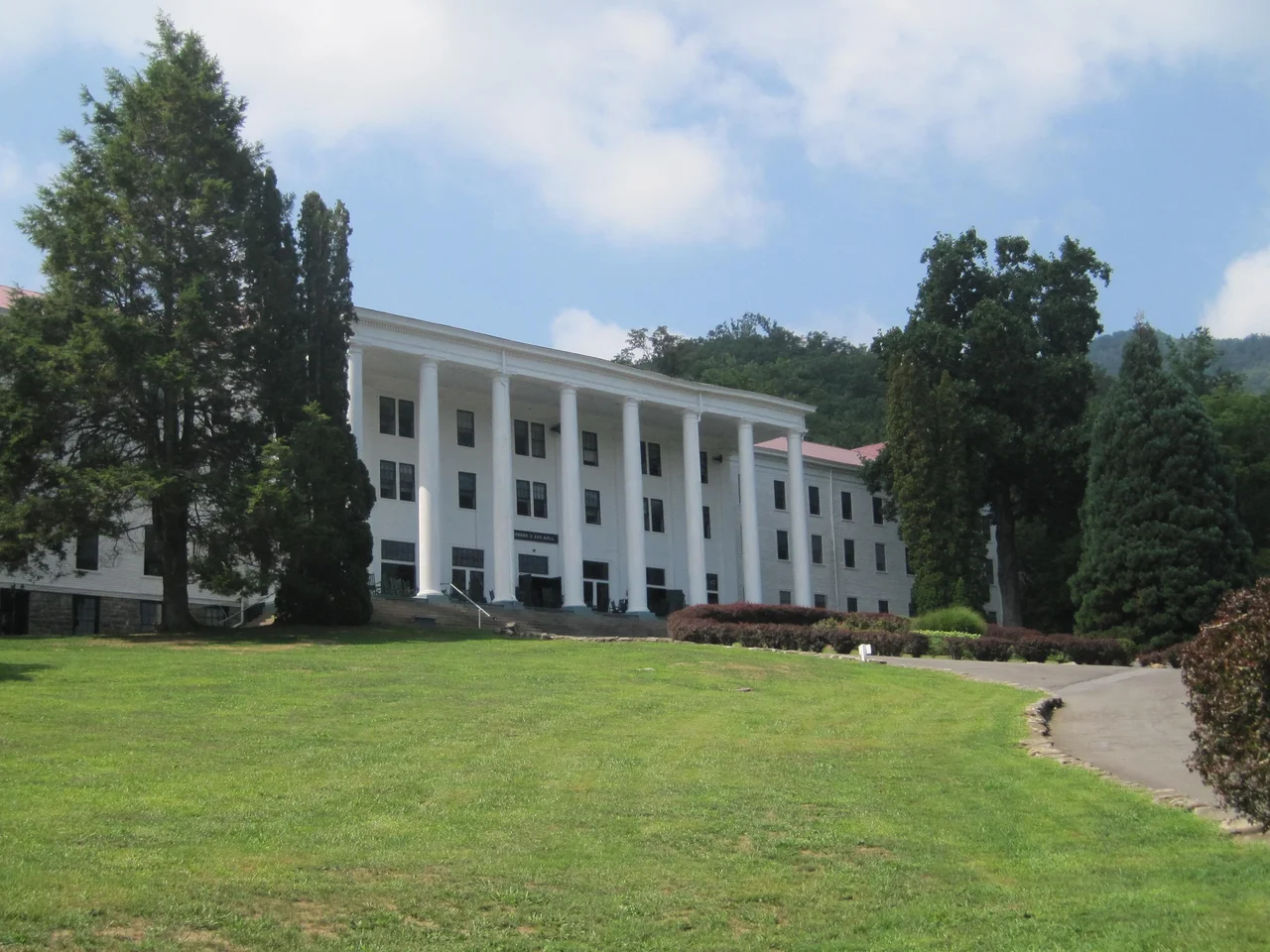

Black Mountain College
Four professors got fired from Rollins College in 1933 for refusing to sign a loyalty pledge. They had no job and no plan, and they were standing at the edge of the worst depression American higher education had ever known. Within months they were renting a YMCA assembly building south of Black Mountain, North Carolina, and starting an experimental college built around a single radical idea: that art-making was not extra-curricular but central to learning. They opened with a $10,000 gift from a former Rollins colleague named Mac Forbes. They had no accreditation, no endowment, and no rules about when students should graduate. In the twenty-four years that followed, that improvised school changed American culture.
The Founders and the Refugees
John Andrew Rice, Theodore Dreier, Frederick Georgia, and Ralph Lounsbury - the four exiles from Rollins - structured the college around John Dewey's philosophy of progressive education. The school was non-hierarchical: students and faculty made decisions together, owned the work of the farm and the kitchen together, and decided together when a student was ready to graduate, which famously few did. Then Hitler came to power. Rice and Dreier reached out to displaced European artists and intellectuals. In 1933 Josef and Anni Albers arrived from the closed Bauhaus - Josef spoke almost no English on arrival. The college effectively became the Bauhaus in exile, then went considerably further.
The Faculty
The names sound like a roster of mid-century American art. Josef and Anni Albers stayed for sixteen years, training painters and weavers who would shape every American art department after them. John Cage and Merce Cunningham came in 1948 and 1952 and used the college as the laboratory for the unscored, indeterminate performances that would become Happenings. Buckminster Fuller arrived in 1948 and attempted to build a geodesic dome with students in the meadow - it famously collapsed, earning the nickname the "supine dome." He succeeded with a second dome the following summer in 1949. Willem and Elaine de Kooning, Franz Kline, Robert Motherwell, Walter Gropius, Charles Olson, Robert Creeley, Aaron Siskind, Cy Twombly, M.C. Richards, Ruth Asawa, Robert Rauschenberg - the list of people who taught or studied at the college reads like the obituary section of a twentieth-century art encyclopedia.
Inside the Jim Crow South
Black Mountain operated in the segregated South. In 1944, the student Alma Stone Williams enrolled - by some accounts the first Black student to attend an all-white institution of higher education in the Jim Crow South. The Julius Rosenwald Fund paid the salaries of African-American instructors during the summer sessions: the contralto Carol Brice and the tenor Roland Hayes taught at the 1945 Summer Music Institute, the painter Jacob Lawrence and his wife Gwendolyn Knight taught at the 1946 Summer Art Institute. These were small acts of integration in a state where segregation was the law, and the college's record was not perfect - racial tensions existed in the surrounding county and within the campus - but Black Mountain was attempting something that nearly no Southern college of its era would attempt.
Lake Eden
The college rented the Blue Ridge Assembly buildings from 1933 until 1941. In 1937 it bought 667 acres across the valley at Lake Eden, and in May 1941 it moved there permanently. The Lake Eden campus is where the famous photographs were taken - Fuller's geodesic dome, the Albers in their studios, the John Cage piano prepared with rubber and bolts, the Rauschenberg paintings drying outdoors. Two frescoes painted by Jean Charlot in 1944 still survive on the buildings. After the college closed, the property became Camp Rockmont, an ecumenical Christian summer camp for boys. The Lake Eden Arts Festival now uses the same lake. The geographies of utopia and summer camp turned out to overlap exactly.
Closing and Legacy
Black Mountain College closed in 1957 by court order after running out of money. Albers had left in 1949 to chair Yale's new design department. Enrollment dwindled. The school's books were finally closed in 1962, all debts covered. But its alumni and faculty were just getting started: Rauschenberg's combines, Cunningham's choreography, Cage's silences, Asawa's wire sculpture, the Black Mountain poets around Charles Olson. Helen Molesworth's 2015 exhibition Leap Before You Look at Boston's ICA and the Hammer Museum cemented its retrospective canonization. The Black Mountain College Museum + Arts Center in downtown Asheville keeps the conversation alive. The original campus is still there at Lake Eden - the buildings smaller than memory suggests, the lake more beautiful.
From the Air
The Lake Eden campus is at 35.6324N, 82.3602W in the Swannanoa Valley, elevation roughly 2,300 ft, just east of the town of Black Mountain. Now operating as Camp Rockmont. Asheville Regional (KAVL) is 18 nm southwest. Hickory (KHKY) 38 nm east. Look for the lake from altitude; the surviving college buildings cluster on its west shore.
Nearby Stories
- Hendersonville, North Carolina 2.2 km away
- Forest City, North Carolina 4 km away
- North Carolina Mountains 7.7 km away
- Chattooga River 27 km away
- Grandfather Mountain 30 km away
- Joara 30 km away
- Great Smoky Mountains National Park 41 km away
- Knoxville: The Gateway to the Smokies Where Tennessee Began 87 km away