
Bombardment of Cherbourg
Just before noon on 25 June 1944, the battleship USS Texas was steering hard to starboard off the Norman coast when a 280-millimetre shell from the German Battery Hamburg punched through her hull and came to rest beside a sailor's bunk. The shell did not explode. It had been manufactured by slave labour somewhere in the Reich, and like a great many German shells fired that day, it was a dud. Across the task force, similar near-disasters were unfolding minute by minute. A shell jammed against the anchor chain of the destroyer USS Laffey was pried loose by the damage control party and tossed overboard. The men of US Task Force 129 came home that night because of German manufacturing failures - and because they had managed, between dud hits and smoke screens, to silence enough of the guns above Cherbourg for the army to break into the city.
What Cherbourg Was Worth
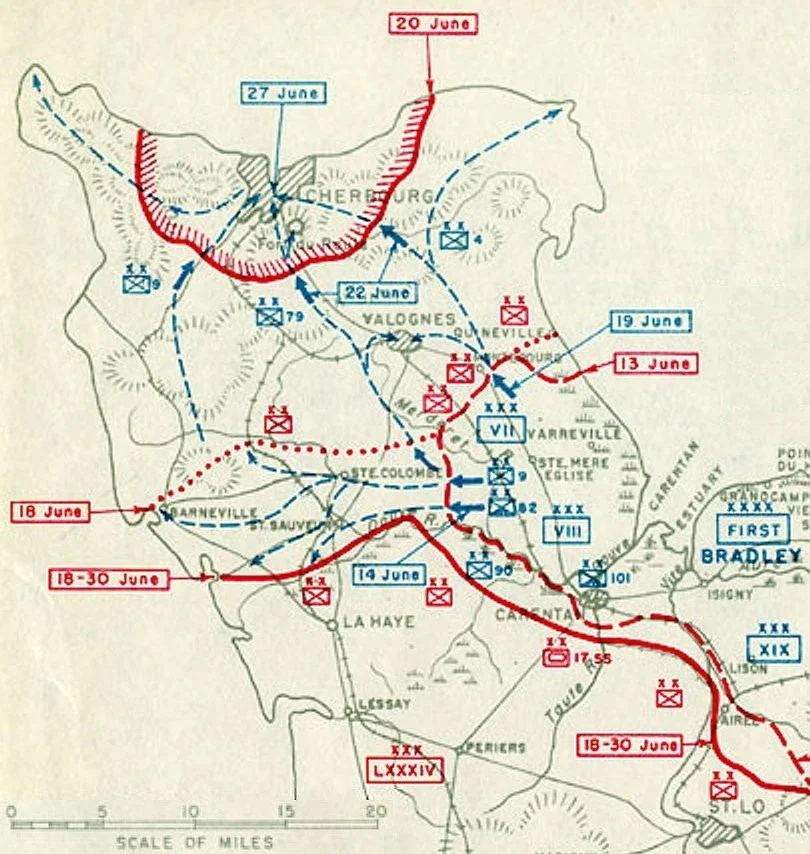
Cherbourg in June 1944 was the most heavily fortified coastal city in northwestern Europe. Twenty casemated coastal batteries ringed the city - massive concrete bunkers with steel and reinforced ceilings several feet thick, some armed with naval-calibre guns that could be trained inland against advancing infantry. The garrison was 40,000 strong. Hitler had ordered the place made impregnable and granted it 'fortress' status. American ground forces under Major General J. Lawton Collins had pushed three infantry divisions to within a mile of the German lines by 20 June, and on 22 June Collins launched his general assault. To break the back of the coastal artillery, the navy was asked to come close - closer than the doctrine prescribed - and slug it out with the bunkers gun-for-gun. Rear Admiral Morton Deyo started building the plan on 15 June. A late-June Channel storm scattered his ships out to sea, drove them into Portland Harbour in Dorset for shelter, and forced a reassembly before they could even start.
Two Battle Groups
Task Force 129 went to sea in two groups. Battle Group 1 under Deyo himself, flying his flag from the New Orleans-class cruiser USS Tuscaloosa, was assigned the inner harbour forts and the western approaches. With him came a battleship, more cruisers and six destroyers. Battle Group 2 under Rear Admiral Carleton Fanton Bryant aimed for the worst target on the list - Battery Hamburg, near Fermanville east of Cherbourg, which spotters described as the most powerful German strongpoint on the Cotentin. Bryant had the battleships USS Texas and USS Arkansas and five destroyers. Overhead, General 'Pete' Quesada's Ninth Air Force provided fighter cover. Grumman TBF Avengers of the British Royal Navy's Fleet Air Arm worked the anti-submarine screen. Two Allied minesweeping flotillas - one American, one British - swept lanes ahead of the heavy ships, repeatedly taking fire from the very batteries the bombardment was meant to silence.
Duel at Battery Hamburg
USS Arkansas opened fire on Battery Hamburg first, using a fire control system already two world wars old. Her salvos did no visible damage. As Battle Group 2 worked closer, the German guns at Hamburg straddled the minesweepers and bracketed the destroyers. USS Barton took a ricochet dud in her aft diesel room. USS Laffey took the dud in her port bow. The minesweepers were splashed by near misses. And then Texas, swerving hard between straddles, took the 280-millimetre shell that lodged beside a sailor's bunk. By 13:35 - more than an hour into the action - Texas had finally knocked out one of Battery Hamburg's main guns. She and Arkansas kept hammering through the afternoon, with destroyers laying smoke whenever the German fire grew accurate. Both battleships were targeted again, both manoeuvred away under cover of smoke, and both escaped without serious damage. The Germans never managed a clean explosive hit. The reason, according to Admiral Bertram Ramsay of the Royal Navy, was simply faulty ammunition - if the shells had worked, 'they might well have inflicted heavy damage to the Allied ships at the relatively close range'.
The Small Ships Did the Work
The thing that surprised everyone was that the big ships were not actually the most useful. The battleships disabled 22 of their 24 assigned targets but destroyed none of them - the casemates were simply too thick for direct hits to penetrate, and infantry had to go in afterwards to clear each bunker by hand. What worked best was something Allied planners had not particularly anticipated: the destroyers and the small ships providing call-fire to army shore parties. Each firing ship had an army artillery officer aboard who tracked Allied positions and decided whether each shoot was safe. The shore fire control parties watched the fall of shot and corrected fire by clock code. Under this system the small ships could put high-explosive shells onto point targets nine kilometres inland - on bunkers, on trench lines, on observation posts - exactly where the assaulting infantry needed them. After the action, Allied reports agreed: the most effective fire of the day came from the destroyers, not the battleships.
What It Did and Did Not Do
Eisenhower wrote later that 'the final assault was materially assisted by heavy and accurate naval gunfire'. Von Schlieben told Rommel that further resistance was useless in part because of the 'heavy fire from the sea'. Admiral Theodor Krancke, in his war diary, called it 'a naval bombardment of a hitherto unequalled fierceness'. The interrogations of captured German gunners told another story: many guns had fallen silent not because they were destroyed, but because their crews could no longer make themselves serve them under the storm of incoming shells. The Germans were demoralised, not annihilated. The naval historian Samuel Morison drew the lesson plainly afterwards: even the most modern fire-control systems could not let a manoeuvring warship destroy a casemated coastal gun with direct hits. The right tool for that job was infantry, walking up the road and clearing the bunker by hand. Cherbourg fell four days later. The harbour was so thoroughly demolished that the first ships could not use it until late July. The shells lodged in Texas and Laffey went to dud disposal. And somewhere in occupied Europe, factory workers had quietly sabotaged enough ammunition to save Allied lives - though no one would ever know their names.
From the Air
The bombardment was fought offshore north and east of Cherbourg Harbour (49.65°N, 1.63°W). Battery Hamburg's casemates still exist in the cliffs near Fermanville, about 12 km east of the city centre, and are visible as low concrete structures from the air. Cherbourg's three-breakwater outer harbour is the obvious landmark from cruise altitude. Nearest airports: Cherbourg–Maupertus (LFRC) 11 km east, Carentan (LFAD) 35 km south. Best viewed at 3,000-5,000 feet AGL. The English Channel here is busy with commercial traffic and often hazy at sea level.
Nearby Stories
- Abbey of Saint-Sauveur-le-Vicomte 4.3 km away
- Alderney Society Museum 9.3 km away
- Channel Islands 18 km away
- Operation Donnerkeil 31 km away
- German Submarine U-672 31 km away
- D-Day: The Longest Day 59 km away
- Fishbourne Roman Palace 103 km away
- Basilica of Sainte-Therese, Lisieux 110 km away