
Botum Sakor National Park
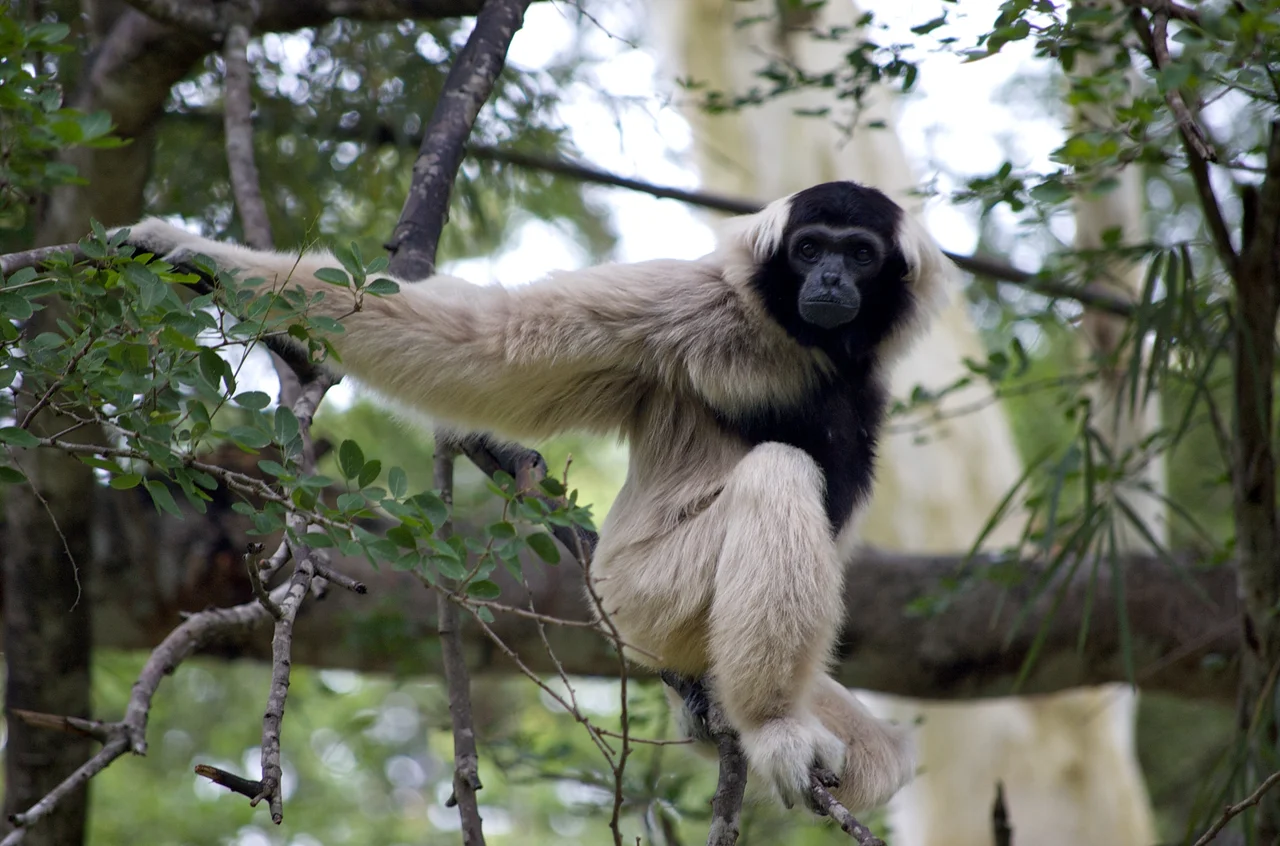
Before light reaches the canopy, the gibbons start. Pileated gibbon pairs sing at dawn — the male jet black, the female pale buff with a dark cap and belly — and the duet is a property claim, made by two animals who will hold the same patch of forest together for life. Researchers have estimated that as much as a tenth of the world's remaining pileated gibbons live on this single peninsula. The same peninsula carries a 3,200-metre international runway, a port cut for deep-draught ships, and a lease that does not expire until 2107.
A Peninsula Shrugged Off the Cardamoms
Botum Sakor pushes southwest out of the Cardamom Mountains into the Gulf of Thailand, and at the hinge the terrain changes character completely. Behind it the Cardamoms rise steep and streaming with rain. Here the land lies down. Most of the park's 1,826 square kilometres is gently sloping lowland: evergreen woods thinning into grassland, grassland sinking into coastal floodplain, floodplain dissolving into mangrove and freshwater swamp forest and finally into water. Two high tides a day push up the creeks. The monsoon does the rest, soaking the peninsula through the wet months and leaving it to bake once the rains move on. Cambodia's Ministry of Environment declared the park in 1993, drawing its boundary across three districts of Koh Kong Province — Kiri Sakor, Botum Sakor and Koh Kong. It is frequently described as the country's largest national park. It isn't; Southern Cardamom and Virachey are both considerably bigger. What it is, is one of the least surveyed.
The Uncounted
Little sustained fieldwork has been published here, which means the species lists are almost certainly short. Even so, over a quarter of the mammals recorded in the park carry some degree of global conservation concern: hairy-nosed and smooth-coated otters, the large-toothed ferret-badger, the large-spotted civet, sambar deer. A survey confirmed fishing cats in the park in 2009. In the creeks there is something rarer still. The Siamese crocodile was written off as effectively extinct in the wild in 1992, then found alive in the Cardamoms in 2000 by Fauna & Flora International working with Cambodia's Forestry Administration. Perhaps two to four hundred survive anywhere on Earth, most of them in Cambodia. In July 2024, sixty hatched from five nests in neighbouring Southern Cardamom National Park — the largest wild breeding record of the century for the species. Saltwater crocodiles are here too, and in Cambodia they are thought to be confined to Koh Kong Province alone.
One Hundred and Nineteen Thousand Hectares
The park was two years old when the leasing started in earnest. In November 1998 the Chinese firm Green Rich signed for 602 square kilometres of oil palm, fruit trees and acacia, more than eighty percent of it inside the park. Then a tapioca concession in 2010, a casino operator's holding in 2011, rubber the same year, a reservoir and hydropower contract in 2012. Add the areas together and the total passes 1,191 square kilometres — roughly seventy percent of the park, promised away. Satellite imagery from the years after 2008 shows clear-cutting advancing through the concessions on a schedule. The coastal mangrove has taken the worst of it. None of this replaced an untouched forest: between 1997 and 2002 illegal logging had already stripped an estimated 229 square kilometres of evergreen cover, and the rosewood cutters never really left.
Dara Sakor
The largest single concession was signed in April 2008 — 360 square kilometres, ninety-nine years, granted to the Tianjin-linked Union Development Group for a resort city called Dara Sakor. More than a thousand families lived on that land. Their homes were demolished, in many cases without adequate compensation, with private security and Cambodian armed forces present at the clearances. These were farming and fishing households whose claim to the peninsula long predated the park boundary, and who ended up with neither the forest nor the payment. What rose instead was an airport with a runway of roughly 3,200 metres, finished in 2024 and now handling small domestic flights to Phnom Penh, and port works deep enough for large vessels. In September 2020 the United States Treasury blacklisted Union Development Group, citing corruption and the seizure of land from Cambodians.
Snares and Surveys
The quieter damage is harder to photograph from orbit. Snare lines are set through the undergrowth, indiscriminate by design, and small mammals are taken opportunistically for food or for the traditional medicine trade. Snakes — king cobras, Malayan pit vipers — are killed on sight around the plantations. Cutters take not only rosewood but the saffrol laurel, a cinnamon relative whose oil feeds the drug trade, and the processing sites sit inside the park itself. Against this, Fauna & Flora International, Conservation International and Wildlife Alliance all work the Koh Kong corridor. The peninsula is not finished. Considerable forest still stands in the interior, the gibbons still sing over it at first light, and how much of that survives the lease is a question that has not yet been answered.
From the Air
Botum Sakor National Park occupies the peninsula at 11.1155°N, 103.2497°E, projecting southwest from the Cardamom Mountains into the Gulf of Thailand. Terrain is low — mostly under 100 m — so 3,000 to 5,000 ft AGL gives good detail without haze. The clearest navigational marker is the Dara Sakor runway (DSY/VDDS), a 3,200 m strip cut into coastal forest near the peninsula's western shore; the geometric edges of plantation blocks against ragged natural canopy are visible for miles. Sihanouk International (KOS/VDSV, elev. 40 ft, 3,300 m runway) lies about 70 km southeast. Southwest monsoon from roughly May to November brings low cloud, embedded rain and poor visibility; December through March is the reliable window.
Nearby Stories
- Tatai 12 km away
- Koh Rong 23 km away
- PMTair Flight 241 35 km away
- Bokor National Park 35 km away
- Khmer Rouge Tribunal 118 km away
- Battle of Pailin 159 km away
- U-Tapao: The Airfield Built on a Shipyard 247 km away
- Sultanate of Singora 469 km away