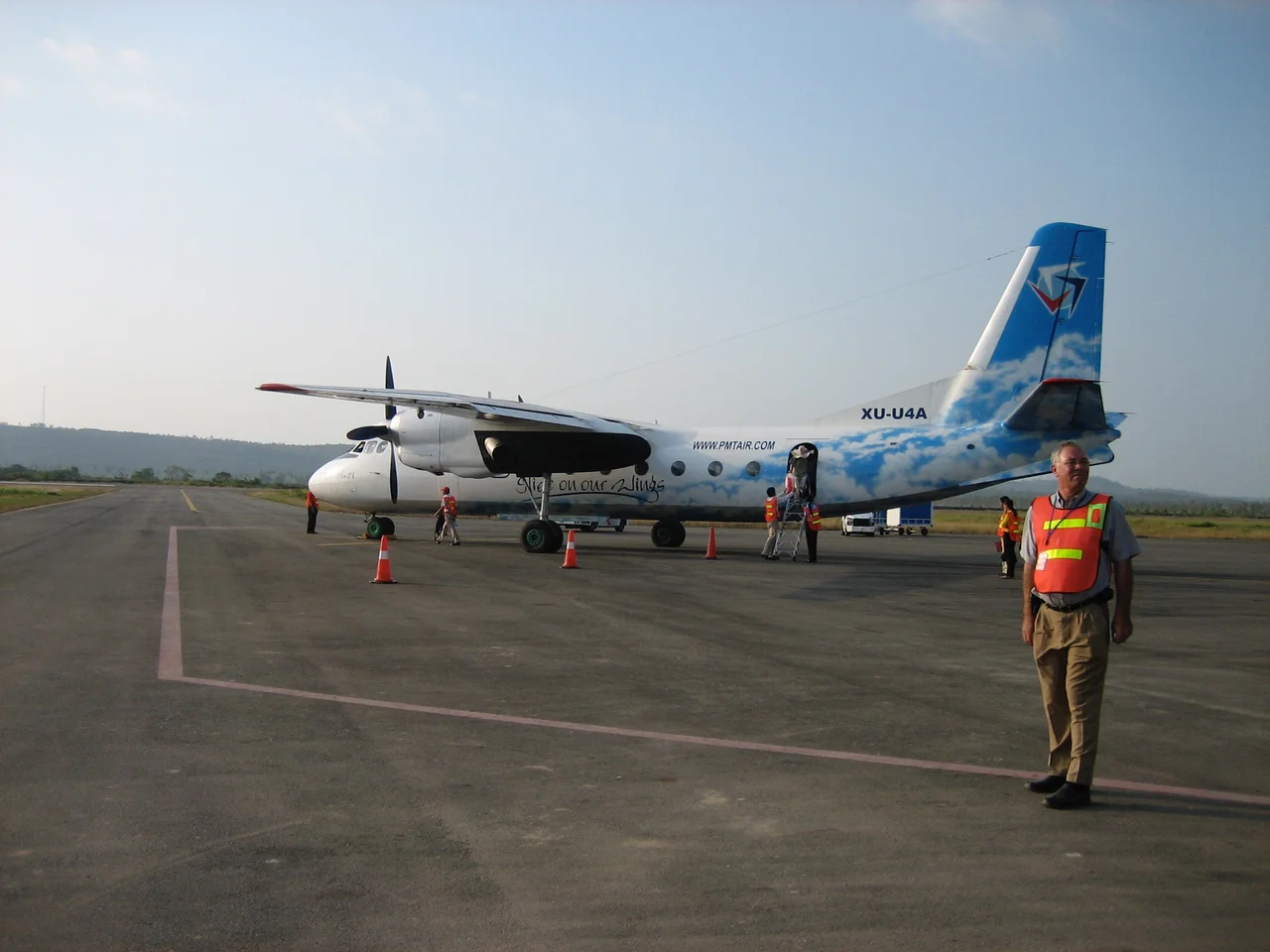

PMTair Flight 241
The last thing anyone heard from Flight 241 was an acknowledgement. Cleared to descend to 2,000 feet in cloud and rain somewhere north of Sihanoukville, the crew read it back at 10:48 on the morning of 25 June 2007. Two minutes earlier the aircraft's blip had already slipped below Phnom Penh's radar coverage; by 10:50 there was nothing on the frequency at all. The Antonov An-24B was 47 minutes into a flight that should have taken about an hour, carrying eighteen passengers and four crew from the temples of Angkor to the beaches of the southern coast. It had flown left of its designated track, and the Dâmrei Mountains were in front of it.
Twenty-Two People
Thirteen of the passengers were South Korean, travelling as a tour group. Cambodia's tourism industry was in the middle of a genuine recovery after decades of war, and South Koreans were its largest single source market - around 221,000 of the 1.7 million foreign visitors in 2006. Their itinerary was the standard one: Angkor Wat first, then the coast. Three Czech travellers were aboard, and five Cambodians, three of them the working crew. The other two were flight attendants riding home off duty, listed as passengers. In the cockpit, 42-year-old Uth Chan Dara, a Cambodian, was the pilot flying; alongside him sat the commander, 56-year-old Nikolay Pavlenko of Uzbekistan. PMTair had opened this Siem Reap-Sihanoukville route only that January, a small airline betting on the tourist boom.
The Aircraft and the Gap in the Cockpit
The An-24B had been built in Ulan-Ude in 1969 and had logged more than 25,000 flight cycles by that morning. Investigators found no recorded technical defects. What they found instead was a communications problem that nobody had thought to call a problem. Reviewing the air traffic control tapes, they noted that much of the exchange between the tower and the flight deck - including several critical portions - was conducted in Khmer rather than English. Captain Pavlenko did not speak Khmer. Whether his co-pilot translated any of it is unknowable, because both flight recorders were later returned by Russia's Interstate Aviation Committee containing no data at all from the accident flight. The investigation had radar traces and radio tapes, and nothing from inside the cockpit.
Four Days
The search was enormous and, for most of its length, futile. Thousands of soldiers and police worked the jungle below the mountains while helicopters went up whenever a rainstorm cleared, and came back with nothing. Prime Minister Hun Sen travelled to Kampot to meet military commanders, offered a US$5,000 reward to anyone who found the wreck, and asked Washington to turn surveillance satellites onto the search; the United States joined the effort. In Incheon, relatives of the Korean passengers boarded flights to Phnom Penh within hours of the news, were put on a bus to a hotel, and waited there while a jungle they had never seen was searched on their behalf. On 29 June the wreckage was found on Phnom Damrey at an elevation of about 2,700 feet, lying inverted on the slope. There were no survivors. "This is a tragedy no one should have to experience," Hun Sen said.
What the Report Could and Could Not Say
The investigation was completed in March 2008. It laid out a chain rather than a single cause: the crew had continued beyond their designated route, they had continued the descent in weather that did not justify it, and PMTair's management had been poor. But Kao Sivoeun, the civil aviation official overseeing the process, said plainly that investigators could not determine whether the airline or the pilots were to blame. With blank recorders, the question stayed open. Cambodia suspended PMTair's domestic flights until the report was published; the airline ceased operations entirely in 2008. In 2011 a Korean court found for eleven families who had sued, ordering compensation totalling 3.2 billion won. Flight 241 remains the second-deadliest air disaster in Cambodian history, behind Vietnam Airlines Flight 815 in 1997.
The Mountain Keeps It
Phnom Damrey is not a dramatic peak. It is part of a densely wooded ridge running down toward Kampot, high enough to catch cloud on almost any wet-season morning and to hide a thirty-metre aircraft completely from helicopters flying directly overhead. That is the whole geometry of the accident in a sentence: a modest mountain, a descent begun early, and weather that made the difference between the two invisible. The Dâmrei have been a barrier for as long as anyone has moved through this part of Cambodia - to armies, to roads, to the pepper trade. In June 2007 they were a barrier to twenty-two people who had every reason to expect to be on a beach by lunchtime.
From the Air
Crash site near 10.85°N, 103.93°E, on Phnom Damrey in the Dâmrei (Elephant) Mountains, at roughly 2,700 ft elevation and about 27 nautical miles from Sihanoukville. The terrain is a continuous forested ridge with no distinguishing summit from the air, which is precisely why the search took four days. Recommended viewing altitude 5,000-8,000 ft AGL for the ridge profile, approaching from the Gulf side. Nearby airports: Sihanoukville International (VDSV) to the southwest, Kampot (VDKT) to the southeast, Phnom Penh International (VDPP) to the northeast, Siem Reap (VDSR/VDSA) far to the north. Terrain-induced cloud is routine here during the May-October southwest monsoon and can sit below ridge height for hours; treat any descent over this ridge on a published profile with care.
Nearby Stories
- Koh Rong Marine National Park 10 km away
- Dara Sakor International Airport 17 km away
- Bokor Hill Station 18 km away
- Southern Cardamom National Park 31 km away
- Hà Tiên 39 km away
- Tatai 39 km away
- Doun Kaev 40 km away
- Khmer Rouge Tribunal 51 km away