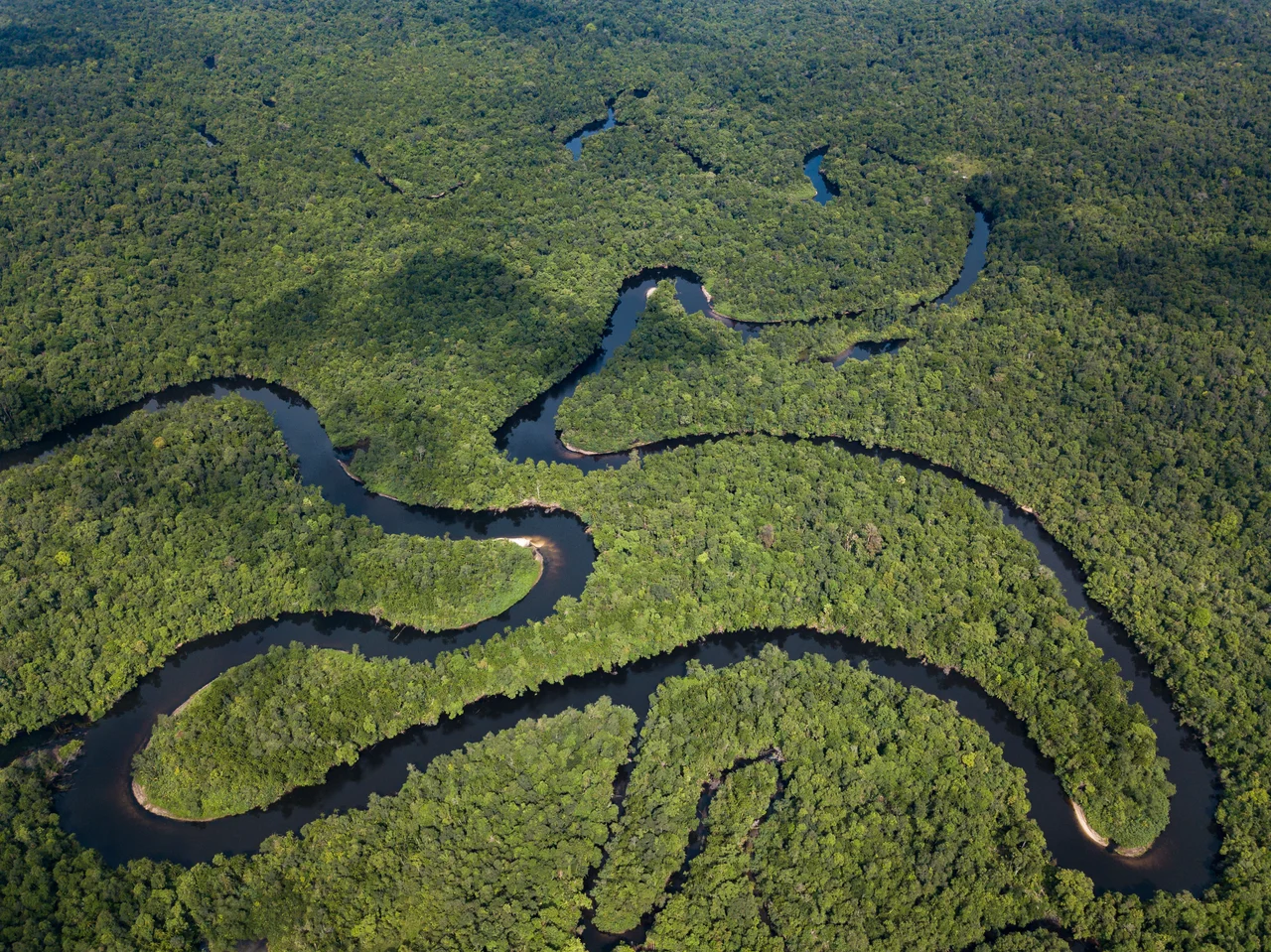

Southern Cardamom National Park
The park was designed around an absence. Tigers vanished from Cambodia in 2007, and when the government drew the boundaries of Southern Cardamom National Park nine years later, one of the stated purposes was to hold a forest large enough and safe enough that tigers could one day be brought back to it. That is an unusual thing to build: 4,104 square kilometres of protection for an animal that is not there, on the bet that the prey, the cover and the quiet can be assembled first and the predator added afterwards. Everything difficult about conservation in the Cardamom Mountains follows from that bet - what a forest is for, who it belongs to, and who pays to keep it standing.
One Park, Made of Many
Sub-decree 89 established the park on 9 May 2016, dividing it into Western, Central and Eastern sectors across the southern flank of the Cardamom range. Its real significance is not its own footprint but what it joins together. To the north lie Phnom Samkos Wildlife Sanctuary, Central Cardamom Mountains National Park and Phnom Aural Wildlife Sanctuary; to the south, Peam Krasop Wildlife Sanctuary, Botum Sakor National Park and Kirirom. Southern Cardamom is the connective tissue between them, and with it in place the greater Cardamom landscape amounts to 18,211 square kilometres of contiguous protected area - a block of Southeast Asian forest big enough for animals that need to move. Elephants do not respect sector lines. Neither, eventually, would a tiger.
Sixty Small Survivors
In July 2024, sixty Siamese crocodiles hatched from five separate nests inside the park. For a reptile that has lost more than eighty percent of its global population since the 1940s, that number was extraordinary - the largest wild breeding record of the species this century. Siamese crocodiles were thought effectively gone from Cambodia until a survey rediscovered them in the Cardamoms in 2000, and even now the country's wild population, the world's largest, is conservatively put at between two and four hundred animals across roughly thirty sites. The park shelters more than sixty globally threatened species besides them, including Malayan sun bears and Sunda pangolins, along with seventeen endangered tree species, some found nowhere outside Cambodia. Five nests is a fragile foundation. It is also the most hopeful thing to happen to the species in decades.
Who Pays for a Forest
Protection costs money, and the money came from carbon. The Southern Cardamom REDD+ project, run by Cambodia's Ministry of Environment with the conservation group Wildlife Alliance, began in January 2015 across roughly half a million hectares; Verra certified it in 2018, and multinational companies in Europe and the United States bought its credits to offset their own emissions. The mechanism is elegant on paper. A forest that would otherwise be cleared is kept standing, the avoided emissions are measured, and someone else's carbon accounting pays the rangers. What the paper did not capture was that people were already living inside the boundaries being drawn - eight villages of Chong, an Indigenous people of the Cardamoms whose ancestors were described by a Chinese envoy to Angkor in 1296.
The Cost Nobody Counted
Human Rights Watch published its findings in February 2024, after interviewing more than ninety people across twenty-three of the project's twenty-nine villages. The first community consultations, it found, did not take place until August 2017 - thirty-one months after the project started. Six Chong families were forced off land they had customarily farmed. Three community members were detained for months without trial. Two men described being arrested, in 2018 and 2021, while collecting resin, a practice their families have used for generations without felling a tree. One of them recalled the moment: "When they first rushed into the camp they hit me in the back with their gun. They destroyed everything I had with me - even the clothes on my back." Verra stopped issuing credits and opened a review in June 2023. Wildlife Alliance denies wrongdoing, pointing to wells, schools, scholarships and health posts built for local villages, though no formal benefit-sharing agreement exists with the communities affected.
What the Park Has Left to Prove
Both things about this place are true at once. The forest is genuinely intact, the crocodiles genuinely hatched, and the corridor genuinely connects. And the households that lost their farmland to that outcome were among the poorest in one of the poorest provinces in Cambodia, asked to underwrite a climate transaction that neither began nor ended with them. The tiger reintroduction has not happened. Whether it ever does depends less on the biology - the prey base, the corridors, the source population - than on whether the eighteen thousand square kilometres can be held together for the decades it would take. That, in turn, depends on the Chong villages inside the lines deciding that this park is worth defending. So far, nobody has made that case to them convincingly enough.
From the Air
Southern Cardamom National Park centres near 11.43°N, 103.67°E, spanning the southern flank of the Cardamom Mountains in Koh Kong and Pursat provinces. Best viewed from 8,000-12,000 ft, high enough to appreciate the scale of unbroken canopy and the way the ridges run northwest to southeast with almost no roads, clearings or lights breaking them. Landmarks are natural rather than built: the Preak Piphot and Areng river systems, steep-sided valleys, and the abrupt transition from forest to coastal plantation on the southern edge. Nearest airports: Sihanouk International (VDSV/KOS), Dara Sakor International (VDDS/DSY) on the Koh Kong coast, and Phnom Penh International (VDPP/PNH). Terrain elevation is modest but rugged, and there are no emergency landing options over the interior. Weather: the southwest monsoon runs roughly May to October, with windward slopes receiving 3,800-5,000 mm of rain annually; expect persistent low cloud, rapid convective build-up over the ridges, and poor visibility in the wet season.
Nearby Stories
- Cambodian campaign 6.2 km away
- Tatai Wildlife Sanctuary 9.1 km away
- Koh Kong 12 km away
- Central Cardamom Mountains National Park 19 km away
- Operation Cuu Long 44-02 36 km away
- Sangkae River 62 km away
- Boeng Tonle Chhmar 118 km away
- Koh Poulo Wai 149 km away