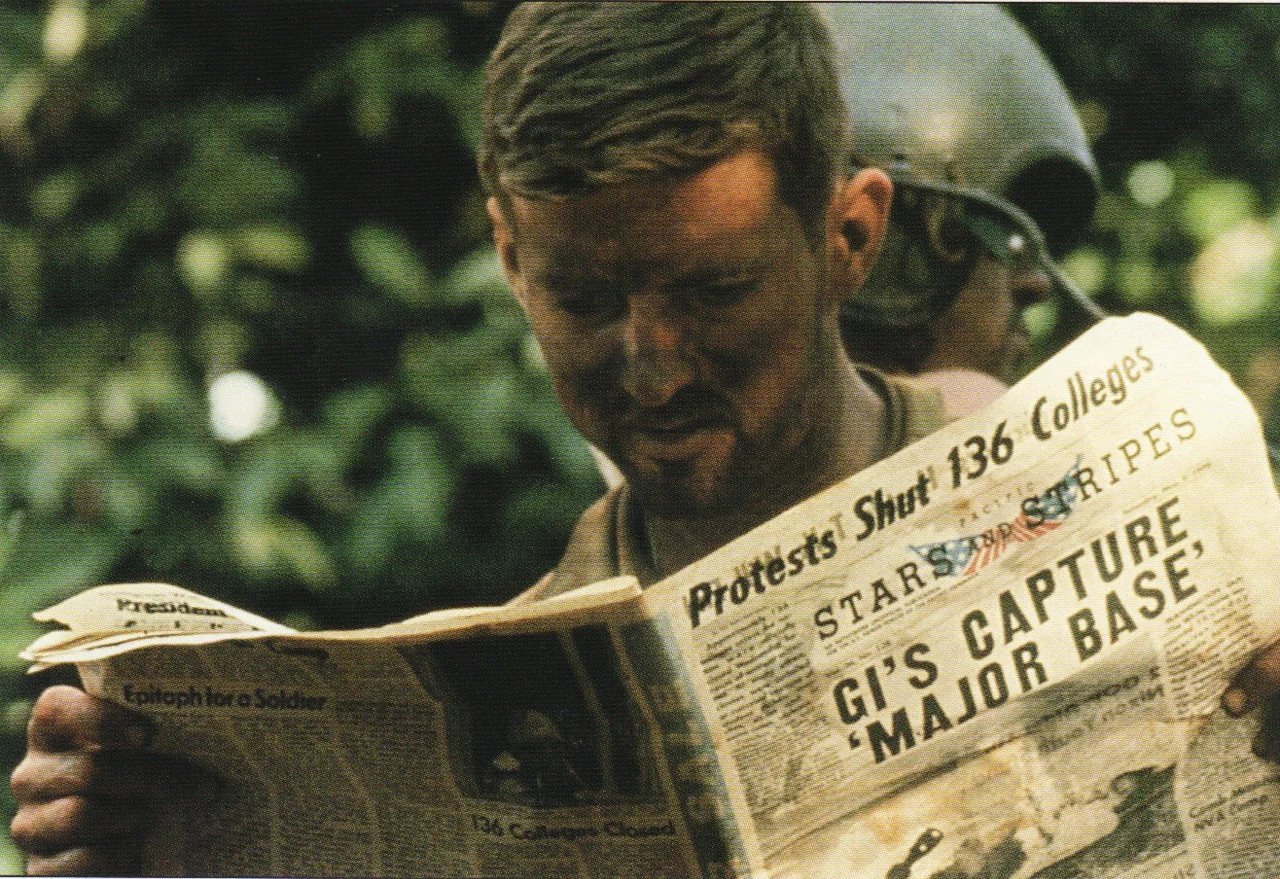

Cambodian campaign
It had already gone. On 19 March 1970 the Central Office for South Vietnam — COSVN, the mobile command running the communist war in the south, and the single object American planners most wanted to seize — packed up and moved north. Six weeks later, at nine in the evening on 30 April, President Richard Nixon went on all three American television networks to announce that US forces were entering Cambodia to capture "the headquarters of the entire communist military operation in South Vietnam." His troops had crossed the border ninety minutes earlier, and his own command had already advised the White House that catching COSVN was not feasible.
The Sanctuaries
For most of the 1960s eastern Cambodia was the back room of the war next door. North Vietnamese units had been crossing since 1963, and in 1966 Prince Norodom Sihanouk — hedging against a communist victory he thought inevitable — agreed with Beijing to permit permanent bases on Cambodian soil and resupply through Sihanoukville. Weapons came up the Sihanouk Trail to base areas where roughly 40,000 North Vietnamese and Viet Cong troops could rest and reorganise beyond American reach. Washington knew. Rather than confront Sihanouk, President Johnson authorised covert reconnaissance across the border, and after the Tet offensive of 1969 an enraged Nixon signed off on a secret bombing campaign. Cambodia was, formally, neutral.
Spring, 1970
The arrangement collapsed in weeks. Sihanouk was deposed in March and replaced by General Lon Nol, pro-American and militarily weak. On 29 March the North Vietnamese attacked the Cambodian army — at the explicit request of the Khmer Rouge, Soviet archives later revealed — and swept up much of the east of the country. On 14 April Lon Nol appealed for help, saying Cambodia was about to lose its independence. The communist leadership, meanwhile, was already walking north; Trương Như Tảng, justice minister in the Provisional Revolutionary Government, remembered the retreat toward Kratié as forced marches broken up by B-52 raids. Nixon was blindsided by all of it. "What the hell do those clowns do out there in Langley?" he asked the National Security Council.
The People Nobody Was Fighting
Roughly 400,000 people of Vietnamese descent lived in Cambodia, many in families settled for generations. Lon Nol decided they were useful as hostages against North Vietnamese attack and had them rounded up and interned. Soldiers and civilians went further, and the police helped organise it: thousands were murdered in pogroms across the country. On 15 April, at the village of Chroy Changvar, 800 Vietnamese men were tied together, executed, and pushed into the Mekong. The bodies drifted downstream and came ashore in South Vietnam, where their arrival enraged a public on both sides of a war otherwise divided about everything. These were fishermen, shopkeepers, farmers and their sons. They had no part in the fighting that was used to justify killing them.
Toan Thang
The incursion came in two thrusts. On 30 April some 8,700 South Vietnamese troops under Lieutenant General Đỗ Cao Trí — who had refused to start a day earlier because his astrologer found the heavens unfavourable — drove into the Parrot's Beak in Svay Rieng. The next morning 36 B-52s laid 774 tons of bombs on the Fishhook, and Task Force Shoemaker went in behind them with 10,000 American and 5,000 South Vietnamese troops. The only conventional battle Americans fought was at Snuol, where resistance was answered with two days of air strikes that left the town in rubble. Southwest of it they found what soldiers named "The City": two square miles of huts and bunkers packed with supplies, with truck repair shops, hospitals, eighteen mess halls, a pig farm and a swimming pool. The haul ran to 22,892 individual weapons, up to 8,000 tons of rice and 1,800 tons of ammunition.
The Bill
The allies claimed 11,369 enemy dead and 2,328 prisoners; a CIA official later acknowledged the body count included civilians. American losses were 338 killed, South Vietnamese 638; General Nguyễn Viết Thanh, who planned the Parrot's Beak operation, died in a helicopter crash on 2 May. At home the reaction was immediate and violent. On 4 May, Ohio National Guardsmen shot dead four unarmed students at Kent State University, two of whom were not taking part in the protest. On 15 May police killed two students and wounded twelve at Jackson State College in Mississippi, a historically Black school whose dead received a fraction of the attention. Congress moved too: the Cooper–Church amendment, passed that December, barred American ground troops from Cambodia and Laos, and the Gulf of Tonkin Resolution, under which two presidents had waged seven years of undeclared war, was repealed.
What Was Left Behind
Nixon called it "the most successful military operation of the entire war." The North Vietnamese, forewarned and under orders to break contact rather than fight, rebuilt their logistics through Laos; by 1972 they were supplying the siege of An Loc out of Cambodia again. What did not recover was Cambodia. The allies withdrew from ground they could not hold, the North Vietnamese and the Khmer Rouge filled the vacuum, and an insurgency that had been marginal in 1968 was flooded with weapons, advisers and — historians have argued ever since — recruits the incursion itself produced. The fighting spread west: in January 1971 South Vietnamese troops fought to reopen National Road 4 at the Pich Nil Pass in the Elephant Mountains, closed by a North Vietnamese division. Four years after the incursion the Khmer Rouge held Kampot. Five years after it, they held everything.
From the Air
This story is pinned to 11.195°N, 104.074°E — the Pich Nil Pass, where National Road 4 threads the Elephant Mountains between Phnom Penh and the coast, and where in January 1971 South Vietnamese forces fought to reopen the highway after a North Vietnamese division occupied it. The wider campaign ranged across eastern Cambodia, from the Parrot's Beak in Svay Rieng (about 11.0°N, 105.8°E) and the Fishhook in Kampong Cham to Snuol on the Vietnamese border, roughly 200-350 km northeast of here. From the air the Pich Nil is obvious: a single road cutting a green saddle between forested ridges, with the Gulf of Thailand visible to the southwest on a clear day. Best viewing altitude is 6,000-10,000 ft. Nearest airports are Techo International (VDTI) south of Phnom Penh, about 85 km northeast, and Sihanouk International (VDSV), about 80 km southwest. Cloud stacks against the ridges through the May-October southwest monsoon; the dry season from November to April offers the clearest terrain.
Nearby Stories
- Southern Cardamom National Park 4.8 km away
- Phnom Chisor 6.8 km away
- Khmer Rouge Tribunal 11 km away
- Bokor National Park 23 km away
- Tatai Wildlife Sanctuary 26 km away
- Kbal Chhay Waterfall 27 km away
- Lê Văn Duyệt 41 km away
- Tuol Sleng Genocide Museum 75 km away