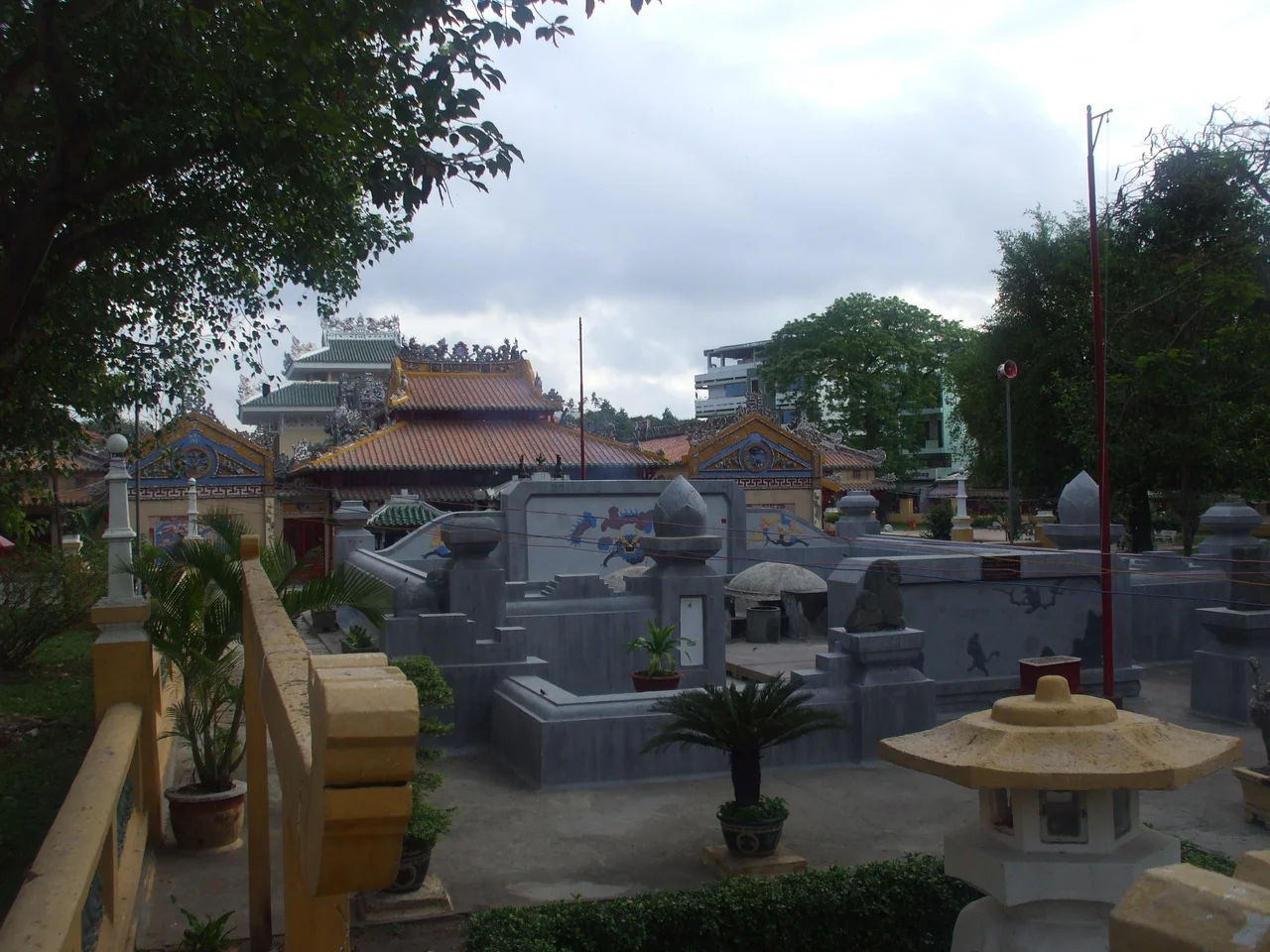

Lê Văn Duyệt
"We still have between our teeth the rice which the missionaries gave us when we were starving." Lê Văn Duyệt wrote that to Emperor Minh Mạng, who had just ordered every Catholic missionary in Vietnam to report to the imperial capital - officially to work as translators, actually to stop them preaching. Officials in the centre and the north complied. Duyệt, who governed the entire south as viceroy and answered to nobody within a month's ride, did not. He had spent fifty years accumulating the standing to write a sentence like that, and the rest of his life discovering that an emperor's patience is finite. The canal cutting across this borderland is his, and so is much of what the delta became.
The Fugitive's Household
Duyệt was born around 1763 or 1764 in Định Tường, deep in the marsh country of the Mekong Delta. He was intersex, a fact recorded plainly by the court and later flattened by Europeans into a nickname - "the Great Eunuch" - that told them what they expected rather than what was true. In 1780 he entered the household of Nguyễn Ánh, an eighteen-year-old prince and the most senior survivor of a family that the three Tây Sơn brothers had swept out of southern Vietnam three years earlier. The prince was a fugitive hiding in the delta's jungles. Duyệt was made a Cai Cơ, a commander of bodyguards, and in 1782, when the Tây Sơn retook Gia Định yet again, it was Duyệt who got him out and across the water to the island of Phú Quốc. The two men would spend two decades winning the country back.
Thị Nại
Made a general in 1789, Duyệt fought the long grinding campaigns up the south-central coast around Nha Trang and Qui Nhơn, and in 1801 engineered the naval victory at Thị Nại that broke the Tây Sơn for good. That same year a close colleague, Tống Viết Phúc, was killed in battle, and Duyệt went into a rage that ended with him killing enemy soldiers indiscriminately - conduct his own lord rebuked him for, which is worth recording alongside the victories. In 1802 Nguyễn Ánh took Phú Xuân, declared himself Emperor Gia Long, and sent Duyệt north with the ponderous title Marshal of the King's Left Division, Tây Sơn Pacification General. By October the north had fallen. Duyệt renamed it from Bắc Hà, Northern River, to Bắc Thành, Northern Citadel, and the war was over. Southerners called him Cọp Gấm Đồng Nai, the White Tiger of Đồng Nai.
Eighty Thousand Diggers
The straight line of water running southwest from Châu Đốc toward Hà Tiên is the Vĩnh Tế Canal, eighty-seven kilometres of it, begun at the end of 1819 under Gia Long and finished in 1824 under Minh Mạng. Nguyễn Văn Thoại directed the digging; Duyệt, as viceroy, supervised the works that completed it. Roughly eighty thousand people cut that channel by hand - Vietnamese and Khmer conscripts working sour, waterlogged ground in a malarial season, and many of them died, of disease and of the fighting that kept flaring along the frontier. When the canal was named in 1824, the honour went to Châu Vĩnh Tế, Thoại's wife; the historian David Biggs suggests it was for the relief she organised for the families of the dead. The canal made the Vietnamese south defensible and farmable. It is also a mass grave with a towpath, and the Khmer villages along it have not forgotten which came first.
The Viceroy Who Would Not Obey
Duyệt governed the south from 1812 to 1815 and again from 1820 until his death, and Minh Mạng handed him extraordinary powers: authority over all foreign trade entering his territory and the right to set taxes in Cambodia at his own discretion. He used them like a man who had never sat an examination, because he never had. He put former rebels, bandits and newly arrived Chinese refugees into administrative posts if they could do the work. He courted the Chinese merchant community so assiduously that the court in Huế came to see the whole southern trade as a smuggling operation running rice out and opium in. He sheltered Catholic converts and European missionaries from the emperor's edicts. Minh Mạng, a rigorous Confucian who found all of this an insult to the shape of a proper state, rewarded him with a jade belt and a princess for his adopted son, and quietly spent a decade removing his subordinates one by one.
A Stele and What It Could Not Do
Duyệt died in the Citadel of Saigon on 30 July 1832, aged sixty-eight. Minh Mạng abolished the office of viceroy, making him the last man to hold it, then had his tomb broken open and a stele set over the ruins reading: "Here lies the eunuch Lê Văn Duyệt who resisted the law." On 10 May 1833 Duyệt's adopted son Lê Văn Khôi rose in revolt. The rising held the south briefly, drew in a Siamese invasion, and took three years to crush. The stele lasted rather less well than the reputation it was meant to bury. Emperor Thiệu Trị rehabilitated him; Tự Đức made the tomb a national monument; the French colonial administration, busy dismantling everything else imperial, left his annual festival alone and sent politicians to it. His face appeared on a South Vietnamese hundred-đồng note. Today the shrine at Lăng Ông in Bình Thạnh draws Buddhists, Catholics, Vietnamese and Chinese alike - a local hero venerated across every line that usually divides.
From the Air
This point, near 10.57°N, 104.926°E, sits over the western end of the Vĩnh Tế Canal corridor, where the waterway Duyệt completed runs toward the Gulf of Thailand at Hà Tiên. From 4,000-7,000 feet the canal is unmistakable: a dead-straight seam of water crossing an otherwise braided, chaotic delta, with the limestone karst outcrops behind Hà Tiên to the west and the Seven Mountains rising to the northeast. Rạch Giá (VVRG) is about 38 nautical miles south-southeast, Phú Quốc (VVPQ) about 60 nautical miles southwest, and Cần Thơ (VVCT) about 55 nautical miles east-southeast. Best light is early morning before the delta haze thickens; the southwest monsoon from May to October brings low cloud and heavy afternoon convection.
Nearby Stories
- Angkor Borei and Phnom Da 9 km away
- Phnom Sorsia 9.5 km away
- Koh Ach Seh 10 km away
- Óc Eo 29 km away
- Cambodian campaign 50 km away
- Collapse of Can Tho Bridge 50 km away
- Battle of Tri Phap 53 km away
- Battle of Prek Klok I 103 km away