
Angkor Borei and Phnom Da
You cannot dig most of Angkor Borei, because people live there. A working market town in Takeo Province sits directly on top of what may be the oldest city in Cambodia: houses, roads, a pagoda and a school laid over roughly three hundred hectares of walled and moated settlement that was already ancient when Angkor was still floodplain. Archaeologists work the gaps - a garden plot here, a road cutting there, the ground beneath a temple when the monks allow it. Three kilometres to the southeast, on a granite outcrop called Phnom Da, they had a freer hand. What came off that hill rewrote the beginning of Khmer art.
Three Hundred Hectares, Occupied
The outline of the old city is still legible from above. Brick and earthen walls with moats enclose about 300 hectares, and inside them archaeologists have counted more than a hundred water features - reservoirs, ponds, channels - the work of a settlement managing water on a serious scale centuries before the great baray of Angkor.
Systematic work began late. Miriam Stark and the Lower Mekong Archaeological Project ran field investigations here in 1995 and 1996, returning to excavate a cemetery in 1999 and 2000, and their reports remain the backbone of what is known. Progress is necessarily piecemeal, since every trench must be negotiated around a living community. The interpretation of one of Southeast Asia's most important early cities rests on a handful of small windows into the ground.
The Cemetery at Vat Komnou
One of those windows opened onto a burial ground. The Vat Komnou cemetery held roughly sixty people interred between about 200 BC and AD 400, and their remains are the most direct testimony this place has left us - more direct than any inscription, because nobody edited them.
With them came over thirteen hundred glass and stone beads. Beads are unglamorous finds and also among the best trade evidence archaeology has, since raw materials and manufacturing techniques can be traced to their sources. These show a delta community plugged firmly into a network reaching west across the Bay of Bengal. The teeth tell a quieter story: they lack the wear and decay associated with heavy consumption of sugars and starches, pointing to a diet unlike that of the rice-centred Cambodia that came after.
The Oldest Date in the Country
On a rise called Vat Chroy, on the right bank of the Angkor Borei river, someone once set up a stone that now carries a small distinction: inscription K. 557/600 bears the date 611, and it is the earliest dated inscription known from Cambodia. George Coedes published it in 1942. It is written in Old Khmer with Sanskrit loanwords, cut in an early Pallava script derived from Brahmi - a South Indian hand, used to write a Southeast Asian language.
What it records is a donation of people. Men and women were given to religious foundations along with land and goods, and the stone lists them by name. Those names are the surprise. They come from Sanskrit, from Old Khmer, and from Austronesian and Austroasiatic languages, which means the bonded households of this city were drawn from several different peoples. For most of them, a name carved by someone else, in a transaction they did not choose, is the only trace they left.
Vyadhapura, Probably
Chinese court records describe a Mekong polity they called Funan, and generations of historians have tried to pin its capital, Vyadhapura, to a map. Angkor Borei is the leading candidate and has been for a long time. The case is circumstantial but strong: a large walled and moated settlement of the right period, sitting at the inland end of a canal that runs 68 kilometres southeast to the great port of Oc Eo.
The case is not closed. George Coedes built his identification partly on an etymology - the Chinese Temu rendering a Khmer word for hunter - that later linguists rejected, and others have looked instead toward Ba Phnom. Funan itself is a Chinese label found in no local text, and whether it named a single kingdom or a shifting alliance of city-states is still argued. Probably Vyadhapura, then. Say it that way and you are being accurate rather than evasive.
The Hill Where Khmer Sculpture Begins
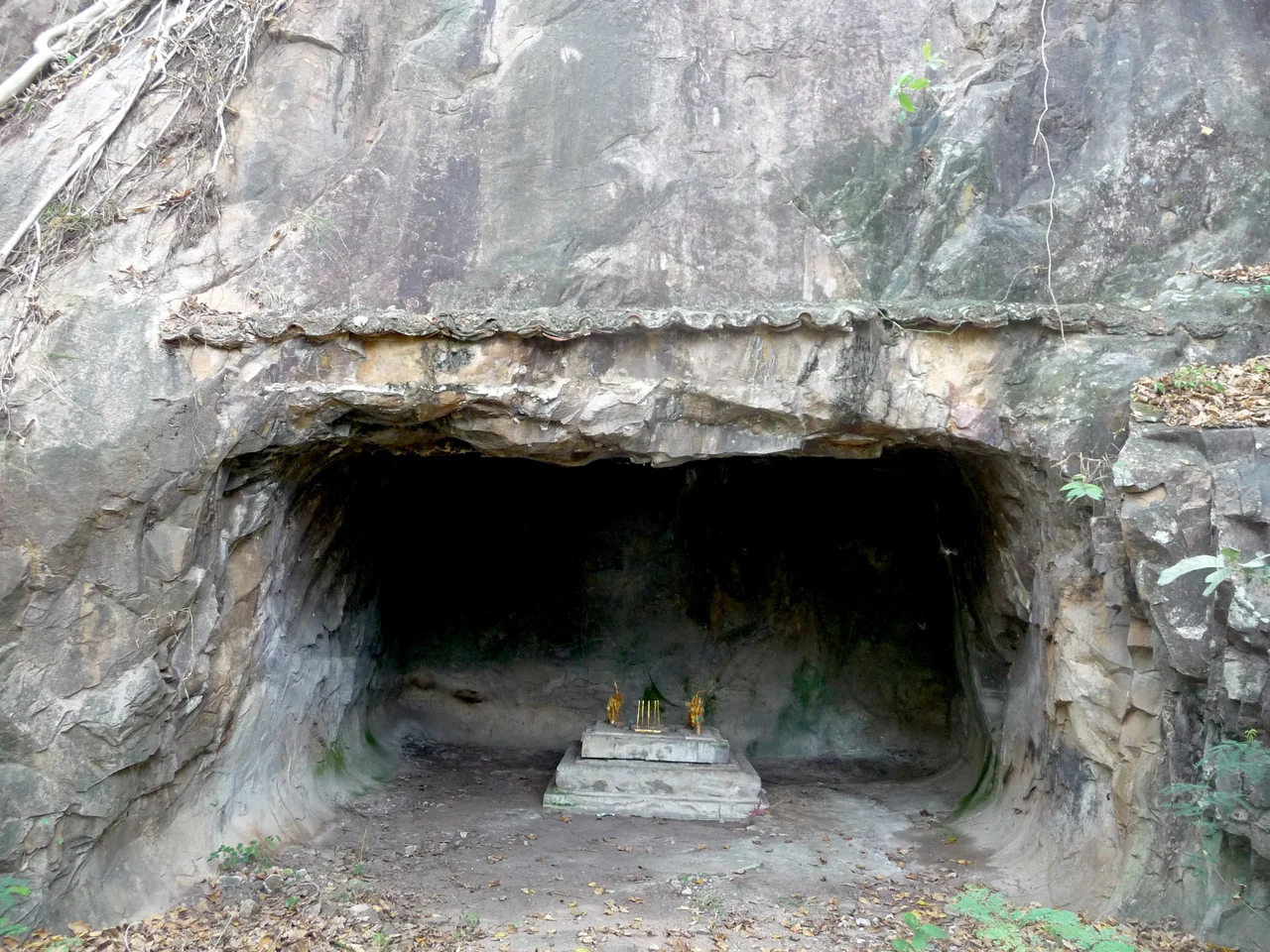
Phnom Da is a granite outcrop with a brick temple on its summit, and it holds the oldest surviving temple architecture and very likely the earliest stone statues in Cambodia. The masterpiece is a triad. Vishnu stands 288.5 centimetres tall, flanked by his avatars Rama at 179.8 and Balarama at 185.5, all carved from sandstone in the sixth or seventh century and now in the National Museum in Phnom Penh.
The Vishnu has eight arms, with attributes preserved in six hands and two more presumed lost, each tied to one of the eight Lokapalas who guard the regions of space. Behind the figure is the technical breakthrough: the carvers left an arch of the original block standing to carry the weight, the first time Khmer sculptors solved that problem in a freestanding image. The faces are oval, the noses aquiline, the brows a single continuous curve, the wet cloth rendered with real delicacy.
The statues are traditionally assigned to King Rudravarman, who ruled in the first half of the sixth century, though the dating has been challenged and the chronology remains unsettled. What is not disputed is the sequence. Art historians call this the Phnom Da style, and it is the first entry in the list - the earliest named style in Khmer art, ancestor of everything at Angkor.
From the Air
Angkor Borei sits at 10.964 N, 104.989 E in Takeo Province, southern Cambodia, about 10 km from the western branch of the Mekong delta, 150 km from the sea and close to the Vietnamese border. The terrain is uniformly flat, so the one reliable landmark is Phnom Da itself - an isolated granite hill 3 km southeast of the town with a brick temple on its crown, visible for a long way in clear air. The plain around both floods seasonally, and in the wet months the town and hill stand out as raised ground in a sheet of water. Techo International (VDTI) is roughly 50 km north; Phnom Penh International (VDPP) remains in use for domestic and general aviation. The Oc Eo site in Vietnam lies 68 km southeast along the line of an ancient canal. Best viewed from 2,000-4,000 ft. Late dry season brings agricultural haze; the clearest light and the most dramatic flooding both come toward the end of the monsoon.
Nearby Stories
- Phnom Sorsia 14 km away
- Lê Văn Duyệt 17 km away
- Tuol Sleng Genocide Museum 33 km away
- Cambodian campaign 44 km away
- Battle of Tri Phap 56 km away
- Southern Cardamom National Park 84 km away
- Battle of Prek Klok I 84 km away
- Battle of Loc Ninh 100 km away
Sources
- Angkor Borei and Phnom Da - Wikipedia
- Vishnu, Rama, Balarama - Phnom Da - Angkor Database
- The earliest dated Cambodian inscription K. 557/600 from Angkor Borei
- Angkor Borei and Lower Mekong Archaeological Project research
- Re-verification pass (2026-08-17) - Angkor Borei and Phnom Da, Jayavarman II, Chenla, Oc Eo