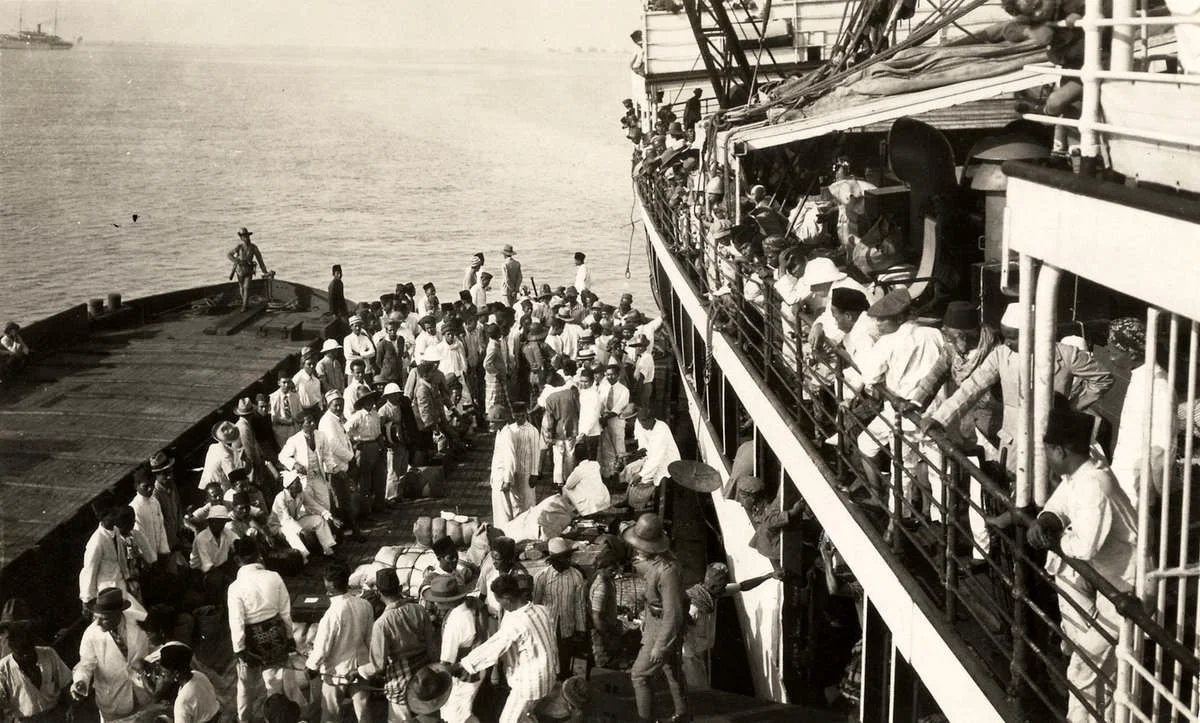

Boven-Digoel Concentration Camp
A Dutch journalist named Marcus van Blankenstein traveled 450 kilometers up the Digul River in 1928 to see the camp for himself. What he found horrified him. In articles for the Nieuwe Rotterdamsche Courant, he wrote that innocent people had been imprisoned without charge, that sanitary conditions were so appalling that detainees were dying "like rats during a plague." The place was Boven-Digoel, a concentration camp operated by the Dutch East Indies government from 1927 to 1947, located in one of the most remote corners of what is now South Papua, Indonesia. At its peak in 1930, it held around 1,300 internees and 700 of their family members — communists, nationalists, and anyone the colonial authorities considered a threat to order.
Exile Without End
The Dutch had practiced political exile for centuries, but Boven-Digoel represented something new in scale and intent. After the failed communist uprisings of 1926 in Java and Sumatra, roughly 4,500 Indonesians were accused of direct participation and imprisoned or sentenced to death. Another 8,500 had committed no specific crime but were deemed dangerous by association. The colonial government cast its net wider and wider, first targeting principal leaders of the Communist Party of Indonesia (PKI), then anyone who had held an identifiable leadership role, then new leaders who emerged to replace those already exiled. The site chosen was a barren stretch of malaria-ridden swampland on the banks of the Digul River, originally thought suitable for agriculture. Captain Becking was dispatched with KNIL soldiers and convict laborers to prepare the camp at Tanah Merah. The first fifty internees arrived in March 1927, accompanied by thirty family members.
A Prison Without Fences
Boven-Digoel had no walls and no wire. It did not need them. The surrounding terrain — dense swamp, malarial jungle, and hundreds of kilometers of river — made escape virtually impossible. Internees were allowed to bring personal items from Java and Sumatra, and after an early experiment with forced labor was abandoned, those willing to work for the public good were paid a wage. They could write letters, though the mail was censored. They kept gardens, though the poor soil limited yields. The tree cover had been so thoroughly cleared to build the camp that there was almost no shade from the equatorial sun. Food was often substandard. The stipends were gradually reduced. And the defining misery was this: imprisonment was indefinite, with no process for appeal. Internees who refused to cooperate were sent to a separate facility at Tanah Tinggi, where conditions were far worse and rations barely sufficient.
The Nursery of Independence
The colonial government intended Boven-Digoel to suppress Indonesian nationalism. Instead, it concentrated some of the movement's most capable thinkers in one place. When Governor General Bonifacius de Jonge took office in 1931, he expanded the camp rather than winding it down, believing the fear of exile served as a deterrent. In 1933 and 1934, the government began sending non-communist nationalists as well, though university-educated intellectuals were generally redirected to the less harsh Banda Islands. Indonesians continued to be exiled to Digoel until the final weeks of Dutch rule. When Japanese forces threatened in 1942, the remaining detainees were evacuated to Australia, where some were initially imprisoned again before trade unions and the Communist Party of Australia secured their release. In the years after Indonesian independence, former Digoel detainees entered politics at the highest levels, including members of the House of Representatives during the Sukarno era.
Memory in the Mud
The novelist Pramoedya Ananta Toer, himself a political prisoner during Indonesia's New Order era, spent years researching Boven-Digoel. In 2001 he published Cerita dari Digul (Stories from Digul), an anthology of firsthand accounts from the camp. I. F. M. Salim, a former detainee, wrote his own memoir in 1973: Fifteen Years in Boven Digoel. The camp's archive is housed at the National Archives of Indonesia in Jakarta. Today, the site on the banks of the Digul River has largely returned to the swamp and forest that surrounded it. The malaria remains. The remoteness remains. But the memory of what happened here — thousands of people exiled to the end of the world for their political beliefs, their families dragged along, their futures suspended indefinitely — has become an important chapter in the story of how Indonesia became a nation.
From the Air
Coordinates: 6.10°S, 140.30°E, on the banks of the Digul River in South Papua. Best viewed from 5,000–10,000 ft where the river's course through lowland swamp forest is visible. Nearest airport: WAKT (Tanah Merah). The site is extremely remote; the Digul River and surrounding swampland dominate the landscape. No visible structures remain from the camp.
Nearby Stories
- 2016 Sunbird Aviation Britten-Norman Islander Crash 35 km away
- Battle of Bobdubi 70 km away
- South Papua 90 km away
- Baliem River 121 km away
- New Guinea Mangroves 174 km away
- Asmat Regency 178 km away
- Great Papuan Plateau 181 km away