
Asmat Regency
Asmat Regency does not exist on most tourist maps, which is a fair reflection of how most tourists travel. It covers 25,015 square kilometers of tidal swamp and lowland rainforest in the northwest corner of South Papua province, bordered by the Arafura Sea on the southwest and hemmed in by three other Papuan provinces on its remaining sides. About 120,902 people lived here in 2024, the overwhelming majority of them members of the Asmat ethnic group, whose woodcarvers are among the most celebrated sculptors of the Pacific. The regency was carved out of Merauke on 12 November 2002 and rearranged again in 2022 when South Papua itself was split off from the older Papua province. Administratively new, culturally ancient.
The People the Regency Is Named For
The name is the name of a people. The Asmat ethnic group, estimated around 70,000 within a wider regency population of about 120,000, have lived along these rivers and swamps since long before any European ship reached the Arafura Sea. Their traditional social structure was organized around ceremonial houses, kinship groups, and ritual cycles tied to ancestral spirits and to the complex ecology of the mangrove-swamp-forest mosaic in which they lived. Dutch colonization reached the region late and lightly compared to other parts of what became Indonesia. Missionaries arrived in the late nineteenth century. An administrative presence grew in the twentieth. The Asmat themselves remained, through colonization, handover, and integration, the cultural center of the place.
From Dutch to Indonesian
Between Indonesian independence in 1949 and 1962, Asmat continued as part of Dutch New Guinea while Indonesia and the Netherlands argued over sovereignty of the western half of the island. In 1962 the Netherlands transferred the territory to the United Nations Temporary Executive Authority, which passed it to Indonesia the following year. In 1969, the Act of Free Choice, a deeply contested process in which a small number of hand-picked delegates voted unanimously for integration, formally made Western New Guinea part of Indonesia. Asmat Regency itself was organized in 1969 as part of the early administrative effort to govern the new territory. It sat within Papua Province for decades, then moved into the new South Papua Province when that was created in 2022.
Twenty-Five Districts on a Swamp
Asmat Regency began with eight districts in 2010 and expanded through subsequent reorganizations to 25. Tomor Birip and Sor Ep were the most recent additions, carved out of existing districts. The administrative centre is Agats, the elevated town on the Asewets River delta where the regency's government offices perch above the tides. Most other settlements are villages, kampung, scattered along the rivers: Atsy, Omandesep, Otsjanep, and dozens more that share the same essential architecture of houses on stilts, dugout canoes tied to the porch, and woodcarvings at the front door. Only a handful of the regency's 120,000 residents ever see a road, because the land itself resists road-building. Transportation is water, and has always been water.
Woodcarving as Identity
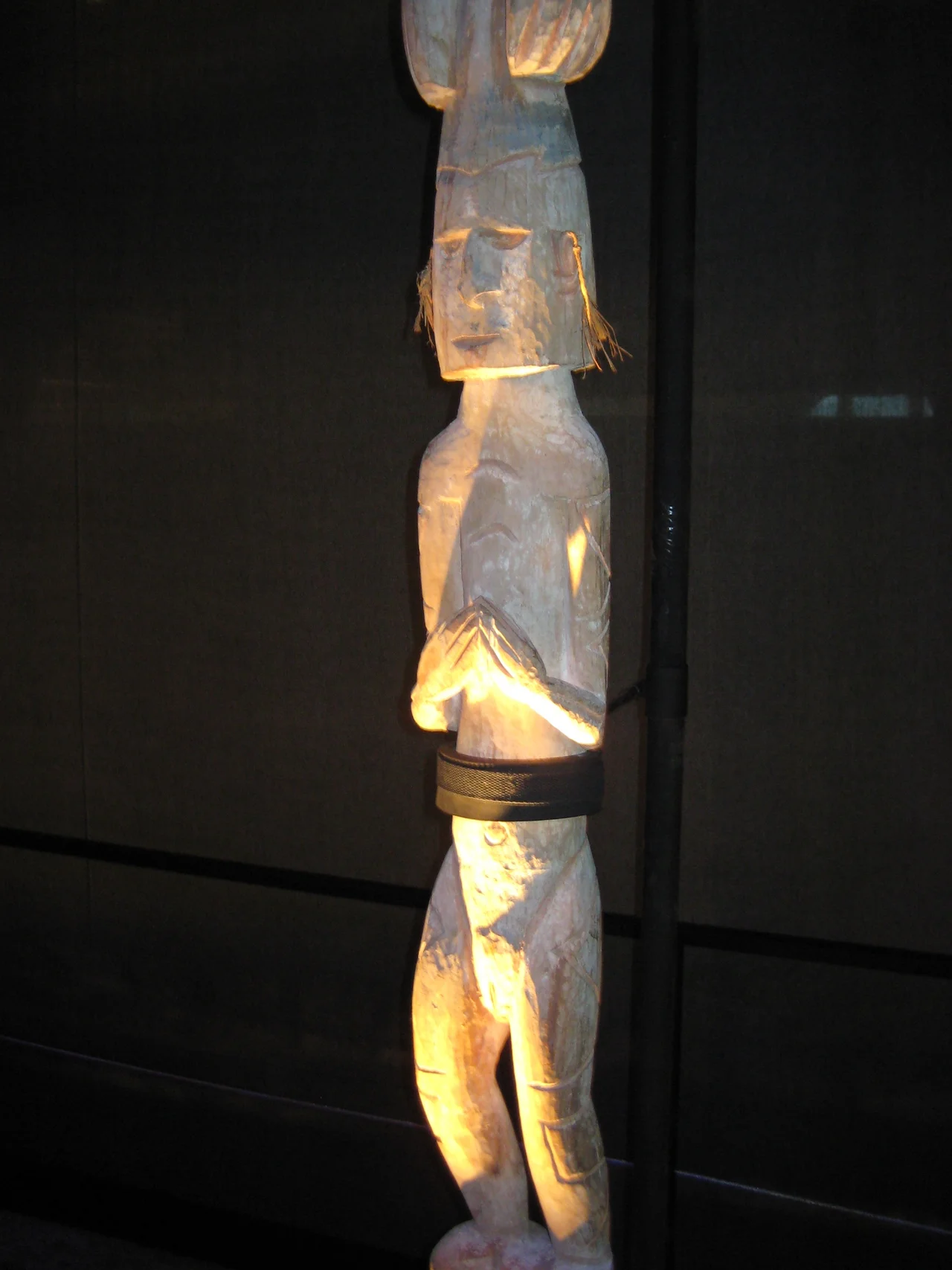
If Asmat is known anywhere beyond Indonesia, it is known for its carvers. Shields, ancestor poles, paddle handles, ceremonial drums, and spirit figures of extraordinary complexity have moved from village festivals into museum collections in New York, Amsterdam, Basel, and Jakarta. The Metropolitan Museum of Art's Michael C. Rockefeller Wing contains major Asmat works; the son of a New York governor had been collecting in this very regency when he disappeared in 1961, a loss whose exact circumstances remain debated. The Asmat Museum of Culture and Progress in Agats, founded in 1973, houses masterworks and living practice together. The carvers themselves continue to work, cutting mangrove wood and ironwood into shapes that outsiders have collected for a century and that Asmat families still carry in their own ceremonies.
The Regency Now
Asmat today sits between forces. Part of the regency lies inside Lorentz National Park, a UNESCO World Heritage Site protecting glacier-to-sea biodiversity. Other parts feel the pressure of logging, land-use change, and the administrative expansion that has reshaped the Indonesian provinces of Papua repeatedly in the last two decades. A serious famine struck in 2018; President Joko Widodo's response included a proposal to relocate remote communities into the capital at Agats, which met significant resistance. The population is growing. The woodcarving continues. The question, asked differently depending on who is asking, is what Asmat should look like in another generation. That question is not settled, and the people living in the swamps and on the boardwalks of its 25 districts are the ones still answering it.
From the Air
Centered at approximately 5.38°S, 138.46°E in South Papua. The regency covers 25,015 sq km of mostly lowland swamp and rainforest. Administrative centre Agats sits on the Asewets delta. Ewer Airport (ICAO: WAKE) is the main aviation gateway. Nearby airspace features extensive river networks and tidal channels; maintain VFR reference to larger rivers as landmarks. Expect rainforest climate with heavy convective weather. The northern boundary approaches Lorentz National Park and the foothills of the Maoke Mountains.
Nearby Stories
- Baliem River 12 km away
- Western New Guinea 39 km away
- 1981 Irian Jaya Earthquake 70 km away
- 2016 Alfa Indonesia DHC-4 Crash 109 km away
- New Guinea Mangroves 154 km away
- Tembagapura 157 km away
- Boven-Digoel Concentration Camp 167 km away
- Marchinbar Island 639 km away