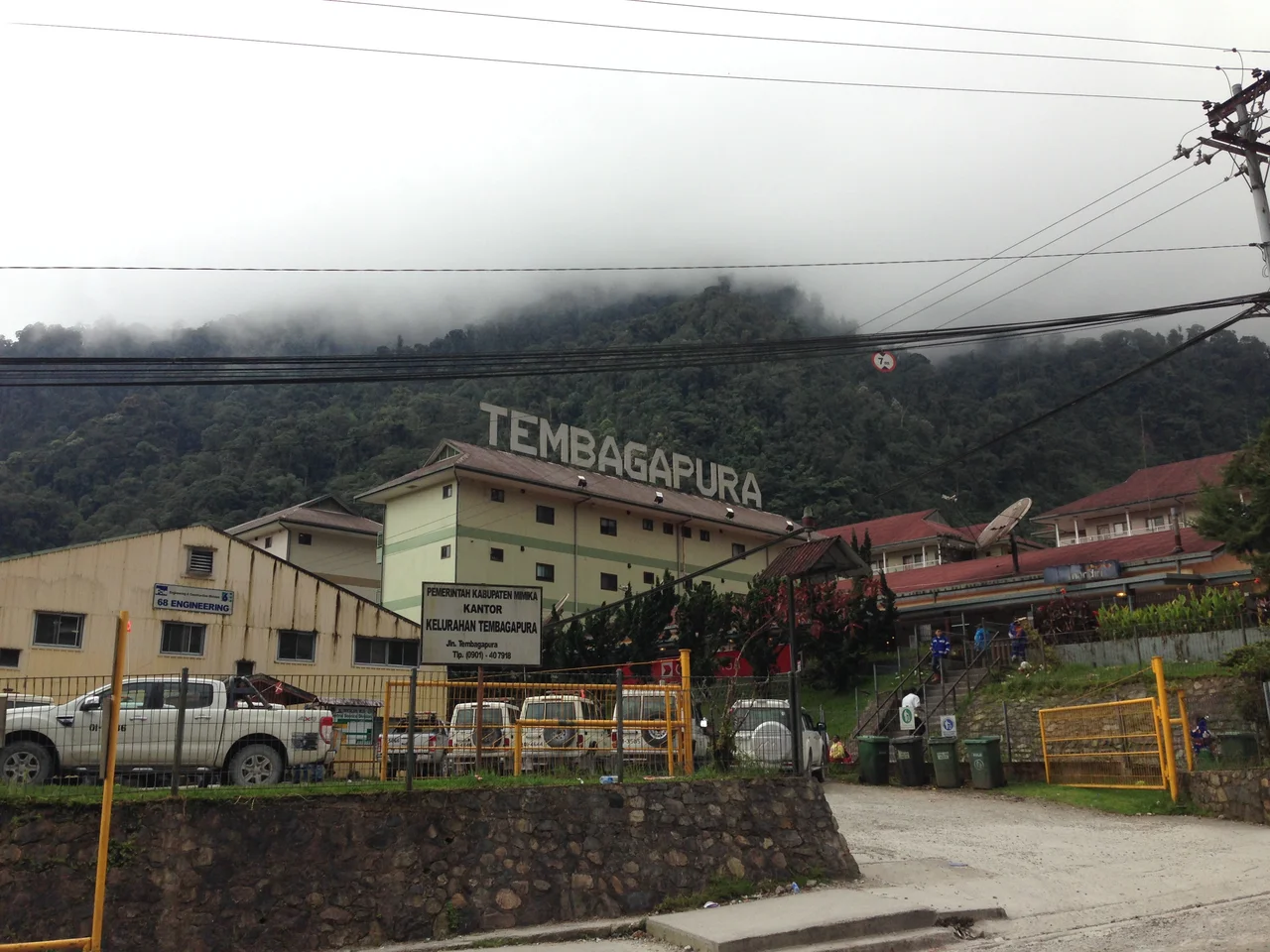

Tembagapura
The name translates plainly. Tembaga is Indonesian for copper. Pura is Sanskrit for town. Copper Town, built in the late 1960s on a rocky shelf in the Sudirman Range because Freeport-McMoRan needed somewhere to house the engineers, the geologists, and eventually the 3,000 workers who would descend daily into what became the Grasberg mine. At 1,930 meters above sea level, tucked at the base of Mount Zaagkam, Tembagapura is an oddity even by the standards of remote Indonesia: a purpose-built highland settlement complete with a Hero Supermarket, indoor squash courts, and a school for expatriate children that has been called, without much argument, the most remote international school on Earth.
Before the Town Was a Town
Before Freeport's bulldozers, about 500 Amung people lived in traditional villages across these slopes. Their language, their ceremonies, their hunting grounds, their ancestral ties to the mountain that outsiders would later call Zaagkam had been here long before the Dutch geologist Jean Jacques Dozy spotted the ore body in 1936, and before American capital circled back to it decades later. The Amungme regarded then, and regard now, the land beneath the town and the mine as theirs. Not Indonesia's. Not Freeport's. When construction began in the late 1960s, the scale of what was coming for those villages was not something anyone in the valley had the tools to anticipate.
A Town Built for Copper
By 1981, Tembagapura housed over 3,000 mine workers and their families. The amenities read like a checklist assembled by someone who understood that people will tolerate remoteness only if the groceries are reliable. A hospital. A library. A full outdoor soccer field. Indoor tennis and squash courts. The Lupa Lelah Club, which translates roughly to the Forget Tired Club, anchors expatriate life with its restaurant and bar. The shopping plaza holds a Hero Supermarket, a Guardian pharmacy, a Hero department store, even a hairdresser. Rain falls roughly 3,220 millimeters per year. Mornings arrive sunny and clear. By noon the clouds pour over the ridge and the afternoon turns cool and wet. This is the climate that hosts the tennis match.
The Mountain Above
Sixteen kilometers northwest of town sits the Grasberg mine, one of the largest gold and copper operations in the world. Look up from the streets of Tembagapura and you see Mount Zaagkam rising behind; beyond Zaagkam, the Sudirman Range, and beyond that, the ice-capped pyramid of Puncak Jaya, the highest mountain peak of any island on Earth. Tembagapura exists because of geology this dramatic. The collision of the Australian and Pacific plates lifted limestone seabed into equatorial snowfields and concentrated copper and gold in quantities that justified building a city at 1,930 meters with nothing but helicopters and an access road to sustain it.
The Hard Edges
Tembagapura has never been a peaceful place in the simple sense. As the settlement grew, migrants arrived, from elsewhere in Papua like the Dani people, from Java, from Sulawesi. Tensions rose between newcomers and the Amungme, Moni, Ekari, and Dani communities who hold the surrounding highlands as ancestral land. The Free Papua Movement, known as OPM, has for decades treated the mine and its infrastructure as targets. Indonesian military units, funded in part by the mining operation, have responded with operations that have resulted in displacement of and reprisals against indigenous Papuans. The security arrangement here is not a footnote to the story of Tembagapura. It is one of the central facts of the place.
Life at Altitude
For the families who live here on expatriate contracts, Tembagapura offers something no other mining town quite replicates: a cloud forest commute, a school bus that climbs switchbacks, weekends in a climate that feels more like Scotland than Jakarta. For the Papuan workers and their families, it is a wage economy in a place where wages had not previously existed. For the Amungme elders who still trace ancestral songlines across ridges now marked on mine maps, it is an unresolved question about whose land this is, and what a town whose name means Copper can ever owe to the people who were here first. The rain arrives every afternoon. Somewhere above the clouds, the shovels are still working.
From the Air
Located at 4.14°S, 137.09°E in the Sudirman Range of Central Papua. Elevation 1,930 meters at the base of Mount Zaagkam. The Grasberg mine complex sits roughly 16 km northwest. Puncak Jaya (4,884 m) rises to the east. The nearest major airport is Mozes Kilangin Timika (ICAO: WABP), about 60 km south at sea level; a single mountain road connects the two. Expect afternoon clouds and heavy rain; morning VFR windows are brief. Maintain well above ridge level and approach from the Timika side.
Nearby Stories
- 2016 Alfa Indonesia DHC-4 Crash 20 km away
- Republic of West Papua 32 km away
- Lorentz National Park 57 km away
- Central Papua 109 km away
- Western New Guinea 136 km away
- 2026 Smart Air Cessna 208 Crash 179 km away
- Foja Mountains 229 km away
- The Abyss That Isn't a Trench 609 km away