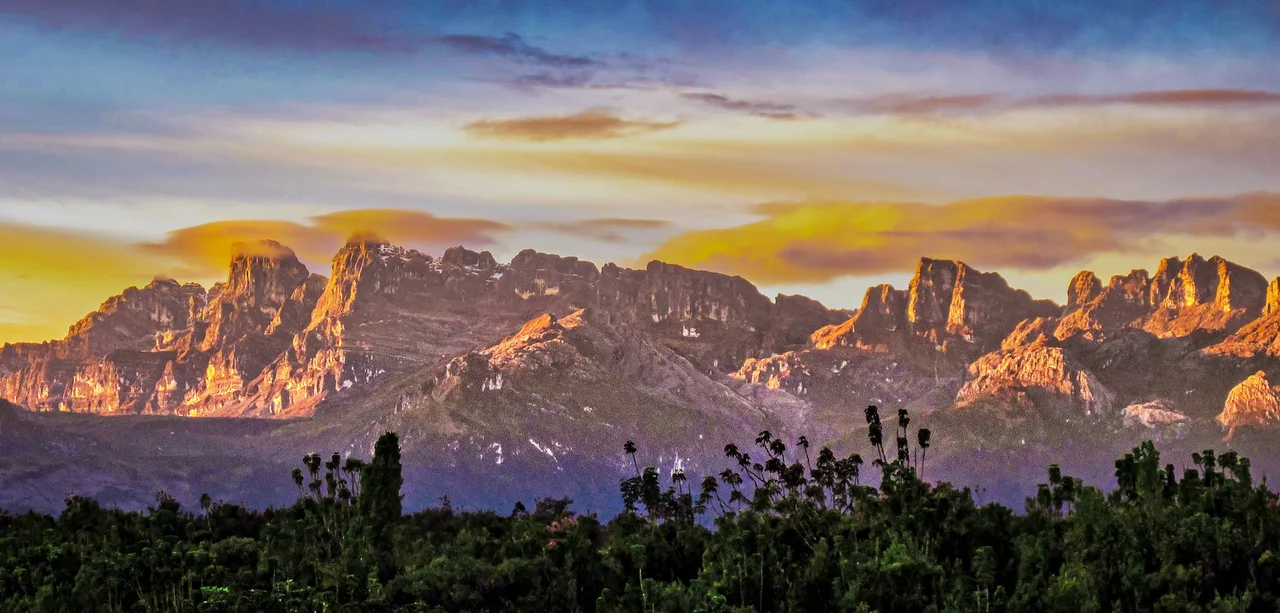

Lorentz National Park
Start at the coast, at the brackish edge where saltwater pushes into the roots of mangroves. Walk inland. Climb through swamp forests that pool knee-deep after rain, then lowland rainforest where the canopy closes so completely that noon looks like dusk. Keep climbing. The trees shrink, then give way to mossy cloud forest, then to tussock grasslands where the air thins and the light sharpens. Finally, at 4,884 meters, cold granite and the last equatorial glaciers on Earth. Lorentz National Park is the only reserve on the planet where a single unbroken transect runs from tidal sea to tropical ice.
The Full Altitudinal Stack
At 25,056 square kilometers, Lorentz is the largest national park in Southeast Asia, and the only nature reserve in the Asia-Pacific region with a complete altitudinal array of ecosystems. Marine areas, mangroves, tidal and freshwater swamp forest, lowland and montane rainforest, subalpine shrub and grassland, alpine tundra, equatorial glaciers. The park contains five of the World Wildlife Fund's Global 200 ecoregions in one continuous landscape. Puncak Jaya, the peak that tops it all at 4,884 meters, is the tallest mountain between the Himalayas and the Andes. Few places on Earth let you watch climate zones stack vertically in a single view; Lorentz lets you walk through them.
A Reserve Barely Known to Science
Birdlife International has called Lorentz "probably the single most important reserve in New Guinea," and the numbers bear it out. Six hundred thirty documented bird species, roughly 95 percent of the total recorded in Papua. One hundred twenty-three mammal species. Two kinds of cassowary, 31 doves and pigeons, 60 species of kingfisher. Six birds are endemic to the Snow Mountains alone, including the Snow Mountain quail and the Snow Mountains robin. The mammal roll call reads like a greatest hits of Australasian evolution: long-beaked and short-beaked echidnas, four species of cuscus, wallabies, quolls, tree-kangaroos. And yet much of the park remains unmapped. New species almost certainly wait in its folds, and the ethnobotanical knowledge held by communities living within its boundaries is still poorly documented by outsiders.
Named for a Dutchman Who Passed Through
The park takes its name from Hendrikus Albertus Lorentz, a Dutch diplomat and amateur biologist who led expeditions into this country in 1909-10. His party was the first group of outsiders to reach the equatorial snow of New Guinea, at 4,460 meters on 8 November 1909 - a feat that cost four expedition members their lives on the return. Lorentz named a lake in the highlands after a colleague named Habbema; a river was later named after him. Dutch colonial authorities created a 3,000-square-kilometer Lorentz Nature Monument in 1919. Indonesian protection followed: a Strict Nature Reserve in 1978, the national park itself in 1997, and UNESCO World Heritage listing in 1999. About 1,500 square kilometers were excluded from the World Heritage area because of mining exploration titles that still overlap the park.
Glaciers on the Way Out
The equatorial glaciers that make Lorentz extraordinary are also disappearing. At the start of the 20th century, all of New Guinea's highest mountains were ice-capped. The ice cap on Puncak Trikora, Lorentz's other great peak, melted entirely between 1936 and 1962. Only Puncak Jaya still holds glacial ice, and those glaciers are shrinking visibly from year to year. Recent satellite imagery suggests the last equatorial ice in the Asia-Pacific may be gone within a generation. What was once a geographical oddity - snow on the equator - is becoming a memory. The park's full altitudinal stack, the thing that makes it globally unique, may soon be missing its top rung.
Protected Mostly by Isolation
Governance of Lorentz has been thin for most of its existence. As recently as 2005, the park had no assigned staff or guards; the Lorentz National Park Bureau was only established in 2006 and became functional in 2007, with 44 staff by mid-2008. A 2008 UNESCO monitoring mission found the bureau's capacity seriously limited by a lack of funding, equipment, and experience. What has protected the park is less bureaucracy than topography: vertical terrain, constant rain, and the communities of Dani, Asmat, Amungme, and other Papuan peoples who have lived with this land for millennia. Their continued support, not external enforcement, is what conservationists acknowledge keeps Lorentz whole. A trans-Papua highway now under construction threatens to change that calculus.
From the Air
Centered near 4.75S, 137.83E, Lorentz spans from the Arafura Sea coast to the Central Range crest. Puncak Jaya (4,884m) is the visual landmark, often cloud-shrouded; clear mornings offer the best views. Nearest approach airports: Timika (WABP/TIM) to the southwest serves the mining region; Wamena (WAVV/WMX) to the north reaches the highland valleys. VFR through the interior is impractical - weather builds quickly over the range. Cruise at FL350+ for a continental view of the park's full altitudinal sweep.
Nearby Stories
- Puncak Trikora 29 km away
- Nduga Hostage Crisis 34 km away
- Lorentz River 50 km away
- Baliem River 58 km away
- Puncak Jaya 62 km away
- Tembagapura 87 km away
- Marchinbar Island 690 km away