
Burry Port
At twenty minutes to one on the afternoon of 18 June 1928, a Fokker tri-motor seaplane named Friendship dropped out of fog and cloud over the Loughor estuary in south Wales and came down on water none of its crew had ever seen before. Pilot Wilmer Stultz had been flying for nearly twenty-one hours. Co-pilot and mechanic Louis Gordon had spent much of that time wrestling with the engines. In the back, with no radio and not much to do, sat a 30-year-old Boston social worker named Amelia Earhart. She was the flight's commander but not its pilot. When the Friendship came ashore at Burry Port Harbour a few hours later - tide and refuelling and weather having all conspired against the original plan to fly on to Southampton - Earhart stepped onto Welsh soil as the first woman to have crossed the Atlantic Ocean by air. The whole world wanted to talk to her. She had not, by her own admission, done very much.
The Surprise Arrival
Burry Port had no idea the Friendship was coming. The Fokker FVIIb 3m had taken off from Trepassey, Newfoundland, on the morning of 17 June, bound for Southampton. The crew had no working radio for most of the crossing. Visibility was poor over the Atlantic and got worse as the plane crossed the Irish coast. By the time the Friendship reached Welsh airspace, Stultz was running low on fuel and unable to confirm his position. The plane spotted the Burry estuary - a long, sheltered tidal inlet between Pembrey and Pwll - and came down on the water at 12:40 pm local time, at low tide. The seaplane drifted on the estuary for hours while the crew debated whether to refuel and continue to Southampton in front of their official welcoming party. The tide was racing in. Stultz decided against it. They taxied to Burry Port Harbour and came ashore - and as far as Earhart was concerned, that was the moment the flight ended and the moment she became the first woman to cross the Atlantic by air.
A Night at the Ashburnham
The crew spent the night at the Ashburnham Hotel, a Burry Port landmark. The next morning Earhart sat up in bed surrounded by reporters - the press had arrived in numbers by then - and spoke to Alice Jones, the hotel's proprietor, in words that newspapers across Britain and America would print verbatim: 'How lovely your country is. The stillness and the silence brings back again the almost awesome feeling which came to me as, hour after hour, we pushed forward through the thick clouds and fog. It was as if we were alone in the world. To think that 48 hours ago I was in America and now I am in Wales!' Earhart was not the pilot - she made this point repeatedly in interviews, both then and afterwards. Stultz had flown. Gordon had kept the engines running. Earhart, by her own description, had been baggage. But she was the first woman to make the crossing by air, and she understood what that meant before the press did.
The Near-Miss
The Friendship departed Burry Port Harbour around eleven the next morning, 19 June 1928, bound finally for Southampton. Among the spectators that morning was a quiet, white-haired man named Sir Arthur Whitten Brown - the same Whitten Brown who, with John Alcock, had completed the first non-stop transatlantic flight in 1919, just nine years earlier. Whitten Brown lived in nearby Swansea and had brought his family to Burry Port to congratulate Earhart and present her with a bouquet of flowers. A boat was dispatched to carry him out to the Friendship before it took off. The crew, unaware of his approach, had already begun their departure run. Whitten Brown watched the seaplane lift away. The first man and the first woman to cross the Atlantic by air had been within yards of each other and had missed the meeting by minutes. It would never happen again. Earhart vanished over the Pacific in 1937. Whitten Brown died in 1948. The bouquet, presumably, went home.
The Monument
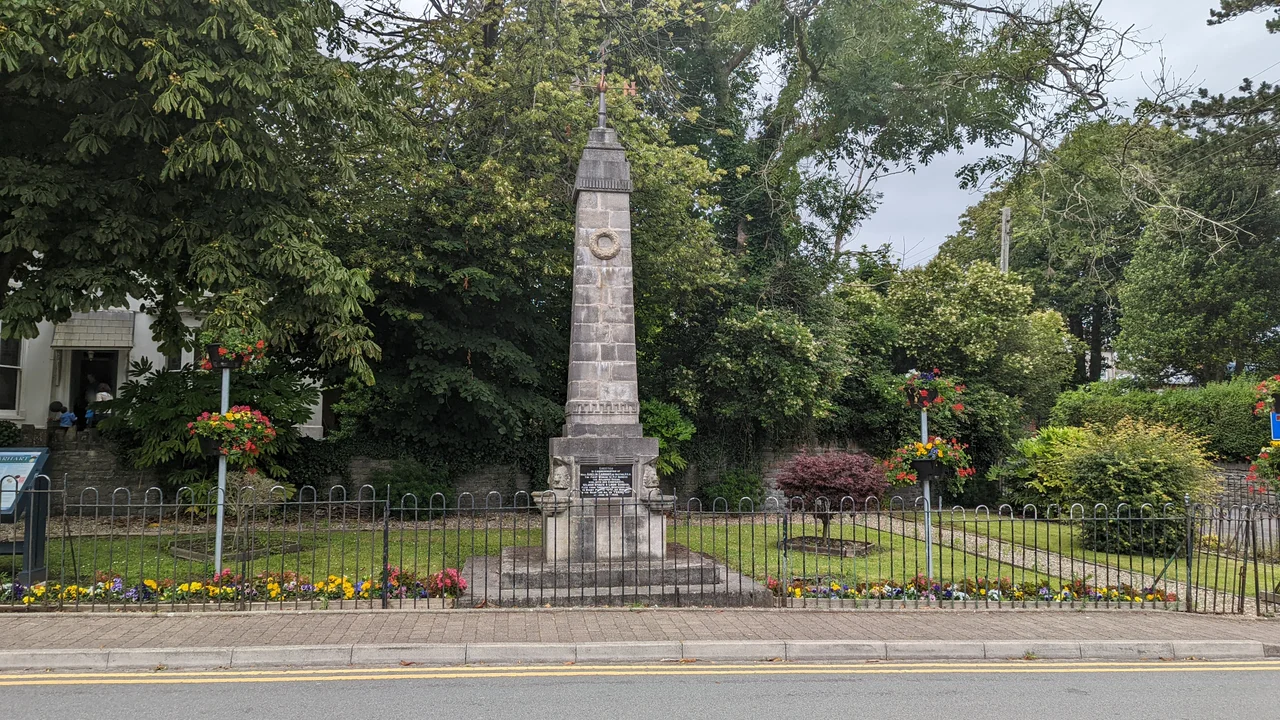
On 8 August 1930, Sir Arthur Whitten Brown unveiled a monument to the Friendship landing on Stepney Road in Burry Port. It is a stone column surmounted by a weathervane shaped like the Fokker seaplane, with small water fountains at each corner of the base. The inscription reads: 'Erected in commemoration of Miss Amelia Earhart, of Boston, USA. The first woman to fly across the Atlantic ocean, who, with her companions Wilmur (sic) Stultz and Louis Gordon, flew from Trepassey, Newfoundland in 20 hours and 49 minutes in the seaplane Friendship on June 18th 1928.' The misspelling of Wilmer is original and has never been corrected. The monument is still there. Schoolchildren on day trips climb the steps, photograph the weathervane, and read the inscription. Most have heard of Earhart. Almost none have heard of Stultz or Gordon, the two men who actually did the flying.
Coal, Copper, and the Quiet Harbour
Burry Port is a modern town by Welsh standards - early records as a settlement appear only around 1850. It grew up around docks built from 1819 onward to ship anthracite coal from the Gwendraeth Valley mines down to the sea. Pembrey New Harbour, opened in 1836, was renamed Burry Port Harbour before it was even completed. In 1848 a copper works opened next to the docks, established by Mason and Elkington of Birmingham; its principal chimney, at 250 feet, was described in 1853 as a landmark visible for miles. The Carmarthen Bay Power Station went up on the north shore of the estuary in 1947, generated its first electricity in June 1953, and was demolished in the early 1990s. With the mines now closed and the railway lifted up the valley, Burry Port today is a market town of about six thousand people, with a small marina where coal ships once docked and a lifeboat station in the same harbour where the Friendship came ashore. Pembrey Airport is a few miles west - the closest commercial airfield to where a 30-year-old Boston woman became, briefly, the most famous person in the English-speaking world.
The Men of Little Hatchets
Before any of this - before the copper works, before the dock, before Amelia Earhart - Pembrey Burrows had a darker reputation. The sand dunes and shifting channels of the Burry estuary were a known hazard to shipping coming up the Bristol Channel, and many vessels ended their voyages on Pembrey sands. Some by mishap. Others, according to local tradition, were deliberately lured to their doom by wreckers known as Gwyr-y-Bwelli Bach - the Men of Little Hatchets. The name came from the locally made tool they carried, a hatchet incorporating a claw, ideal for ripping open salvaged cargo and, the tradition adds, equally useful for dispatching unwanted witnesses. How much of this is true and how much is the kind of folklore that grows around every coastal community is harder to say. But the sands themselves are real, the wrecks are documented, and the coastal communities along this stretch of Carmarthenshire have long maintained a wary relationship with the sea that brought them their copper and their coal - and, one foggy June afternoon, brought them Amelia Earhart.
From the Air
51.69 degrees N, 4.25 degrees W. Burry Port sits on the north shore of the Loughor estuary in Carmarthenshire, 5 miles west of Llanelli. The Friendship's actual touchdown point was on the estuary itself at roughly 51 degrees 40 minutes 35 seconds north, 4 degrees 13 minutes 03 seconds west. The Amelia Earhart monument on Stepney Road is visible from the harbour. Nearest airports: EGFP Pembrey (3 nm west, the closest commercial airfield), EGFH Swansea (10 nm east). The harbour and Cefn Sidan beach are clearly visible at low cruise altitude; Carmarthen Bay sweeps west toward Pembrokeshire.
Nearby Stories
- Teifi Valley Railway 1.2 km away
- Haverfordwest 5.1 km away
- Mumbles Lifeboat Disaster 8.1 km away
- Neath and Tennant Canal 12 km away
- Strata Florida Abbey 27 km away
- HMS H47 31 km away
- Ilfracombe Lifeboat Station 38 km away
- HMHS Glenart Castle 44 km away