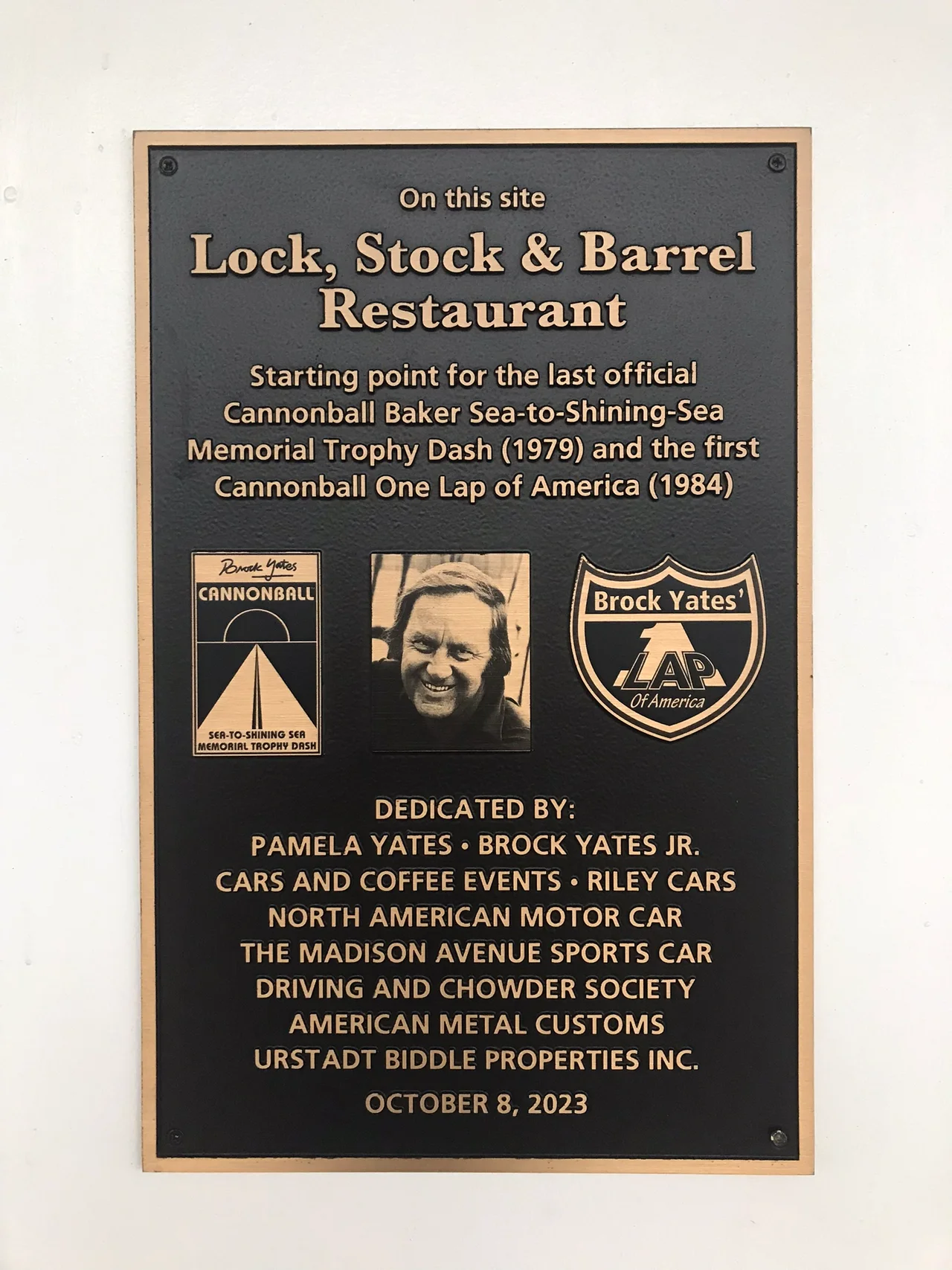

Cannonball Baker Sea-to-Shining-Sea Memorial Trophy Dash
The finish line was a hotel bar. Specifically, the bar of the Portofino Inn in Redondo Beach, California, where drivers who had just crossed the entire United States at illegal speeds — averaging 80, 90, sometimes over 100 miles per hour across four time zones — staggered in to sign a register and order a drink. The Cannonball Baker Sea-to-Shining-Sea Memorial Trophy Dash was not a race, its organizers insisted, because races are illegal. It was a 'rally.' A 'demonstration.' An act of automotive civil disobedience in the name of a simple proposition: the 55-mile-per-hour national speed limit was an absurdity, and they would prove it by ignoring it, in public, repeatedly.
Brock Yates and the Beautiful Outrage
Car and Driver editor Brock Yates dreamed up the Cannonball in 1971, inspired partly by the legendary driver Erwin 'Cannonball' Baker, who had set transcontinental speed records in the early twentieth century. The idea was simple: start from the Red Ball Garage in midtown Manhattan and drive to the Portofino Inn in Redondo Beach as fast as possible. No rules. No designated route. No permitted speeds. The first run in 1971 attracted a handful of cars; by the second and third runs in 1972 and 1975, the event had acquired a mythology. Journalists wrote about it. Car manufacturers quietly lent vehicles. A loose community of people who believed speed was a virtue assembled around the notion of crossing America in a day and a half.
Dan Gurney's Ferrari
The race that made the Cannonball famous was the first run in 1971. Dan Gurney — Formula One race winner, Le Mans champion, founder of Eagle cars — drove a Ferrari Daytona with Brock Yates in the passenger seat and covered the 2,863 miles from New York to Redondo Beach in 35 hours and 54 minutes, averaging over 80 miles per hour across the entire country. That time stood as the benchmark for years. Gurney drove the way he raced: fast, smooth, decisive. He didn't hide from police — his theory was that a gleaming Ferrari driven with confidence was less suspicious than something trying to blend in. He was, improbably, correct. The run cemented the Cannonball as something real, something that mattered to people who cared about cars and speed and the open American road.
The Fastest Run
The event ran five times: 1971, 1972, 1975, 1979, and a final unofficial run. The fastest time was set in the 1979 edition by Dave Heinz and Dave Yarborough in a Jaguar XJ-S, who completed the route in 32 hours and 51 minutes. They averaged better than 87 miles per hour door-to-door, which meant sustained highway speeds well above 100 for long stretches of Nevada and Utah. The national 55-mile-per-hour limit, imposed during the 1973 oil embargo and universally resented by American drivers, was the political context that gave the Cannonball its edge. Every run was a public statement that the limit was being ignored, daily, by ordinary people — and that a determined driver in a fast car could cross the continent in a day and a half.
The Movie
Brock Yates wrote the screenplay. The 1981 film 'The Cannonball Run' starred Burt Reynolds, Roger Moore, Farrah Fawcett, and a cast of celebrity cameos doing a Hollywood version of what the actual runs had been. The movie was a massive commercial success, spawning a sequel, embedding the Cannonball mythology in American pop culture, and — somewhat ironically — turning an act of automotive outlaw culture into mainstream entertainment. The drivers who had actually done it were divided on the film. It captured the spirit of the thing, many said. But the real runs had been grimmer, more focused, less funny. You didn't laugh much when you were trying to stay awake crossing Kansas at 3 in the morning.
The Portofino Inn
The Portofino Inn in Redondo Beach was chosen as a finish line partly because it was near the water — the 'shining sea' of the event's name — and partly because it was a reasonable hotel with a bar that would be open when exhausted drivers arrived at irregular hours. The inn still stands on the Redondo Beach waterfront, its nautical architecture unchanged from the Cannonball years. The event it hosted was a product of a specific American moment: post-Vietnam, post-Watergate, pre-seatbelt-law, deeply suspicious of government authority, in love with cars and speed and the myth of the open road. The Cannonball runs are long over. The 55-mile-per-hour limit was repealed in 1995. But the finish line is still there, and the bar still serves drinks.
From the Air
The Portofino Inn finish line is located at approximately 33.85°N, 118.40°W on the Redondo Beach waterfront, adjacent to King Harbor Marina. Torrance Municipal Airport (KTOA) is approximately 3 miles northeast. Approach from the west over the Pacific for best coastal orientation; the harbor and marina complex are easily identifiable from altitude. The pier and breakwater mark the finish line location.
Nearby Stories
- Ennis House 1.8 km away
- Aliso and Wood Canyons Wilderness Park 5 km away
- Amgen 9.9 km away
- Silverado Fire 12 km away
- Catalina Airport 22 km away
- Santa Barbara Island 22 km away
- Stagecoach Inn (California) 39 km away
- San Bernardino Train Disaster 40 km away