
Cape Correntes
Sailors said mermaids lived here, and that they sang men onto the rocks. The truth was less enchanting and far more lethal: a river of seawater, fast and dark, pouring south past a low Mozambican headland and dragging ships backward against everything their crews could do. The Portuguese named it for the danger itself, the Cabo das Correntes, the Cape of Currents. For three hundred years it was among the most feared points in the Indian Ocean, and the legends were just the way frightened men explained a coast that kept killing them.
Where the Current Runs
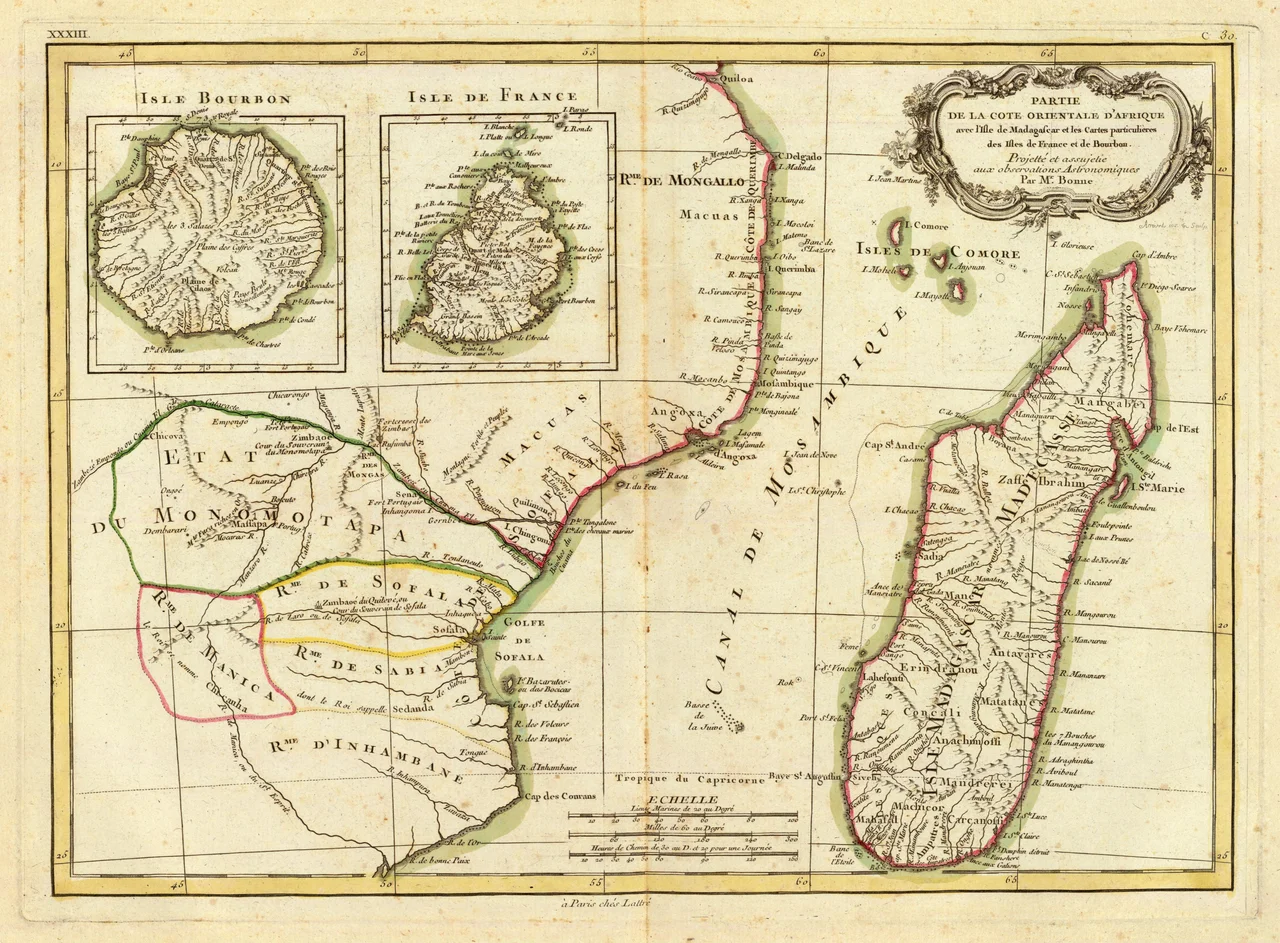
Cape Correntes sits in Inhambane Province, marking the southern doorway into the Mozambique Channel between Africa and Madagascar. The Mozambique Current sweeps past it with unusual speed, throwing off eddies and swirling into the shallows, while the winds above the cape collude with the water below. Gusts arrive without warning here, and whirlwinds spin up out of calm air. A ship that came too close found itself in a trap with no single villain, just current and wind and rock all working against the hull at once. The sea gave the headland its name, and the name was a warning.
The Edge of the Swahili World
Long before European keels arrived, the cape marked the limit of a civilization. The dhows of the Kilwa Sultanate, masters of the East African trade in gold, ivory, and cloth, rarely if ever sailed below it. Cape Correntes became the southern boundary of the Swahili Coast and its cultural world, the frontier where one realm of monsoon traders ended and unknown waters began. Beyond it lay coastline the great Indian Ocean merchants left alone. That a single headland could mark the edge of a cultural sphere tells you how seriously the people who knew these waters best took its dangers. The mermaid legends grew up in that same space of fear, the stories sailors told to give a name and a face to a place that swallowed ships for reasons they could not yet measure.
Da Gama Turned Back
In January 1498, Vasco da Gama became the first European captain to try forcing his way north past the cape from below. It beat him. Contrary currents and tangled winds pushed his fleet backward until he was forced to anchor near the Inharrime River, some seventy kilometers to the south, before he could recover and press on toward India. He was in good company in his failure. Sailing the other way was deadlier still, because the racing current could fling a vessel headlong into the shoals and protruding rocks that line this coast. Through the 16th and 17th centuries, an estimated thirty percent of all ships lost on the annual Portuguese India Armadas capsized or wrecked around Cape Correntes, more than at any other place on the long, deadly route between Lisbon and the East. Whole ships and their crews simply vanished into the swirl off this unremarkable-looking headland.
Outrunning the Legend
The danger was severe enough to reshape how Portugal sailed home. For much of the 16th century, ships returning from India heavy with cargo, and therefore slow to turn, were forbidden to enter the Mozambique Channel at all. Instead they took the outer route, swinging east of Madagascar entirely, threading through the Mascarene islands, and looping back beneath the great island to avoid the cape altogether. What finally tamed Cape Correntes was not better seamanship but better instruments. Once navigators could reliably measure longitude, they could fix their position well enough to keep clear of the headland and steer a calmer course up the middle of the channel. The current still runs as fast as ever. Modern ships simply know to stay away from it.
From the Air
Cape Correntes lies at roughly 23.93 degrees S, 35.53 degrees E, a low headland on the Mozambican coast at the southern entrance to the Mozambique Channel. From 5,000 to 10,000 feet, look for the cape jutting into water that often shows visible current lines and shoal patterns where the Mozambique Current accelerates past the point. Inhambane Airport (FQIN) lies a short distance north along the coast, while Maputo International (FQMA) is the nearest major hub, roughly 230 nautical miles southwest. Conditions are clearest in the dry season from May to October; the same sudden gusts that menaced sailing ships can still bring turbulence over the cape.
Nearby Stories
- SS Lourenco Marques 26 km away
- Manyikeni 175 km away
- Chibuene 191 km away
- Inhaca Island 296 km away
- Maputo 337 km away
- Japanese Submarine I-18 382 km away
- Bassas da India 452 km away
- Fenambosy Chevron 809 km away