
Cardamom Mountains rain forests
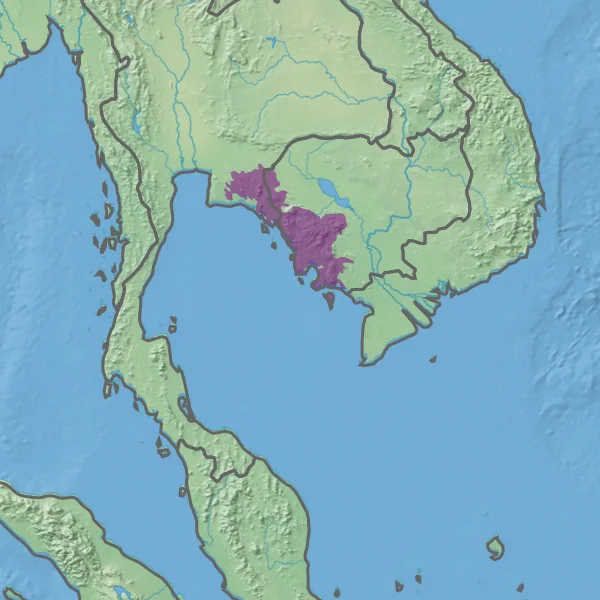
In the waterlogged hollows on the southern slopes, the rainforest stops at twelve metres. That is not a clearing or a fire scar - it is the mature canopy, a dwarf rain forest whose dominant trees are conifers, Dacrydium elatum and Podocarpus neriifolius, with Nageia fleuryi and Dacrycarpus imbricatus scattered among them. Standing in it feels like standing in a scale model of somewhere else. Walk uphill a few hundred metres and the same ecoregion throws up a closed canopy three times that height, built out of tropical oaks. The Cardamom Mountains rain forests cover about 44,289 square kilometres of eastern Thailand, southwestern Cambodia and the Vietnamese island of Phu Quoc, and they contain more variety over short distances than almost anywhere else in mainland Southeast Asia - much of it, because of the terrain and the sparse human population, still only loosely described by science.
Where the Rain Stops
Geography here is a story about a wall. The Cardamom and Elephant ranges stand across the path of the southwest monsoon, wringing it out on their seaward flanks and leaving the country behind them comparatively parched. The consequences show up in the map of neighbouring ecoregions: the Central Indochina dry forests begin immediately east and north, sitting in the rain shadow, while the Chao Phraya lowland moist deciduous forests take over to the northwest. To the southwest lies the Gulf of Thailand, its shoreline fringed by the Indochina mangroves. The one part of the system that has largely gone is the strip that was easiest to reach - the lowland evergreen forest of the narrow coastal plain, cleared over generations, is now mostly a memory.
Oaks in the Tropics
Above roughly 700 metres the montane forest takes over, and it is dominated by a family most people associate with temperate woodland. Beeches and oaks - Fagaceae - form the bulk of the canopy: Lithocarpus cambodiensis, Lithocarpus guinieri, Lithocarpus farinulentus, Lithocarpus harmandii, and Castanopsis cambodiana. Alongside them grow laurels in the genera Cinnamomum and Litsea, and myrtles including Syzygium and Tristaniopsis. The canopy closes at around thirty metres. Beneath it, palms and shrubs crowd the understorey, tree ferns unroll in the gaps, and epiphytes load every horizontal branch - orchids especially, in a diversity nobody has fully catalogued. Because the range is remote, thinly populated and genuinely hard to walk, most of these forests remain among the least botanically explored in the region.
Named for the Range
Species found nowhere else carry the mountains in their names. The Cardamom Mountains wolf snake, Lycodon cardamomensis, and the Cardamom Mountains bent-toed gecko, Cyrtodactylus cardamomensis, are endemic reptiles. Among more than 450 recorded bird species, the chestnut-headed partridge, Arborophila cambodiana, is confined to Cambodian highland forest; it was described in 1928 by Jean Theodore Delacour and Pierre Jabouille from a bird collected near Bokor, and the IUCN lists it as Near Threatened. Its close relative the Siamese partridge is treated by some taxonomists as a full species, Arborophila diversa, and by others as one of its subspecies - an argument that will probably outlast several field seasons. The large mammals are the ones people come for: Asian elephant, gaur, banteng, Sumatran serow, dhole, clouded leopard, and the pileated gibbon, whose bubbling territorial song is the signature sound of a Cardamom dawn.
Protection on Paper, and Who Pays for It
The tiger is the ghost in this inventory. Older accounts list it among the ecoregion's fauna; in truth no wild tiger has been confirmed in Cambodia since 2007, and the species is now considered gone from the country. Reintroducing it was one of the stated ambitions behind the designation of Southern Cardamom National Park on 9 May 2016, a 4,104-square-kilometre addition that brought nearly the whole range under formal protection alongside a string of Thai national parks and wildlife sanctuaries. Formal protection is not the same as protection. Mining, plantation clearance, sand pumping, road and dam construction, illegal logging and organised poaching all continue. And protection can carry its own costs: Human Rights Watch has documented Chong communities displaced from ancestral land in Southern Cardamom by a REDD+ carbon-offset scheme between 2018 and 2023, prompting an investigation by the certifier Verra. The Chong were living in these forests long before anyone assigned them an ecoregion code - the WWF's designation for this one is IM0106 - and whether the last intact rainforest in Southeast Asia can be kept without pushing them out of it remains the open question here.
From the Air
The ecoregion is centred near 11.9587N, 103.2610E and extends roughly 300 km northwest to southeast across the Cambodia-Thailand border, plus the Vietnamese island of Phu Quoc off the southern coast. From the air the boundary is unusually legible: dense unbroken canopy on the seaward slopes gives way abruptly to the paler, more open dry forest and paddy of the rain shadow to the northeast. Recommended viewing altitude is 10,000-15,000 ft for the full sweep of the range against the Gulf of Thailand. Nearest airports are Trat (VTBO) in eastern Thailand to the northwest, Sihanouk International (VDSV) to the southeast, and Techo International at Phnom Penh (VDTI) about 180 km east. Cloud cover is persistent on the western slopes during the May-October monsoon; November through February gives the most reliable visibility.
Nearby Stories
- Tatai 28 km away
- Sangkae River 34 km away
- Pursat 34 km away
- Pursat province 59 km away
- Battle of Pailin 61 km away
- Kirirom 1 Hydropower Dam 70 km away
- Scam Centers in Cambodia 179 km away
- Lampi Island Marine National Park 492 km away