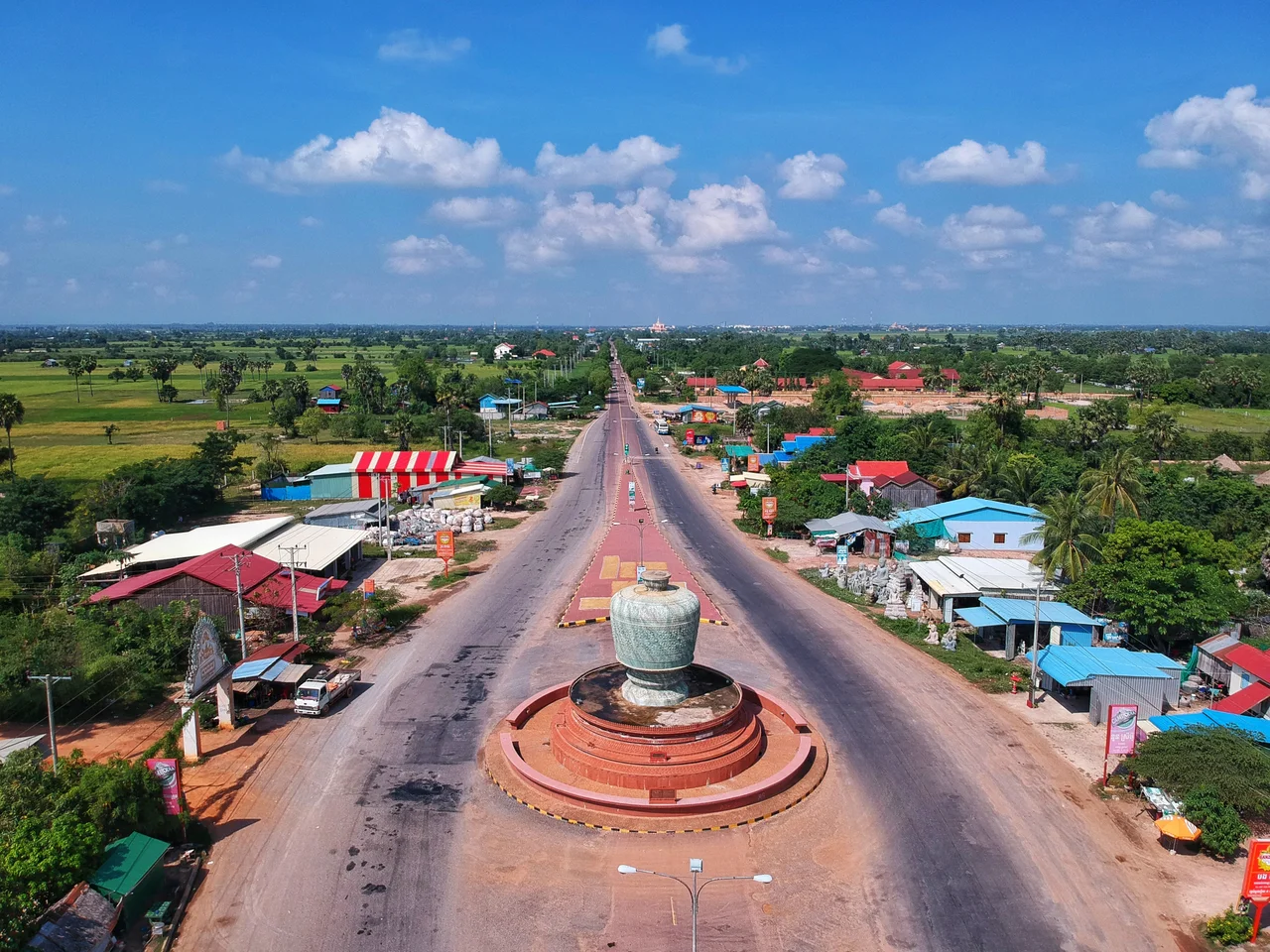

Pursat province
The most expensive wood in the world begins as an infection. Aquilaria trees grow ordinary and pale until a parasitic mould takes hold in a wound, and the tree responds by flooding the injured tissue with a dark, aromatic resin. That resin is agarwood, and the oil pressed from it is oud. Pursat's forests grow Aquilaria crassna in quantity, and Pursat agarwood was long considered the finest anywhere; by the early 1970s oud Cambodi commanded the highest prices on the market, sold on a belief that it worked on the mind as well as the nose. There is no way to know from outside whether a given tree carries resin. So the trees came down - felled by the thousand as gifts for the royal family and for officials - and the wild population has been cut back so far that Aquilaria is now listed as endangered.
Floating Banyan
The province's name is a small piece of Buddhist poetry. Pursat renders the Khmer Poŭthĭsăt, which breaks into two parts: poŭthĭ, from the Sanskrit and Pali bodhi, the tree beneath which the Buddha attained enlightenment, and săt, from rôsăt, meaning to float. Floating banyan. Faith here is not decorative. At Trapeang Chorng in Bakan District stands Wat Bakan, held to be among the oldest continuously active pagodas in Cambodia and thought to be at least eight hundred years old - a Maha Nikaya foundation and one of the most revered sites in Cambodian Buddhism, which is a considerable claim in a country whose temples were systematically attacked within living memory. The 2019 census recorded 96.9 percent of the province as Buddhist. Cham communities have practised Islam here for centuries and account for around three percent, with a small Christian population beside them.
Mountain, Plain, Lake
Pursat covers 12,692 square kilometres, making it Cambodia's fourth largest province by area, though it ranks only fifteenth by population - about 516,000 people spread very thin. Forest covers roughly 58 percent of it. The Cardamom range fills the west and southwest along the Thai border, and parts of that high country were incorporated into Central Cardamom Mountains National Park in 2016. From there the land tilts northeast, dropping out of the mountains into the plains that continue into Battambang and produce a substantial share of Cambodia's rice. The Pursat River follows the same line, running out of the Cardamoms to empty into the Tonlé Sap, which forms the province's entire eastern boundary; Pursat is one of nine provinces inside the Tonlé Sap Biosphere Reserve. That river also carries the province's best-known public event. The annual River Run, first held in 2007, sends 5-kilometre and 10-kilometre fields along its banks - men and women, including wheelchair racers - and has grown into the second largest race of its kind in the country.
Six Million Trees
The agarwood story did not end with the depletion of the wild stands. Because the resin can be induced rather than waited for, the modern industry works by deliberately infecting cultivated Aquilaria and harvesting the response - a way of getting oud without stripping the forest for it. The scale of that ambition became clear in 2015, when Lieutenant General Ouk Kosa of Cambodia's Ministry of National Defense signed a memorandum with a Singaporean company granting access to six million mature Aquilaria trees for inoculation. Six million is a number worth sitting with. It suggests both how much planting has already happened and how much money is riding on a fungus. Whether cultivated oud can undercut the incentive to poach the last wild trees is the open question; the same logic has been tried on rhino horn and rosewood with mixed results.
Condominiums at Thmada
The other new money arrived at the far western edge. In the border village of Thmada, in Veal Veang District, Chinese investors have committed close to 10 billion baht to build an entire town from nothing, planned in five phases with condominiums, a luxury hotel, restaurants and casinos. By 2019 roughly 80 percent of the first phase - a thousand condominium units - had gone up, with completion targeted for 2022 or 2025 depending on which announcement you read. It is a peculiar thing to appear in a province otherwise administered as six districts and a single municipality across 51 communes, most of them farming villages a long way from a paved road. Pursat has always been a place people passed through on Highway 5 between Phnom Penh and Battambang without stopping. That may be changing, though not in any way its residents chose.
From the Air
Pursat province is centred near 12.533N, 103.917E in western Cambodia and covers 12,692 km2, running roughly northeast to southwest from the Tonlé Sap shoreline to the Thai border in the Cardamom Mountains. The gradient makes it easy to read from the air: open rice plain and the lake's seasonal flood margin in the northeast, then a sharp transition into dense unbroken forest climbing toward Central Cardamom Mountains National Park in the southwest. National Highway 5 and the Phnom Penh-Battambang railway run parallel across the plain and give a reliable heading. Recommended viewing altitude is 6,000-12,000 ft. Nearest airports are Battambang (VDBG) about 106 km northwest, Techo International at Phnom Penh (VDTI) roughly 174 km southeast, and Siem Reap-Angkor International (VDSA) across the lake to the northeast. Expect afternoon convection over the Cardamoms from May to October; the clearest conditions run November to February.
Nearby Stories
- Tonlé Sap 20 km away
- Killing Caves of Phnom Sampeau 35 km away
- Cardamom and Elephant Mountains 36 km away
- Kampong Thom province 53 km away
- Samlout District 54 km away
- Central Cardamom Mountains National Park 60 km away
- Sambor Prei Kuk 68 km away
- Khmer Rouge Tribunal 97 km away